What Is Detection Engineering? A Practical Guide
A detection rule that alerts on powershell.exe -enc catches the lazy attacker and misses everyone else. Rename the binary, split the flag, encode it differently, and the rule goes silent while the attack runs. A rule that instead models the behavior, an encoded PowerShell command spawned by a Microsoft Office process, catches the technique no matter what the attacker renames. The difference between those two rules is detection engineering: the difference between a string match someone wrote once and a detection built to survive contact with a real adversary.
Detection engineering is the discipline of designing, building, testing, and maintaining the logic that identifies malicious activity in an environment. It treats detections as engineered products with a lifecycle, not as one-off rules dropped into a SIEM and forgotten. The job is not "write alerts." The job is to turn knowledge of how attackers operate into reliable detections that fire on the real thing, stay quiet on the rest, and keep working as both the environment and the adversary change.
This guide explains what detection engineering is, how it differs from traditional monitoring and from threat hunting, why it matters, the lifecycle a detection moves through, the detection-as-code practice that modern teams run on, the tools and metrics involved, and the honest challenges. It is written for blue teamers: SOC analysts, threat hunters, and detection engineers who write the rules and live with the false positives.
What is detection engineering?
Detection engineering is the systematic process of building and maintaining detection logic that maps attacker behavior to alerts a security team can act on. A detection engineer studies how a technique works, finds what it looks like in telemetry, writes logic that catches it, tests that logic against both malicious and benign activity, deploys it, and tunes it over time.
The word that matters is "engineering." A detection is not a static rule. It is a small piece of software with requirements, a test suite, a deployment process, and a maintenance burden. It can be wrong in two directions: too loose and it buries the team in false positives, too tight and it misses the attack it was written to catch. Engineering the detection means deliberately managing that trade-off instead of guessing at it.
Put plainly, detection engineering answers three questions for every threat that matters:
- What does this attacker behavior actually look like in our data?
- Can we write logic that catches it without drowning the analysts in noise?
- Will that logic still work next month, against a slightly different version of the attack?
The practice sits upstream of the alert queue. Every alert a SOC analyst triages exists because a detection fired. Detection engineering is the work that decides which detections exist, how good they are, and whether the queue is full of signal or full of noise.
Detection engineering vs. traditional monitoring vs. threat hunting
Three things get blurred together. Pulling them apart is the fastest way to see what detection engineering is.
| Detection engineering | Traditional monitoring | Threat hunting | |
|---|---|---|---|
| What it is | Building and tuning purpose-made detections | Running vendor default rules out of the box | Manually searching for threats with no alert |
| Posture | Proactive, iterative | Reactive | Proactive, exploratory |
| Output | Tested, maintained detection content | Alerts from preset signatures | Findings, and new detection ideas |
| Driven by | Threat models and ATT&CK coverage gaps | The product's shipped ruleset | A hypothesis about an undetected threat |
| Question | "What should we detect, and how well?" | "What did the tool flag?" | "What is here that nothing is catching?" |
Versus traditional monitoring. Out-of-the-box monitoring runs whatever signatures the vendor shipped. It catches commodity threats and generates a lot of generic noise, because the rules were written for everyone and tuned for no one. Detection engineering builds detections for your environment, your threat model, and your data, then measures and improves them. One is a product you switch on; the other is a capability you develop.
Versus threat hunting. Hunting is the manual search for threats that no detection caught: a human forms a hypothesis and goes looking. Detection engineering is what makes a find repeatable. When a hunt turns up a technique sliding through undetected, the engineer turns that one-time discovery into a standing detection so a human never has to find it by hand again. Hunting feeds detection engineering; detection engineering frees hunters to chase the next unknown instead of re-finding the same known.
Why detection engineering matters
The case for the discipline is operational, not theoretical.
It shrinks dwell time. Mandiant's M-Trends 2026 reported a global median dwell time of 14 days, up from 11 the year before. Two weeks is how long the median intruder operates before anyone notices, and the only thing that closes that window is a detection that fires early. Better detections mean earlier detection, which means less an attacker can do.
It cuts the noise that buries real alerts. Most alerts in an untuned environment are false positives, and false positives are the direct cause of alert fatigue. Detection engineering treats alert fidelity as the product. A detection that fires accurately is worth more than ten that fire constantly, because analyst attention is the scarcest resource in the SOC.
It makes coverage measurable. Mapping detections to a framework like MITRE ATT&CK turns "are we secure?" into a concrete question: which techniques can we detect, which can we not, and where are the gaps an attacker would walk through. You cannot improve coverage you cannot see.
It scales a team that cannot hire its way out. Skilled analysts are scarce and expensive. Codifying detection knowledge into tested, version-controlled content means the team's expertise lives in the detections, not only in the heads of the people on shift. That is how a small team defends a large environment.
The detection engineering lifecycle
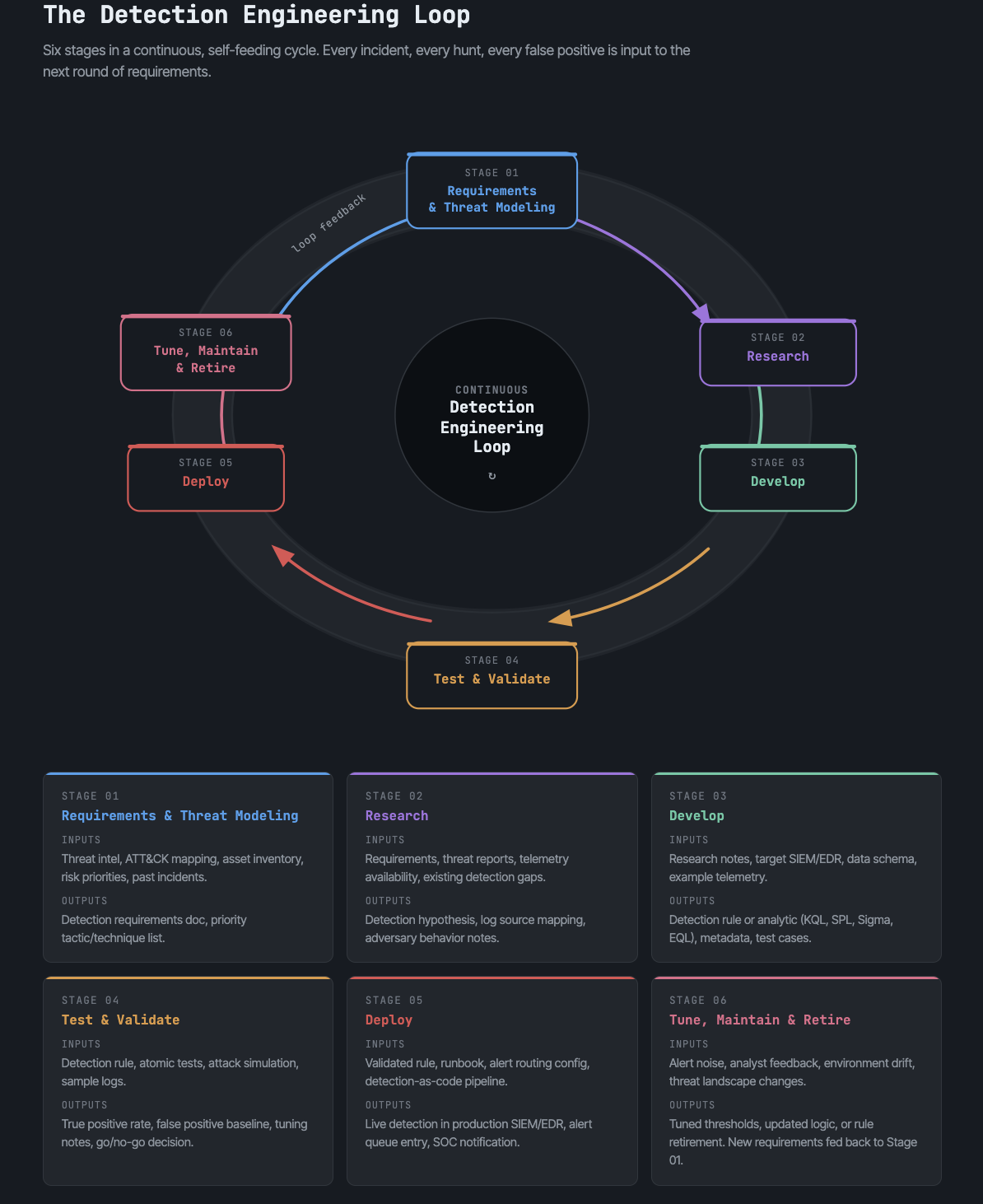
A good detection moves through a repeatable loop. Skipping steps is how brittle rules end up in production.
- Requirements and threat modeling. Decide what to detect, and why. Drive it from threat intelligence, the organization's real risk, and gaps in ATT&CK coverage, not from whatever rule is easiest to write. The output is a specific target: this technique, used by this kind of attacker, against these systems.
- Research. Understand the technique in detail. What does it actually do on a host or network, which data source reveals it (process creation, command line, authentication, DNS), and what does normal activity in that same data look like? You cannot separate malicious from benign until you know both.
- Develop. Write the detection logic, a Sigma rule, a SIEM query, or an EDR rule. Aim at the behavior, not a single brittle string, so the detection survives an attacker changing file names, flags, or tooling.
- Test and validate. Run the detection against known-bad activity, generated with adversary emulation, and against a known-good production baseline. This is where you measure whether it actually catches the technique and how much noise it makes, before it ever reaches an analyst.
- Deploy. Push the detection to production, ideally through a detection-as-code pipeline with peer review and automated checks rather than a hand-edit in a console.
- Tune, maintain, and retire. Watch how the detection performs in the wild, tune it down when it cries wolf, update it as the environment and the attacker shift, and retire detections that no longer earn their keep. Detections decay; a rule written for last year's stack quietly stops mattering.
The loop feeds itself. Every incident, every hunt, every false positive is input to the next round of requirements. A detection program that stops iterating is a detection program going stale.
Detection-as-code
The practice that turned detection writing into detection engineering is detection-as-code (DaC): managing detections the way software teams manage code.
In a DaC workflow, detections live in version control. A change is a pull request, reviewed by another engineer before it ships. A CI/CD pipeline runs automated tests against the rule, confirming it still fires on the known-bad sample and does not light up on the known-good baseline, before it deploys. Every change is tracked, attributed, and reversible.
The payoff is the same as it is for software. You get history, so you know who changed a detection and why. You get review, so a second set of eyes catches the logic error before production does. You get testing, so a rule cannot ship broken. And you get repeatability, so the same detection content can be deployed across environments instead of being hand-rebuilt in each one. A detection you cannot test, review, or roll back is a liability; detection-as-code is how the discipline stops treating production as the test environment.
The detection engineer's toolkit
Detection engineering runs on a handful of tools and resources, integrated so a detection can be written, tested, and deployed without leaving the workflow.
| Tool / resource | Role in detection engineering |
|---|---|
| MITRE ATT&CK | Shared language for attacker behavior; used to map coverage and find gaps |
| Sigma | Vendor-neutral detection rule format; write once, convert to many SIEM backends |
| YARA | Pattern-matching rules for identifying files and malware families |
| SIEM / EDR | Where detections run against live endpoint and log telemetry |
| Adversary emulation (e.g. Atomic Red Team) | Generates known-bad activity on demand to test whether a detection fires |
| Version control and CI/CD (Git) | The detection-as-code backbone: review, test, and deploy rules like software |
ATT&CK is the map, Sigma and YARA are common rule formats, the SIEM and EDR are where detections execute, adversary emulation is the test harness, and version control ties it together. Machine learning has a place in the stack too, mostly for behavioral baselining and anomaly detection that surfaces the unusual without a predefined rule. It is a complement, not a replacement: ML is good at flagging the strange and bad at explaining why, so its output still needs a detection engineer to turn a vague anomaly into a precise, actionable detection.
How detection quality is measured
A detection program that cannot measure itself cannot improve. A handful of metrics matter.
- True positive rate and precision. Of the alerts a detection fires, how many are real. High precision is the whole point; a detection that is right is what lets analysts trust it.
- False positive rate. How much noise the detection generates. This is the tax every detection charges the analyst team, and the number tuning exists to drive down.
- Detection coverage. How much of the attacker behavior in your threat model, expressed as ATT&CK techniques, you can actually detect, and where the gaps are.
- MTTD (mean time to detect). The outcome metric. The faster your detections fire on real activity, the less dwell time an attacker gets.
- Time to deploy. How long it takes to get a new detection from idea to production. Engineering velocity is what lets a team keep pace with new threats.
Coverage and precision pull against each other, and managing that tension is the core of the job. The goal is not maximum detections or zero false positives. It is the most real-threat coverage the team can sustain without burying itself in noise.
Detection engineering challenges
The discipline has hard parts, and they are practical.
You cannot detect what you do not log. Detection is capped by telemetry. If the data source that reveals a technique is not being collected, no rule will catch it. Visibility gaps, especially in cloud and identity, are silent blind spots that no amount of detection writing fixes.
False positives never stop. Environments change, and a detection that was clean last quarter starts firing on a new legitimate tool. Tuning is permanent work, not a one-time setup, and the team that stops tuning drowns.
Detections decay. Attackers adapt, software gets patched, the stack shifts. A detection is accurate the day it ships and slowly less so every day after unless someone maintains it. Treating detection content as write-once is how coverage rots without anyone noticing.
Testing requires realistic adversary activity. You cannot validate a detection against attacks you cannot safely reproduce. Building or adopting adversary emulation, and the lab environment to run it in, is real upfront work that teams routinely underinvest in.
It is a skills-intensive role. Detection engineering sits at the intersection of attacker tradecraft, the data, and software practice. That blend is rare, which is why the role is hard to hire for and why hands-on practice is the fastest way to build it.
Frequently asked questions
Common tools include MITRE ATT&CK for mapping attacker behavior and coverage, Sigma and YARA as detection rule formats, a SIEM and EDR where detections run against live telemetry, adversary emulation such as Atomic Red Team to test detections, and Git-based version control and CI/CD for the detection-as-code workflow.
A detection engineer needs to understand attacker tradecraft (how techniques work and what they look like in data), the telemetry and query languages of their SIEM and EDR, the MITRE ATT&CK framework, and software practices like version control and testing. The role blends offensive knowledge, data analysis, and engineering discipline.
The core metrics are precision and true positive rate (how many alerts are real), false positive rate (how much noise a detection makes), detection coverage against MITRE ATT&CK, and mean time to detect (MTTD). The aim is the most real-threat coverage the team can sustain without overwhelming analysts with false positives.
Detection engineering is the practice of building, testing, and maintaining the rules and logic that security tools use to catch attacker activity. Instead of relying on a vendor's default alerts, a detection engineer designs detections for specific attacker behaviors, validates that they work, and tunes them over time so they catch real threats without flooding analysts with false positives.
Threat hunting is the manual search for threats that no detection has caught, driven by a human hypothesis. Detection engineering is what makes a find repeatable: when a hunt uncovers an undetected technique, the engineer builds a standing detection for it. Hunting discovers the unknown; detection engineering codifies it so it is caught automatically next time.
Detection-as-code (DaC) is the practice of managing detections like software. Detection rules live in version control, changes go through peer review and automated testing in a CI/CD pipeline, and deployments are tracked and reversible. It brings history, review, testing, and repeatability to detection content instead of hand-editing rules in a console.