What Is Digital Forensics?
Delete a file, empty the recycle bin, and most people assume it is gone. It is not. On an NTFS volume the operating system removes the file's entry from the master file table and marks its clusters as free, but the bytes sit untouched in unallocated space until something else overwrites them, which may be minutes or months later. A forensic examiner carves those bytes back, reconstructs the timestamps, and shows when the file existed and what touched it. That gap, between what a user believes is erased and what actually remains on the media, is where digital forensics works.
Digital forensics is the branch of forensic science that recovers, preserves, and analyzes digital evidence so the findings hold up under scrutiny. The output is not just data. It is a defensible account of what happened, supported by evidence that can be proven authentic and unaltered.
This guide covers what digital forensics is, how it differs from incident response, the branches of the field, the forensic process, what makes digital evidence admissible, the tools, the challenges, and how to build the skill. It is written for blue teamers: SOC analysts, forensic examiners, and incident responders who work the evidence when it counts.
What is digital forensics?
Digital forensics is the practice of identifying, preserving, recovering, and analyzing data from digital devices so that the results are accurate, repeatable, and defensible. It applies forensic method to computers, phones, servers, network traffic, and cloud accounts. The goal is to answer questions, what happened, when, in what order, and who was responsible, in a way that survives challenge in court, in a regulatory proceeding, or across the table from opposing counsel.
The discipline borrows its core premise from physical forensics. Locard's exchange principle holds that every contact leaves a trace, and digital systems are relentless about it. Opening a file updates its access time. Plugging in a USB device writes registry keys. Browsing leaves cache, cookies, and DNS records. Running a program leaves prefetch and execution artifacts. The examiner finds those traces, establishes what each one means, and assembles them into a timeline that explains the event.
Two things separate forensics from ordinary data recovery. The evidence has to stay intact, proven byte-for-byte identical to the original. And the method has to be repeatable, so a second examiner working from the same data reaches the same result. Recover a deleted file with a consumer tool and you have data. Recover it with a documented, verifiable process that preserves the original and proves nothing changed, and you have evidence.
Digital forensics vs. incident response vs. DFIR
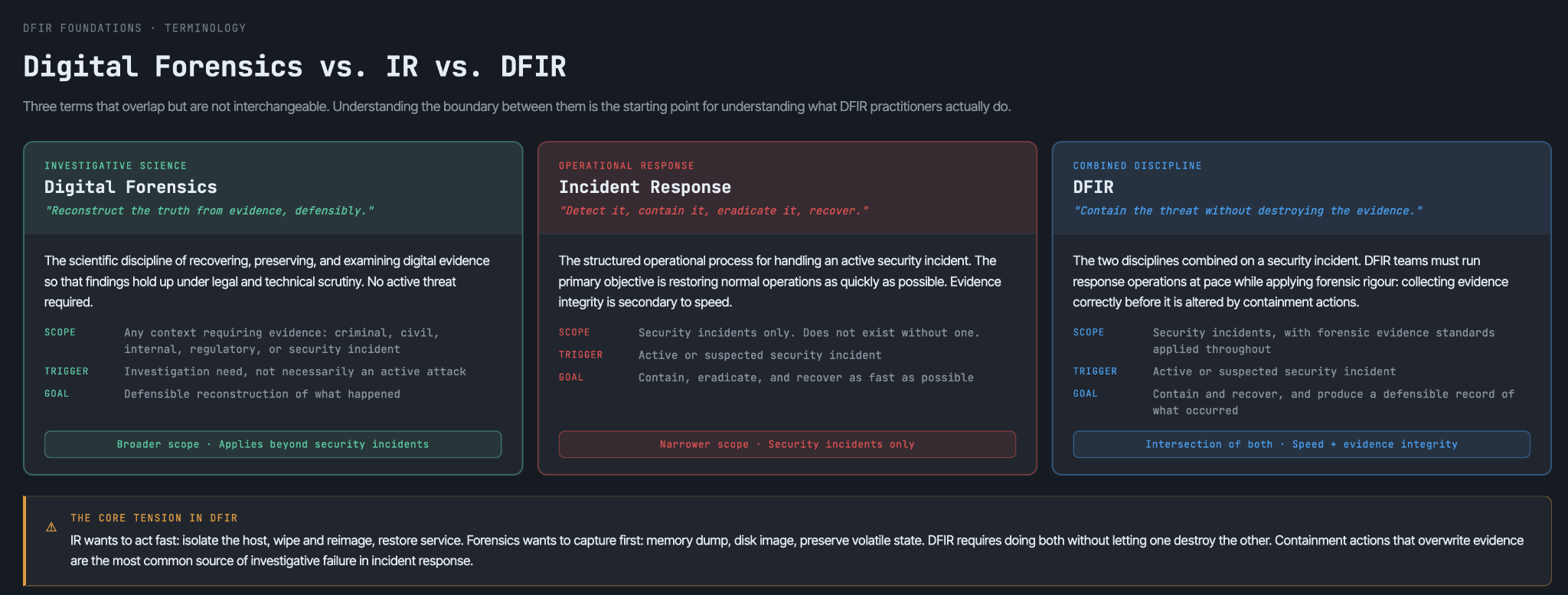
The three terms get used interchangeably, and they are not the same thing. Digital forensics is the investigative science: reconstruct the truth from evidence, defensibly. Incident response is the operational response to an active attack: detect it, contain it, eradicate it, recover. DFIR is the two combined on a security incident, where you have to contain the threat without destroying the evidence.
The key difference is scope. Incident response only exists when there is a security incident. Digital forensics is broader. A forensic examination might be triggered by a cyberattack, but just as often it is a fraud case, an intellectual property dispute, an employee misconduct investigation, or a criminal prosecution that has nothing to do with a network breach.
| Digital forensics | Incident response | |
|---|---|---|
| Core question | What exactly happened, provably? | How do we stop it and recover? |
| Trigger | Any investigation: crime, dispute, breach, fraud | A security incident, in progress |
| Clock | Methodical, evidence-first | Fast, damage-first |
| Output | Defensible findings, often for court | Contained threat, restored systems |
| Standard of proof | Legal admissibility | Operational confidence |
In a serious breach the two run together as DFIR: forensics scopes what the attacker did while response shuts it down. This article focuses on the forensics half, the evidence discipline that the rest of the work depends on.
Types of digital forensics
Digital forensics splits by where the evidence lives. Each branch has its own artifacts, tools, and acquisition method. Most real investigations cross several at once.
- Computer / disk forensics. The original branch. File systems, deleted files, the Windows registry, browser history, and artifacts of program execution and user activity on laptops, desktops, and servers.
- Memory forensics. Analysis of a RAM capture: running processes, open network connections, injected code, encryption keys, and fileless malware that never touches disk. Often the most valuable branch, because attackers live in memory to evade disk-based detection.
- Network forensics. Packet captures and flow data used to reconstruct command-and-control, lateral movement, and data exfiltration. The evidence here is transient, so it has to be captured live.
- Mobile forensics. Phones and tablets: messages, call logs, location history, app data, and deleted records. A large and growing share of casework, because the phone is where the activity is.
- Cloud forensics. Control-plane logs, API activity, and snapshots from AWS, Azure, and SaaS platforms, where there is no physical disk to seize and the evidence lives in a provider's retention settings.
- Email and database forensics. Headers, message stores, and transaction logs used in fraud, insider, and e-discovery cases.
- Malware analysis. Reverse-engineering the attacker's tooling to determine capability and extract indicators of compromise that feed detection.
The digital forensics process
The forensic process is a defined sequence, not an improvisation. The phases below follow the standards that govern the field. NIST SP 800-86 frames the technical core as four phases, collection, examination, analysis, and reporting, and ISO/IEC 27037 governs the front end, the identification, collection, acquisition, and preservation of digital evidence. Put together, an examination moves through six steps.
1. Identification
Find the sources of potential evidence: which devices, which accounts, which logs. At a scene this includes hidden or networked devices and anything volatile that will not survive a shutdown. Identifying everything relevant up front determines what gets preserved.
2. Preservation
Protect the evidence from change the moment it is identified. Isolate the device, block network access, and use write blockers when imaging so the acquisition cannot modify the source. Volatile data, memory and live network state, is captured first because it is gone the instant power is cut.
3. Collection and acquisition
Acquire a bit-for-bit forensic image, not a file copy, so deleted data and slack space come along. Hash the original on acquisition (SHA-256) and work only from verified copies. The hash is what later proves the working image is identical to the source.
4. Examination
Process the acquired data with forensic tools to surface the relevant material: carve deleted files, parse file systems and logs, extract artifacts, and pull strings and indicators from a memory image. Examination gets the signal out of terabytes of raw data without touching the original.
5. Analysis
Turn artifacts into answers. Build the timeline, correlate events across sources, establish root cause and scope, and map the activity to attacker behavior such as MITRE ATT&CK techniques. ISO/IEC 27042 sets the bar here: the analysis has to be reproducible and open to independent scrutiny.
6. Reporting and presentation
Document what was found, how it was found, and what it means, for an audience that may include executives, regulators, or a court. In a serious case the examiner presents and defends the findings as an expert witness, which is where the discipline of the earlier steps pays off or falls apart.
What makes digital evidence admissible
Technical analysis can be flawless and still worthless if you cannot prove it reflects what was actually on the system. Admissibility is what separates forensics from poking around a machine, and it rests on two pillars.
Chain of custody. A documented record of the evidence across its entire life: who collected it, when and where, how it was stored and transported, and everyone who handled it. A gap in the chain is a gap an opposing lawyer drives a truck through. Evidence with a broken chain can be excluded no matter what it shows.
Evidence integrity. You prove the evidence is unaltered with cryptographic hashing. Hash the original on acquisition, work only from verified copies, and re-hash to show the values still match. Pair this with write blockers and bit-for-bit imaging so the source is provably untouched.
There is also a legal bar the analysis itself has to clear. In US federal court, expert testimony is governed by Federal Rule of Evidence 702 and the Daubert standard, which makes the judge a gatekeeper: the methods behind an expert's conclusions must be reliable and properly applied before a jury hears them. The Supreme Court's later Kumho Tire decision extended that gatekeeping to all expert testimony, not just hard science. For a forensic examiner, this is the practical reason method matters. A repeatable, standards-based process is what lets the findings stand; an undocumented one is what gets them thrown out.
Where digital forensics is used
Digital forensics reaches well beyond the SOC. The same discipline serves several very different consumers.
- Criminal investigations. Phones, computers, and cloud accounts as evidence in cases from fraud to violent crime. Digital evidence now features in a large and growing share of criminal cases.
- Civil litigation and e-discovery. Recovering and authenticating documents, email, and messages for lawsuits and disputes.
- Corporate and internal investigations. Policy violations, intellectual property theft, insider threats, and employee misconduct, where the evidence has to hold up in arbitration or a wrongful-termination suit.
- Fraud and financial investigations. Reconstructing transactions and tracing activity across systems.
- Incident response. Scoping a breach: how the attacker got in, what they took, and which systems are affected. This is the ransomware and intrusion work where forensics and incident response meet as DFIR.
Digital forensics tools
No tool runs the investigation, but the right ones make acquisition and analysis possible without corrupting evidence. The categories that matter, with common tools:
| Category | What it does | Common tools |
|---|---|---|
| Disk forensics | Image and analyze file systems and artifacts | Autopsy / The Sleuth Kit, OpenText EnCase, Exterro FTK, X-Ways, Magnet AXIOM |
| Memory forensics | Analyze RAM captures | Volatility 3, MemProcFS |
| Network forensics | Reconstruct activity from traffic | Wireshark, Zeek, NetworkMiner, tcpdump |
| Mobile forensics | Extract and decode phone data | Cellebrite UFED, Magnet AXIOM, MSAB XRY |
| Triage / collection | Fast remote acquisition at scale | KAPE, Velociraptor, GRR |
| Timeline | Build a unified timeline of events | Plaso / log2timeline |
The center of gravity in modern practice is fast, remote, scalable collection. Tools like Velociraptor pull targeted artifacts from hundreds of endpoints at once, which matters when imaging each disk by hand is not an option. A SIEM supplies the correlated log history that turns scattered artifacts into a timeline. The disk imaging format pioneered by EnCase, the E01 image, remains the common currency for forensic disk images across tools.
Challenges and anti-forensics
The work is hard for reasons that are operational, not academic.
Encryption and anti-forensics. Full-disk encryption, secure deletion, log tampering, and timestamp manipulation (timestomping) are designed to defeat investigation. Suspects and attackers actively cover their tracks, and some anti-forensic techniques leave their own detectable traces.
Data volume. A single case can span thousands of devices and terabytes of data. Finding the relevant artifacts in that haystack is the real work, and it does not scale by hand.
Cloud and remote evidence. There is often no physical disk to seize. The evidence is API logs and snapshots, governed by a provider's retention policy you may not control, and a capture window that closes when an instance scales away.
Time and expertise. Forensics wants to be methodical while the incident, or the legal deadline, wants to be over. The constraint is rarely the tool. It is an examiner who can acquire correctly, find the signal, and defend the result.
How to build digital forensics skills
Digital forensics is one of the most hands-on disciplines in security, and the skill is built by working real evidence, not reading about it.
- Learn the artifacts. Know where evidence lives and what normal looks like: Windows event logs, the registry, prefetch, file-system metadata, memory structures, network captures. You cannot spot the anomaly without the baseline.
- Practice acquisition discipline. Order of volatility, hashing, write blockers, chain of custody. Do it right on practice data until it is reflex, because a real case offers no second attempt.
- Build timelines. The core analytical skill is turning scattered artifacts across sources into one coherent sequence of events.
- Learn memory forensics early. Attackers live in RAM to evade disk-based detection, so memory analysis is where modern investigations are won.
- Write it up. A finding you cannot explain clearly and defend is a finding that does not count. Reporting is a core skill, not an afterthought.
The fastest way to build all of this is on realistic evidence from real attacks: memory images, disk artifacts, packet captures, and logs from genuine intrusions, the kind in CyberDefenders blue team labs. Those are the exact skills hands-on digital forensics training like CCDL2 certifies, disk, memory, and network forensics worked as real cases, with CCDL1 covering the DFIR foundations.
The bottom line
Digital forensics is the discipline of pulling the truth out of digital evidence and proving it. The work is recovering data others assume is gone, preserving it so nothing changes, analyzing it through a repeatable method, and presenting findings that survive a courtroom. The standards that hold it together, ISO/IEC 27037 for handling evidence, NIST SP 800-86 for the process, and the chain of custody and integrity checks that make findings admissible, are what separate forensics from guesswork.
The constraint, as always, is skill: an examiner who can acquire a system without altering it, find the attacker in a memory dump, build the timeline, and defend the result. That is built on real evidence, not theory.
Frequently asked questions
Digital forensics is the investigative science of reconstructing what happened from evidence, defensibly, and it applies to crimes, disputes, and fraud as well as breaches. Incident response is the operational work of detecting, containing, and recovering from an active attack. When both run on a security incident, the combined discipline is called DFIR.
Often, yes. Deleting a file and emptying the recycle bin usually just removes the file system's pointer to the data and marks the space as free. The actual bytes remain in unallocated space until they are overwritten, so a forensic tool can frequently carve them back. Secure-wiping or full-disk encryption is what makes recovery genuinely hard.
Common tools include Autopsy and The Sleuth Kit for disk forensics, Volatility for memory analysis, Wireshark for network forensics, Cellebrite and Magnet AXIOM for mobile, and KAPE and Velociraptor for fast collection at scale. Commercial suites like OpenText EnCase and Exterro FTK are standard in enterprise and law-enforcement work.
Digital forensics is the science of recovering and analyzing data from digital devices so the findings hold up as evidence. It covers identifying, preserving, examining, and reporting on data from computers, phones, networks, and the cloud, in a way that proves the evidence is authentic and unaltered. The output is a defensible account of what happened.
The main branches are computer (disk) forensics, memory forensics, network forensics, mobile forensics, and cloud forensics, plus specialized areas like email, database, and malware analysis. Each branch differs by where the evidence lives and how it has to be acquired. Most investigations touch more than one.
The process runs through identification, preservation, collection and acquisition, examination, analysis, and reporting. NIST SP 800-86 defines the technical core as four phases (collection, examination, analysis, reporting), and ISO/IEC 27037 governs the handling of evidence at the front end. The sequence keeps the evidence intact and the method repeatable.