What Is SecOps? Security Operations Explained
A vulnerability scanner flags a critical CVE on a production database server Monday morning. The security team files a ticket and moves on. The IT operations team, measured on uptime and bonused on it, sees that patching means downtime and a maintenance window they have to fight for. The ticket sits for three weeks. The attacker who scanned the same server needs eight days. That gap, between the team that finds the risk and the team that owns the system, is exactly the gap SecOps exists to close.
SecOps (security operations) is the practice of merging security and IT operations into a single, collaborative function, so systems are built, run, and defended as one job instead of three teams throwing tickets over a wall. It is not a tool and not a team you can buy off a shelf. It is an operating model: shared goals, shared data, and shared accountability between the people who keep systems running and the people who keep them secure.
This guide explains what SecOps actually is, the silo problem it solves, how it differs from a SOC and from DevSecOps, the core functions it runs, the tools it runs them on, how to build the function, and the honest challenges of operating one. It is written for blue teamers: SOC analysts, threat hunters, and DFIR practitioners who live the security-versus-operations tension every patch cycle.
What is SecOps?
SecOps is the integration of security and IT operations into one continuous practice for protecting an organization's systems, data, and services. People, process, and technology, aligned so that detecting threats, responding to incidents, hardening systems, and keeping services available are treated as parts of the same job rather than competing priorities.
The name is a contraction of "security" and "operations," and that contraction is the whole point. In the traditional split, IT operations owns availability and performance, security owns risk and defense, and the two optimize for different things. Operations wants to ship and stay up. Security wants to slow down and lock down. SecOps removes the wall between them: security requirements become part of how systems are built and run, and operational reality becomes part of how security decisions get made.
Put plainly, SecOps answers a question neither team can answer alone:
- Are we running this environment securely, right now, without grinding the business to a halt?
A mature SecOps function detects and responds to threats in real time, but it also feeds what it learns back into how systems are configured, patched, and deployed, so the next attack has fewer ways in. Reactive defense and proactive hardening run on the same loop, owned by the same people.
Why SecOps exists: breaking the silo
The reason SecOps is a named discipline and not just "doing security" is that the default organizational structure actively works against security.
Separate teams develop separate incentives. Operations is measured on uptime, ticket throughput, and deployment speed. Security is measured on findings, audits, and incidents avoided. Hand a critical patch to a team bonused on availability and it competes with every other priority. Hand a "ship it now" deadline to a team that owns risk and it becomes a fight. Both teams are doing their jobs. The structure is the problem.
That structure produces predictable failures:
- Handoff delays. Security finds a vulnerability, operations owns the server, and the fix waits in a queue while the exposure stays open.
- Blind spots. Operations stands up a new cloud service; security finds out when it shows up in an alert, not before.
- Friction-driven workarounds. When security is a gate at the end, teams route around it to hit deadlines, and the gate stops meaning anything.
- Slow response. When an incident hits, nobody has agreed in advance who isolates the host, who approves the downtime, or who talks to the business.
SecOps fixes this by collapsing the wall. Shared dashboards instead of thrown tickets. Joint metrics so both sides win or lose together. Security built into provisioning and deployment instead of bolted on after. The point is not that security and operations stop being distinct skills. The point is that they stop being distinct priorities that trade off against each other in the dark.
SecOps vs. SOC vs. DevSecOps
These three terms get used interchangeably and they are not the same thing. Getting the relationship straight is the fastest way to understand what SecOps is.
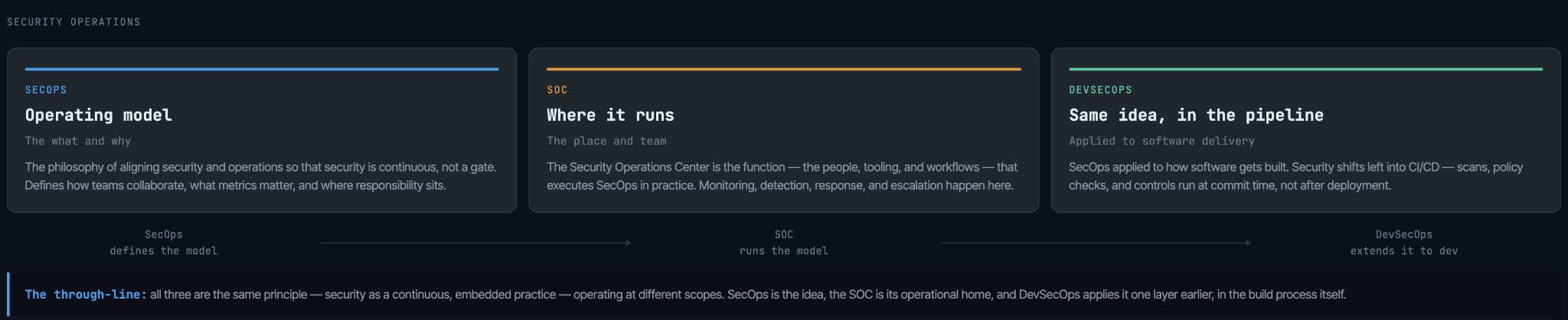
A SOC (security operations center) is where SecOps becomes a staffed, around-the-clock operation. The SOC is the team and the room; SecOps is the broader discipline that says security and operations are one responsibility. You can have a SOC without a mature SecOps culture, a SOC that detects threats while operations still ignores its patch tickets. SecOps is what makes the SOC's findings actually get acted on.
DevSecOps is SecOps pointed at the software delivery pipeline. Where SecOps secures the systems you run, DevSecOps secures the systems you build, embedding security testing and controls into development and CI/CD so vulnerabilities are caught before they ship. "Shift left" is the slogan: move security earlier, into code and build, instead of finding problems in production. The two are complementary. DevSecOps keeps insecure code from reaching production; SecOps defends production once it is live.
Bottom line: SecOps is the operating model, the SOC is where it runs, and DevSecOps is the same idea applied to how software gets built.
The core functions of SecOps
A SecOps function runs a handful of capabilities that feed each other. None of them is new on its own. What makes it SecOps is that they operate as one integrated practice, with operations and security sharing the data and the decisions.
| Function | What it does |
|---|---|
| Security monitoring and detection | Collects telemetry across the environment and runs detection logic to surface suspicious activity |
| Threat intelligence | Enriches detection and decisions with current knowledge of attacker infrastructure, tools, and techniques |
| Incident response | Investigates, contains, eradicates, and recovers from confirmed incidents |
| Vulnerability management | Finds, prioritizes, and drives remediation of exposures before they are exploited |
| Threat hunting | Proactively searches for attacker activity the automated detections missed |
| Automation and orchestration | Runs repetitive response steps as playbooks so analysts spend time on judgment, not toil |
Security monitoring and detection. Telemetry streams in from endpoints, servers, network devices, identity providers, and cloud platforms into a SIEM, where detection logic correlates across sources and raises alerts. This is the always-on sensing layer, and it only works if operations onboards the log sources and keeps them flowing.
Threat intelligence. Cyber threat intelligence turns raw indicators and adversary research into context the team can act on: which threats target your industry, what infrastructure they use, and which techniques to prioritize detecting. Mapping detections to a framework like MITRE ATT&CK keeps that work organized around real attacker behavior.
Incident response. When an alert is confirmed, incident response takes over: scope the activity, contain it, evict the attacker, recover the affected systems, and capture what happened. In a real SecOps function, the containment steps that require operational access are agreed in advance, not negotiated mid-incident.
Vulnerability management. Scanning finds exposures; SecOps is what gets them fixed. The security side prioritizes by real risk, the operations side owns the remediation and the maintenance window, and the shared goal is closing the gap before it is exploited. This is the function the silo breaks most often, and the one SecOps most directly repairs.
Threat hunting. Threat hunting is the proactive layer: experienced analysts form a hypothesis about how an attacker could already be inside and go looking, then turn what they find into new detections. It is how a program gets ahead of the alerts instead of only reacting to them.
Automation and orchestration. SOAR (security orchestration, automation, and response) runs the routine, repeatable parts of response as codified playbooks: enrich an alert, pull host context, block an indicator, open the ticket. Automating the toil is what lets a perpetually understaffed team keep up.
The SecOps toolstack
SecOps runs on an integrated stack, not a pile of disconnected consoles. The value is in how cleanly the tools share data and context, not in their feature lists.
| Tool | Role in SecOps |
|---|---|
| SIEM | Central log collection, normalization, correlation, and search. The hub. |
| EDR / XDR | Endpoint and cross-domain detection and response telemetry |
| SOAR | Automates repeatable response with playbooks |
| Threat intelligence platform | Enriches alerts with known-bad indicators and adversary context |
| Vulnerability scanner | Finds and prioritizes exposures across the environment |
| ITSM / ticketing | Tracks remediation and incidents through to closure, the bridge to operations |
The SIEM is the center of gravity for most programs. It ingests data from every other tool, normalizes it into a common shape, and correlates across all of it to surface threats no single source reveals. SOAR sits beside it, taking confirmed alerts and running the routine response so analysts focus on judgment. The ticketing and ITSM layer is the piece a security-only view tends to forget, and the one SecOps depends on, because it is where a finding becomes a tracked task the operations team actually owns and closes. The modern trend is consolidation: fewer, better-integrated platforms, with AI and automation handling first-pass triage.
How to build an effective SecOps function
Standing up SecOps is more about alignment than acquisition. The order of operations matters more than any single product.
- Break the silo first. Give security and operations shared goals and at least one shared metric so they win or lose together. No tool fixes a structure where the two teams are still scored against each other.
- Get visibility across the whole environment. You cannot defend or operate what you cannot see. Inventory assets, then onboard the high-value log sources first: identity, endpoint, network, and cloud. Blind spots are where attackers live.
- Write an incident response plan and rehearse it. Decide in advance who detects, who decides, who contains, who approves downtime, and who talks to the business. A plan tested only during a real incident is not a plan. Tabletop exercises find the gaps cheaply.
- Automate the repetitive. Use SOAR to codify the response steps your team runs the same way every time. Automation is how an understaffed function keeps pace and how you cut mean time to respond.
- Shift security left where it fits. Extend SecOps into the build pipeline with DevSecOps practices so vulnerabilities are caught in code and CI/CD, not in production. The vast majority of codebases ship with known-vulnerable open-source components, so this is not optional for any organization that builds software.
- Stay current on the threat. Feed threat intelligence into detection and prioritization, and map your coverage to MITRE ATT&CK so you are defending against techniques attackers actually use, not the ones that were relevant last year.
- Measure and improve. Track detection and response speed and feed every incident back into better detection and configuration. The headline numbers are MTTD (mean time to detect), MTTR (mean time to respond), and dwell time, the same metrics a SOC lives by. What you measure is what improves.
SecOps challenges: the hard parts
An honest account names the parts that make this hard. They are organizational and operational, not theoretical.
The silo is sticky. The core challenge is the one SecOps is built to solve, because culture and incentives resist the merge. Operations still gets paged for downtime; security still gets blamed for breaches. Merging the priorities takes leadership backing and shared metrics, not just a new team name.
The skills shortage. There are not enough skilled people. The 2024 ISC2 Cybersecurity Workforce Study put the global gap at more than 4.7 million professionals. Security operations roles are among the hardest to fill and keep, which forces many organizations toward automation and managed services.
Alert fatigue. Detection tools generate far more alerts than any team can investigate, and most are false positives. When analysts tune out, the one real alert in the flood gets missed. Tuning, correlation, and risk-based alerting are the fix, and the work never fully ends.
Tool sprawl. Programs accumulate tools, and disconnected tools create blind spots and swivel-chair work, where analysts manually correlate across consoles. Integration and consolidation matter more than the number of products on the shelf.
Speed versus security, now at cloud pace. Cloud and CI/CD let teams ship constantly, which means the attack surface changes constantly too. Keeping security aligned with that velocity, instead of becoming the bottleneck everyone routes around, is the permanent tension at the center of the discipline.
SecOps does not run itself. The tooling is the easy part to buy and the hard part to operate well, and the people and the culture are the constraints that no purchase removes.
The bottom line
SecOps is the operating model that stops security and IT operations from working against each other. It merges the two into one function with shared goals, shared data, and shared accountability, so threats get detected and contained fast and the systems that run the business get hardened instead of left exposed in a ticket queue. The SOC is where it runs, DevSecOps is the same idea applied to how software is built, and the core functions, monitoring, threat intelligence, incident response, vulnerability management, hunting, and automation, all operate as one loop.
The platforms are the easy part. The constraint is always skill and the willingness to break the silo. If you want to build the skill, do the work.
Frequently asked questions
The core functions are security monitoring and detection, threat intelligence, incident response, vulnerability management, threat hunting, and automation and orchestration (SOAR). What makes them SecOps rather than separate activities is that they run as one integrated practice, with security and operations sharing the data and the decisions.
The hub is usually a SIEM for log collection and correlation, supported by EDR or XDR for endpoint and cross-domain detection, SOAR for automated response, threat intelligence platforms, vulnerability scanners, and an ITSM or ticketing system that bridges findings to the operations teams that fix them. Integration between them matters more than any single tool.
The headline metrics are MTTD (mean time to detect), MTTR (mean time to respond), and dwell time, which measure how fast threats are caught and contained. Vulnerability remediation time and false positive rate matter too, because they show whether security and operations are actually closing the loop and whether the team is fighting noise.
SecOps (security operations) is the practice of combining security and IT operations into one collaborative function, so an organization's systems are built, run, and defended together instead of by separate teams with competing priorities. It covers monitoring, detection, incident response, and hardening as parts of the same job.
SecOps is the discipline; a SOC (security operations center) is the team and facility that runs it day to day. The SOC monitors the environment, triages alerts, and responds to incidents around the clock. SecOps is the broader operating model that ensures those findings get acted on by aligning security with the operations teams that own the systems.
SecOps secures the systems an organization runs in production. DevSecOps secures the systems it builds, embedding security into the software development pipeline and CI/CD so vulnerabilities are caught before they ship. DevSecOps is essentially SecOps shifted left, into development, and the two are complementary.