What Is SOAR? Security Orchestration, Automation, Response
A user reports a phishing email. An analyst opens it, copies the sender, pastes it into a reputation tool, extracts the URL, checks it against a sandbox, pulls the attachment hash, searches the mail logs for everyone else who got the same message, deletes the copies, blocks the domain, and opens a ticket. Twelve steps, eight minutes, zero judgment required. Then they do it again for the next report. And the next. A busy SOC sees hundreds of these a week.
SOAR is what runs those twelve steps for the analyst, in seconds, the same way every time. It connects the tools a SOC already owns, runs a defined sequence of actions across them, and takes the routine response automatically so people spend their time on the decisions that actually need a person.
This guide explains what SOAR is, how a playbook actually executes, the difference between orchestration and automation, how SOAR compares to SIEM and XDR, the use cases it covers, and the honest limits of automating a SOC. It is written for blue teamers: SOC analysts, threat hunters, and DFIR practitioners who have to build and run the playbooks, not just buy the platform.
What is SOAR?
SOAR stands for Security Orchestration, Automation, and Response. A SOAR platform integrates a SOC's separate security tools, runs predefined workflows called playbooks across them, and automates repetitive response actions so analysts handle exceptions instead of routine work.
Gartner coined the term in 2015. It originally stood for Security Operations, Analytics and Reporting, then Gartner redefined it in 2017 to the meaning everyone uses now. The same analysts grouped SOAR into three capabilities, and they still describe the category well:
- Threat and vulnerability management. Workflow and tracking for remediating vulnerabilities and managing the response to them.
- Security incident response. How a team plans, manages, tracks, and coordinates the response to an incident.
- Security operations automation. Machine execution of workflows, processes, and policy so people do not run them by hand.
Put plainly, SOAR answers a different question than the tools that detect threats. Detection asks "is something wrong?" SOAR asks "now that something is wrong, what do we do about it, and can a machine do most of that?"
That distinction matters because the bottleneck in most SOCs is not detection. It is response capacity. Analysts can generate more alerts than they can ever work. SOAR exists to close that gap by taking the mechanical parts of response off their plate.
How does SOAR work?
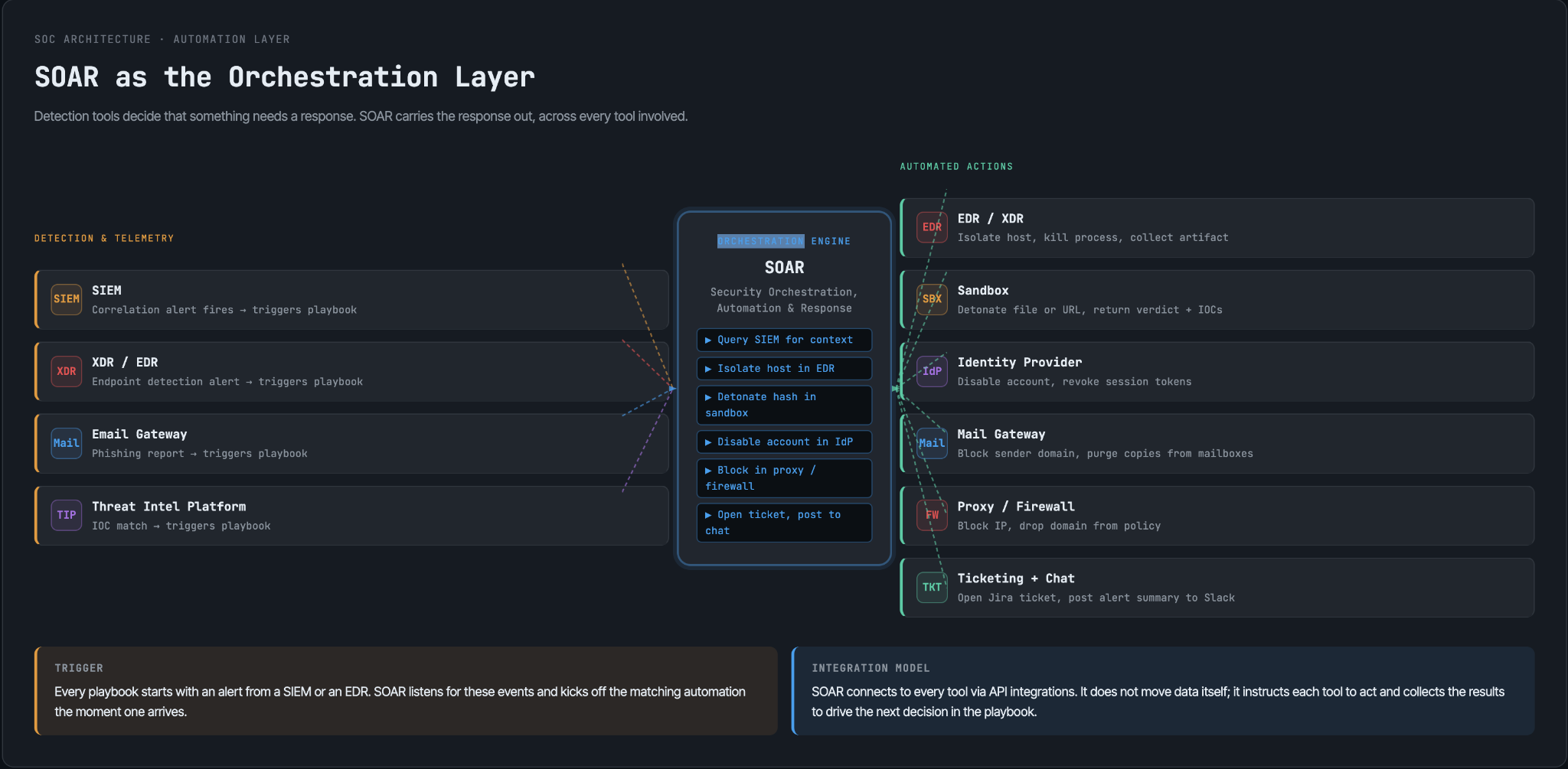
A SOAR platform is a workflow engine wired into everything else. Something triggers it, a playbook runs, and actions happen across your other tools. Four parts make that work.
1. The trigger
A playbook starts when something arrives. The trigger is usually an alert from a SIEM or an EDR, but it can be an email landing in an abuse mailbox, a ticket, a threat intel update, or a scheduled job. The triggering event carries the initial data the playbook works on: an alert ID, a user, a host, a file hash.
2. Orchestration: the integrations
SOAR does its work through other tools, not on its own. It connects to them with integrations, often called connectors or apps, that wrap each tool's API into actions the playbook can call: query the SIEM, isolate a host in the EDR, look up a hash in a sandbox, disable an account in the identity provider, post to Slack, open a Jira ticket. A mature SOAR ships hundreds of these. Orchestration is the act of coordinating actions across all of them in one sequence.
3. Automation: the playbook
The playbook is the logic. It is a sequence of steps, branches, and conditions that says what to do with the triggering data and in what order. A phishing-response playbook reads like this:
``` TRIGGER: a user-reported email lands in the phishing mailbox
- Parse the email: extract sender, URLs, attachments, headers
- Enrich each indicator in parallel:
URLs / domains -> URL reputation + sandbox detonation attachment hashes -> hash reputation + sandbox detonation sender domain -> SPF / DKIM / DMARC result + domain age
- Decide on the worst verdict found:
IF any indicator is malicious:
- search every mailbox for the same message
- delete all copies
- block the sender, domain, and URL at gateway and proxy
- open a case, attach all enrichment, set severity = high
ELSE IF results are inconclusive:
- open a case and assign to a tier-2 analyst
ELSE:
- close as benign, notify the reporting user
```
Two things make this more than a script. First, the branch: the playbook handles the malicious, the inconclusive, and the benign paths differently, so the safe cases close themselves and only the genuinely ambiguous ones reach a person. Second, the human-in-the-loop step: at any branch, a good playbook can pause and ask an analyst to approve an action before it runs. You automate the enrichment and the search every time. You can require a human to approve the mailbox-wide delete.
4. Response and case management
When the playbook acts, that is the response: contain, block, disable, notify, remediate. Everything it does is recorded in a case. The case is the SOAR's other half. It holds the alert, every enrichment result, every action taken and by whom, and the timeline, so the analyst sees the whole incident in one place instead of ten browser tabs. That record is also what makes post-incident review and metrics possible, because the platform already logged what happened and how long each step took.
The payoff is in the numbers a SOC lives by: mean time to detect and mean time to respond. When enrichment and containment that took an analyst eight minutes happen in eight seconds, and the easy cases never reach a human at all, MTTR drops and analysts get their attention back for the work that needs judgment.
Orchestration vs. automation vs. response
The three words in the acronym are not synonyms, and the difference is the whole point of the tool.
Automation is a machine doing one task without a person. Disabling a compromised account, pulling a hash reputation, deleting an email. One action, no human, done.
Orchestration is stitching many automated actions across many tools, plus human checkpoints, into one coordinated workflow. The phishing playbook above is orchestration: it touches the mail platform, a sandbox, a threat intel source, the proxy, and the ticketing system, in order, with branches. Automation is the individual step. Orchestration is the conductor.
Response is what the workflow is for: the containment and remediation actions that change the state of your environment. Detection tells you a host is beaconing to a command-and-control server. Response isolates the host.
The reason the distinction matters in practice: you can automate a task that should not run unattended, and you can orchestrate a workflow whose individual actions are all manual approvals. Good SOAR design is deciding, step by step, what runs by itself and what waits for a human. Enrich automatically. Contain with approval. Never blanket-automate an action that can take production down if the alert was a false positive.
SOAR vs. SIEM vs. XDR
These three get blurred constantly, partly because the vendors selling all three encourage it. Here is the clean split.
| Tool | Primary job | What it works on | Acts or just detects? |
|---|---|---|---|
| SIEM | Collect, correlate, and store log data to detect | Logs and events from the whole environment | Detects and investigates |
| SOAR | Automate and coordinate the response | The workflow layer on top of other tools | Acts (automated response) |
| XDR | Detect and respond across native telemetry | Endpoint, network, cloud, identity from one stack | Detects and responds |
SOAR vs. SIEM. A SIEM detects. It ingests logs from everywhere, correlates them, and raises an alert. It stops there: the alert goes to an analyst. SOAR picks up at the alert and acts on it. The SIEM finds the brute-force-then-success; the SOAR disables the account, isolates the host, and opens the case. They are complements, not competitors, and the common pattern is SIEM feeding alerts straight into SOAR playbooks.
SOAR vs. XDR. XDR (Extended Detection and Response) bundles detection and automated response together inside one vendor's telemetry, usually endpoint plus network, cloud, and identity. Its response is fast and built in, but it acts on the data it natively collects. SOAR is vendor-neutral plumbing: it orchestrates across whatever you own, including tools from competing vendors and non-security systems like ticketing and chat. XDR responds within its own stack. SOAR responds across all your stacks.
The short version: SIEM and XDR decide that something needs a response. SOAR carries the response out, across every tool involved.
SOAR use cases
A SOAR earns its cost on the high-volume, repeatable alerts that otherwise eat analyst hours. The best first playbooks are the ones you already run by hand the same way every time.
| Use case | What the playbook does |
|---|---|
| Phishing response | Parse a reported email, enrich every indicator, purge copies across mailboxes, block the sender |
| Alert triage and enrichment | Pull reputation, geolocation, and asset context onto an alert before a human sees it |
| Malware containment | On an EDR detection, isolate the host, capture artifacts, and open a case |
| Suspicious or failed logins | Enrich the source IP and user, check for impossible travel, force a reset or lock the account |
| Indicator hunting | Take a new IOC and sweep the environment for any host that touched it |
| Vulnerability response | Route a new critical finding to the owning team with context and track remediation |
| Threat intel actioning | Ingest new indicators, deduplicate them, and push blocks to the firewall and proxy |
Three patterns run under all of these. Enrichment gathers context automatically so the alert that reaches an analyst is already decorated with everything they would have looked up. Triage applies the logic that decides what is worth a human and what closes itself. Response takes the containment action. Threat intelligence management, sometimes sold as its own feature, is mostly the enrichment and actioning pattern applied to indicator feeds: collect, normalize, deduplicate, and push to the tools that can block.
Map these playbooks to adversary behavior and the coverage becomes measurable. Aligning response actions to the MITRE ATT&CK techniques they counter shows the SOC which parts of the kill chain it can answer automatically and where a human is still the only option.
What SOAR is good at, and where it struggles
The benefits are real and worth stating plainly:
- Speed. Routine response collapses from minutes to seconds, which is the direct mechanism behind lower MTTR.
- Consistency. Every phishing report gets the same twelve steps. No variance because an analyst was tired or new.
- Analyst time back. Mechanical work leaves the queue, so people spend their hours on investigation and hunting instead of copy-paste.
- A complete record. Every action lands in a case, which makes audits, handoffs, and post-incident review straightforward.
The hard parts are just as real, and any honest guide names them:
- You cannot automate a process you have not defined. A playbook is your manual response written down precisely. If your phishing process is "it depends," there is nothing to automate yet. SOAR forces you to make the process explicit first, and that work is the actual project.
- Playbooks rot. APIs change, tools get swapped, and an integration that worked last quarter silently breaks. Playbooks need owners and testing the same way detection rules do. A SOAR is not set-and-forget.
- Automation can amplify a mistake. A playbook that auto-isolates hosts will, on a bad detection rule, isolate a hundred healthy machines in seconds. Aggressive automation needs guardrails: human approval on destructive actions, scoping limits, and a tested rollback.
- It only orchestrates what it connects to. Value depends on integration coverage. A tool with no connector is a manual step in the middle of an automated playbook, and that gap is where time leaks back in.
SOAR does not replace analysts. It removes the work that never needed an analyst, so the ones you have can do the work that does.
Is SOAR still its own category?
Worth knowing if you are evaluating tools in 2026: standalone SOAR is being absorbed into bigger platforms. Gartner now describes the SOAR market as being consumed into adjacent categories such as SIEM, XDR, and MDR rather than standing on its own, and it covers the space with a Market Guide rather than a Magic Quadrant. The capability is not going away. The separate box it came in is.
You can see it in the products. Palo Alto folded Cortex XSOAR into its broader Cortex platform. Microsoft Sentinel ships SIEM and SOAR as one service. Securonix, Splunk, and Google bundle orchestration and automation into their security operations platforms instead of selling it separately. At the same time, a newer class of automation tools built for engineers, and a wave of AI-driven "agentic" SOC tooling that decides next steps rather than following a fixed playbook, is pushing the same idea from the other direction.
The practical takeaway: you will still build playbooks and automate response. Whether that capability arrives as a dedicated SOAR product or as a feature of your SIEM or XDR is now a procurement question, not a technical one. The skills are identical either way.
SOAR tools in 2026
The platforms split into two rough camps: SOC-suite SOAR bundled with detection, and independent automation platforms that sit on top of whatever you run.
| Platform | Notes |
|---|---|
| Cortex XSOAR (Palo Alto) | Formerly Demisto, acquired in 2019. Deep integration library and mature case management; now part of the Cortex platform |
| Splunk SOAR | Formerly Phantom, acquired by Splunk in 2018. Strongest fit for Splunk-anchored SOCs |
| Google SecOps | Formerly Siemplify, acquired by Google in 2022. SOAR folded into Google's security operations platform |
| Microsoft Sentinel | SIEM and SOAR delivered as one cloud service, automation via playbooks |
| Tines | Independent automation platform with an engineering-first builder and human-in-the-loop steps |
| Torq | Independent hyperautomation platform with a modern, no-code workflow UI |
| Swimlane Turbine | Independent automation platform; reaches OT, ICS, and air-gapped environments |
Names and ownership in this space change often, which is itself the point: verify a tool's current status and parent before you shortlist it, because half of these were independent products a few years ago.
How to choose a SOAR platform
Skip the demo dazzle. A SOAR lives or dies on integration coverage and how hard playbooks are to build and maintain. Evaluate against your environment:
- Integration coverage. Does it already connect to the specific tools you run, by name, not by category? A missing connector is a manual step forever.
- Playbook building. How fast can your team build, version, and test a playbook? Who can do it, an engineer or any analyst?
- Case management. Investigations live here. Judge the case experience as hard as the automation.
- Human-in-the-loop control. Can it pause for approval on destructive actions, with clear scoping limits?
- Where it runs and what it costs. Cloud or self-hosted, and a pricing model (per action, per node, subscription) you can model against your real alert volume.
- Whether you even need a separate one. If your SIEM or XDR already includes capable orchestration, a standalone SOAR may be redundant.
The platform is the smaller half of the project. The harder, more durable work is defining the response processes worth automating and writing playbooks that hold up. Those are analyst skills, built by doing the response by hand enough times to know exactly what the machine should do. Working real investigations against actual data, the kind you do in CyberDefenders blue team labs, is how you learn the response steps a playbook automates, and the same triage and incident-handling skills are what a hands-on incident response course like CCDL1 validates.
Frequently asked questions
Automation is a machine performing a single task without a human, such as disabling an account. Orchestration is coordinating many automated tasks across many tools, with human checkpoints, into one workflow. Automation is the individual action; orchestration is the conductor that runs them in the right order.
Often not. The capability is increasingly bundled into SIEM and XDR platforms rather than sold standalone, and Gartner describes the SOAR market as being absorbed into those adjacent categories. You will still build and run playbooks; whether they come from a dedicated SOAR or a feature of your SIEM or XDR is now mainly a buying decision.
No. SOAR removes the mechanical, repeatable work that never needed a person, like enrichment and routine containment. It does not make the judgment calls on ambiguous incidents, build the playbooks, or hunt. It frees analysts from copy-paste work so they can do the parts of the job that require a human.
SOAR (Security Orchestration, Automation, and Response) is a platform that connects a SOC's separate security tools and runs automated workflows, called playbooks, across them. It takes the routine, repeatable parts of incident response and runs them automatically so analysts focus on the cases that need human judgment.
A SIEM detects threats by collecting and correlating log data, then raises an alert and hands it to an analyst. A SOAR picks up at that alert and acts on it, running a playbook that enriches, decides, and responds across your tools. The SIEM finds the problem; the SOAR carries out the response. Most SOCs run both, with the SIEM feeding alerts into the SOAR.
A playbook is the automated workflow a SOAR runs. It is a defined sequence of steps, branches, and conditions that says how to handle a given alert type: what to enrich, what to check, what to decide, and what action to take. A phishing playbook, for example, parses the email, checks every indicator, purges copies from other mailboxes, and blocks the sender.