What Is User and Entity Behavior Analytics (UEBA)?
In late 2024, an attacker logged into PowerSchool's customer support portal with a single stolen credential and reached a school-information system holding records on tens of millions of students and teachers. No malware fired. No exploit ran. The login was valid, so most of the stack that was supposed to stop it saw nothing wrong. That is the problem UEBA exists to solve: the attacker who is already inside, using a real account, doing things that are technically allowed but completely out of character.
User and Entity Behavior Analytics (UEBA) is the discipline of learning what normal looks like for every user and entity in an environment, then flagging the behavior that does not fit. It does not ask "does this match a known attack?" It asks "is this normal for this account?" That shift is the whole point. Signature-based tools catch known-bad. It catches a trusted account behaving like it has been hijacked, an insider quietly stepping outside their lane, or a service account that suddenly starts roaming the network.
This guide explains what UEBA is, how it differs from the older UBA, why signature-based detection misses credential abuse and insider threats, how UEBA actually works under the hood, what it detects, where it fits next to SIEM and EDR, what it takes to run, and where it falls short. It is written for blue teamers: SOC analysts, threat hunters, and detection engineers who triage the alerts these systems raise.
What is UEBA?
UEBA is a detection approach that uses machine learning to build behavioral baselines for users and entities, then scores activity by how far it deviates from those baselines. A "user" is a person and their accounts. An "entity" is everything else that acts on a network: servers, endpoints, applications, service accounts, IoT devices, cloud workloads. It watches both, because modern attacks move through both.
The word "entity" is what separates UEBA from its predecessor. User Behavior Analytics (UBA) modeled people only. That left a gap, because plenty of malicious activity runs under non-human identities: a service account used for lateral movement, a server beaconing to an unfamiliar host, an application pulling data it never touched before. UEBA, a term Gartner introduced in 2015, widened the lens to cover those entities so the model sees the whole picture, not just the human half of it.
The mechanism is comparison, not signatures. UEBA learns that a finance analyst logs in from one city on weekday mornings, touches a fixed set of applications, and moves modest volumes of data. When that same account logs in at 3 a.m. from a new country, enumerates file shares it has never opened, and starts copying gigabytes to an external destination, no single action is forbidden. Stacked together and measured against the baseline, they are a story. It turns that story into a rising risk score and puts it in front of an analyst.
Why signature-based detection misses this
Most of the security stack is built to recognize known-bad. A firewall blocks known-bad destinations. Antivirus matches known-bad files. Intrusion detection fires on known-bad patterns. This works against commodity malware and reused tooling. It fails against a valid login, because a valid login is not on any blocklist.
Compromised credentials are the textbook case. They look exactly like legitimate access, because they are legitimate access in the wrong hands. That is why they hide so well. IBM's 2025 Cost of a Data Breach Report found that breaches involving stolen or compromised credentials took a mean of 246 days to identify and contain, roughly eight months of an intruder operating inside the environment with valid logins while signature-based controls saw nothing to block. Credential abuse remains one of the most common ways into an organization, second only to vulnerability exploitation as an initial access vector in Verizon's 2026 Data Breach Investigations Report.
Insider threats break the model from the other direction. A malicious insider already has legitimate access by definition. A credential stuffing or brute force attack that succeeds hands the attacker the same thing: a real account. In every one of these cases the question "does this match a known attack?" returns nothing, while the question "is this normal for this account?" returns plenty. PowerSchool is the cautionary example. One stolen credential, a support portal that did not stop it, and a breach that signature-based detection had no rule for. A behavioral model watching that account had a chance to notice it doing something it had never done before.
How UEBA works
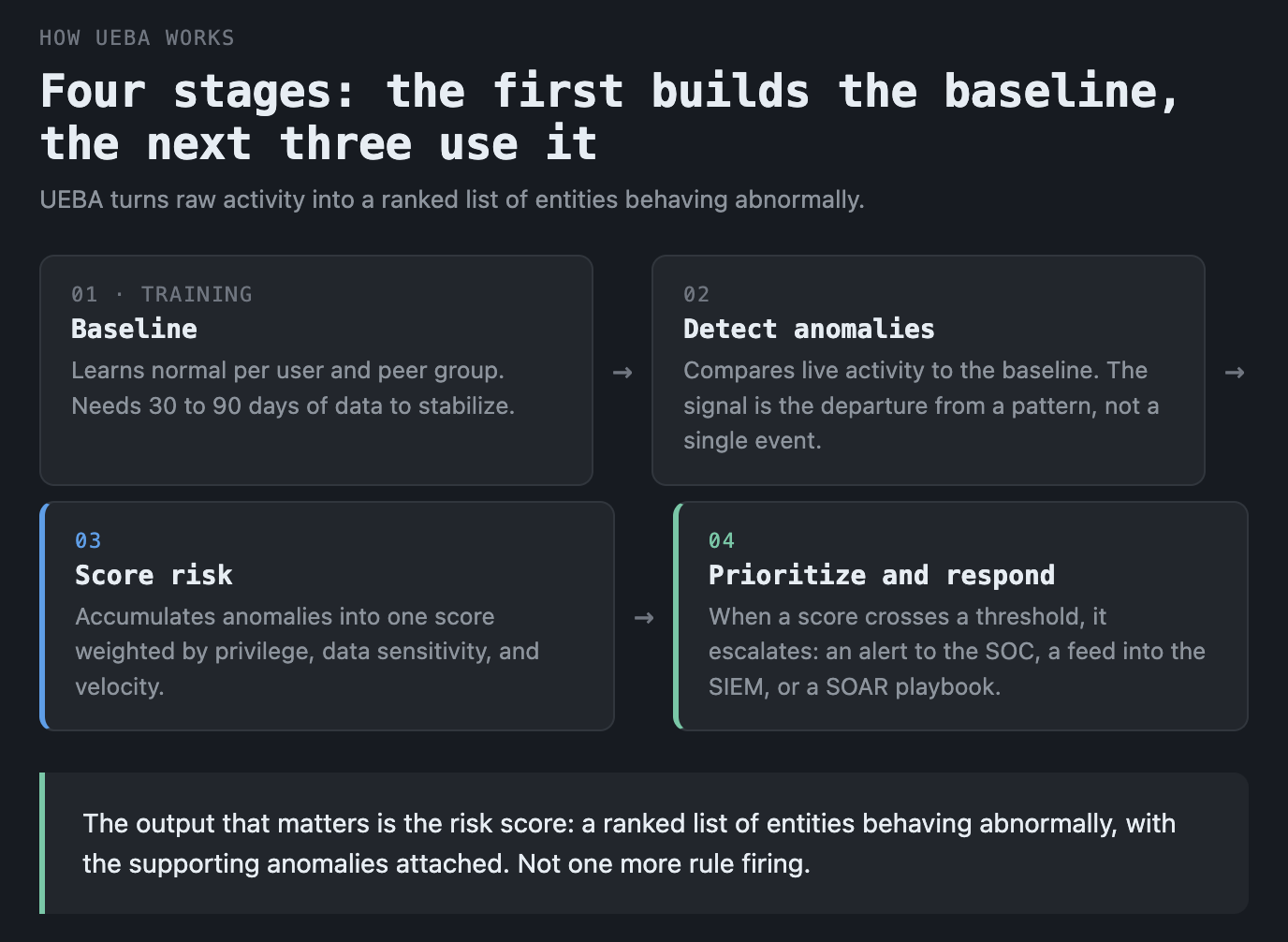
UEBA runs in four stages. The first builds the baseline; the next three use it.
- Baseline (training). UEBA ingests activity data and learns normal for each user and entity: when they log in, from where, on what device, which systems they touch, how much data they move, who their peers are. It builds per-entity baselines and peer-group baselines, so it knows not just what is normal for *you* but what is normal for people in *your role*. This phase typically needs 30 to 90 days of data before the model is stable enough to trust.
- Detect anomalies. Once baselined, UEBA compares live activity against it and surfaces deviations. The useful anomalies are not single events; they are departures from a pattern. Logging in at an odd hour once is noise. Logging in at an odd hour, from a new location, on an unmanaged device, then accessing systems outside your normal scope, is a chain.
- Score risk. This is where UEBA earns its place. Instead of firing a separate alert for each anomaly, it accumulates them into a risk score weighted by context: how privileged the account is, how sensitive the data being touched, how many anomalies are stacking up, and how fast. A dormant admin account that wakes up and enumerates the domain scores higher than an analyst opening one unusual file. The score is the prioritization.
- Prioritize and respond. When a score crosses a threshold, UEBA escalates: a high-fidelity alert to the SOC, a feed into the SIEM, or a trigger into a SOAR playbook. It identifies and ranks; the response itself runs through the controls already in place.
The output that matters is the risk score. A SOC drowning in single-event alerts gets, from UEBA, a ranked list of entities behaving abnormally, with the supporting anomalies attached. That is a different and more useful artifact than one more rule firing.
What UEBA detects
UEBA's value shows up in the detections that signature and rule-based tools struggle with: the ones that hinge on context and behavior rather than a matchable indicator.
| Use case | Behavioral signal UEBA keys on | Example |
|---|---|---|
| Compromised account | Login time, geography, device, impossible travel | Valid credentials used from a new country at 3 a.m. on an unmanaged device |
| Malicious insider | Access outside normal scope, mass downloads | A departing employee bulk-copies the customer database |
| Negligent insider | Risky-but-authorized actions vs peer baseline | A user emails sensitive files to a personal account |
| Lateral movement | An account touching hosts or shares it never uses | A service account suddenly authenticating to new servers |
| Data exfiltration | Volume and destination anomalies | Ten times normal upload to an unfamiliar external endpoint |
| Privilege abuse | Admin actions outside the normal pattern | A dormant admin account enumerates the domain |
The common thread is that none of these has a clean signature. Each is defined by deviation from a learned norm, which is exactly what UEBA models and what static rules cannot. This is also why it pairs naturally with threat hunting: the anomalies it surfaces are leads a hunter can pull, and the techniques a hunter confirms become context that sharpens the model.
UEBA vs. SIEM vs. EDR
UEBA is often confused with the SIEM it feeds and the EDR it sits beside. They answer different questions, and the fastest way to understand it is to see what it is not.
| UEBA | SIEM | EDR | |
|---|---|---|---|
| Core question | "Is this normal for this user or entity?" | "Did anything match a rule or correlate across logs?" | "What happened on this endpoint?" |
| Method | ML behavioral baselines and anomaly scoring | Log aggregation and correlation rules | Endpoint telemetry, signatures, behavioral rules |
| Best at | Compromised accounts, insider abuse, slow anomalies | Cross-source correlation, compliance, known patterns | Malware, process injection, endpoint attacks |
| Blind spot | Needs history; evadable by slow drift; does not respond | Rule-bound and noisy; weak on valid-credential abuse | Endpoint-only; misses identity and cross-entity patterns |
| Response | Flags and ranks by risk; relies on other controls to act | Alerts, some automated response via SOAR | Can isolate or kill a process on the endpoint |
The honest framing is that UEBA is a layer, not a product category that stands alone anymore. Standalone tools have largely disappeared; the capability now ships inside modern SIEM platforms and is folded into insider risk management suites, which is where Gartner now covers it. In practice, it adds the behavioral and identity context that a SIEM's correlation rules lack, and works best when its risk scores route into the SIEM, EDR, and response tooling a SOC already runs. It narrows a flood of low-context alerts into a short list of high-context ones.
Implementing UEBA: what it takes
UEBA is not a switch you flip. Its accuracy is a direct function of the data you feed it and the tuning you put in.
Data sources decide the ceiling. UEBA can only baseline behavior it can see. That means broad, consistent telemetry: authentication logs, VPN and network activity, endpoint events, file and database access, email, cloud and SaaS audit logs, and identity-provider data. Gaps in collection are gaps in the model. If a system is not logging, the model is blind to behavior on it.
The training period is real. Those first 30 to 90 days are noisy. The model has not learned normal yet, so it over-flags, and analysts have to ride the false positives down while the baseline settles. Teams that expect day-one precision abandon the tool before it becomes useful.
Tuning never stops. Environments change. People change roles, new applications come online, business processes shift. A baseline that was accurate last quarter drifts, and thresholds and risk weights need ongoing adjustment. UEBA is a system you maintain, not one you install.
Integration is the hard engineering. UEBA earns its keep when its output flows into the rest of the stack, but every platform speaks a different schema and exposes a different API. Wiring it into the SIEM, the identity provider, and the response tooling so that a risk score actually triggers action is real integration work, and it is where many deployments stall.
The limits of UEBA
UEBA is a strong layer with real failure modes. Knowing them is the difference between deploying it well and trusting it blindly.
It can be evaded by patience. UEBA detects deviation from a baseline, so an attacker who moves slowly enough can become the baseline. Low-and-slow activity that drifts the model gradually is exactly the tradecraft that behavioral detection struggles with. A skilled advanced persistent threat actor counts on this.
It needs history to work. UEBA is weak on entities it has not had time to learn: brand-new accounts, short-lived contractors, ephemeral cloud workloads that spin up and disappear. No baseline means no anomaly, just uncertainty.
It produces probabilities, not verdicts. A high risk score is a strong lead, not a confirmed incident. UEBA does not investigate or respond on its own. It still needs an analyst to triage the score, confirm whether it is a real threat, and drive incident response. The output is a prioritized starting point for human work, not a replacement for it.
It raises privacy questions. Baselining user behavior means monitoring user behavior, and that carries legal and cultural weight. Deployments have to balance detection against employee privacy, data-protection regulations, and the trust cost of pervasive monitoring. This is a governance problem, not just a technical one.
The bottom line
UEBA answers a question the rest of the stack cannot: not "does this match a known attack?" but "is this normal for this account?" That makes it the layer built for the threats that wear a valid login, compromised credentials, malicious and negligent insiders, lateral movement, and quiet data theft, the activity that hides precisely because it is technically allowed. It learns a baseline, scores deviation by risk, and hands the SOC a ranked short list instead of a flood of context-free alerts.
Frequently asked questions
UEBA catches threats that hinge on behavior rather than a matchable indicator: compromised accounts using valid credentials, malicious and negligent insiders, lateral movement, data exfiltration, and privilege abuse. These have no clean signature, so signature- and rule-based tools struggle with them, while a behavioral model flags them as deviations from a learned norm.
UEBA needs a training period, typically 30 to 90 days, to build stable behavioral baselines before its anomaly detection is reliable. During that window it tends to over-flag while the model learns normal. Beyond setup, it requires continuous tuning of thresholds and risk scoring as the environment changes, so it is best treated as a system you maintain rather than a one-time deployment.
Yes. Because UEBA detects deviation from a baseline, an attacker who moves slowly enough can shift the baseline and avoid tripping a threshold. Low-and-slow activity, common in advanced persistent threat campaigns, is the main weakness of behavioral detection. It also struggles with entities it has not had time to baseline, such as new accounts and short-lived cloud workloads.
UEBA (User and Entity Behavior Analytics) is a security approach that uses machine learning to learn what normal behavior looks like for every user and entity in an environment, then flags activity that deviates from that norm. Instead of matching known attack signatures, it catches a trusted account or system behaving abnormally, which is the signature of a compromised account or an insider threat.
UBA (User Behavior Analytics) models the behavior of people and their accounts only. UEBA adds entities: servers, endpoints, applications, service accounts, and other non-human actors on the network. The "E" matters because a lot of malicious activity runs under non-human identities, such as a service account used for lateral movement, which a user-only model would miss.
No. A SIEM aggregates logs and runs correlation rules across them. UEBA adds behavioral baselining and risk scoring that correlation rules lack, and is especially good at catching valid-credential abuse that a SIEM's rules tend to miss. In practice the two are complementary, and it is now usually a capability built into modern SIEM platforms rather than a separate product.