What Is a SOC? Security Operations Center Explained
What Is a SOC? Security Operations Center Explained
It is 3 a.m. An alert fires: a service account just authenticated from an IP in a country your company does not operate in, then started enumerating file shares. The endpoint agent flagged a suspicious process minutes earlier. The firewall logged an outbound connection to a domain registered yesterday. Three signals, three different tools, one story. Someone has to see all three, decide it is real, and act before it spreads. That someone works in a SOC.
A Security Operations Center is the team, the process, and the tooling that watches an organization's environment for threats and responds when one appears. Not a product you buy. A function you run, usually 24/7, staffed by analysts who triage alerts, investigate the real ones, and contain incidents before they become breaches.
This guide explains what a SOC is, what actually happens inside one, who staffs it and at what tier, the tools it runs, the models you can build it under, how it differs from a NOC, the metrics it lives and dies by, and the honest challenges of operating one. It is written for blue teamers: SOC analysts, threat hunters, and DFIR practitioners who work the queue, not just sign the budget.
What is a SOC?
A SOC (Security Operations Center) is the centralized function responsible for monitoring, detecting, analyzing, and responding to cybersecurity threats across an organization, typically on a continuous 24/7/365 basis. It is where security telemetry from every system in the environment converges and where humans decide what that telemetry means.
The purpose is twofold. The first job is reactive: catch and contain threats in real time, before an intrusion becomes an incident and an incident becomes a breach. The second is proactive: continually harden the environment so the next attack has fewer ways in. A good SOC does both. One that only firefights never gets ahead of the attacker.
The word "center" misleads people. It is not primarily a room with screens, even though the physical version exists. A SOC is a coordinated capability: people running a defined process on top of a stack of tools. You can run one from a dedicated facility, from desks scattered across time zones, or entirely from the cloud. What makes it a SOC is the function, not the furniture.
Put plainly, it answers the questions a defending organization asks every hour:
-
Is anything malicious happening in our environment right now?
-
Is this alert real, and if so, how bad is it?
-
Can we contain it, and prove afterward exactly what happened?
What does a SOC do?
Strip the org chart away and a SOC runs one continuous loop: monitor, triage, investigate, respond, improve. Everything else i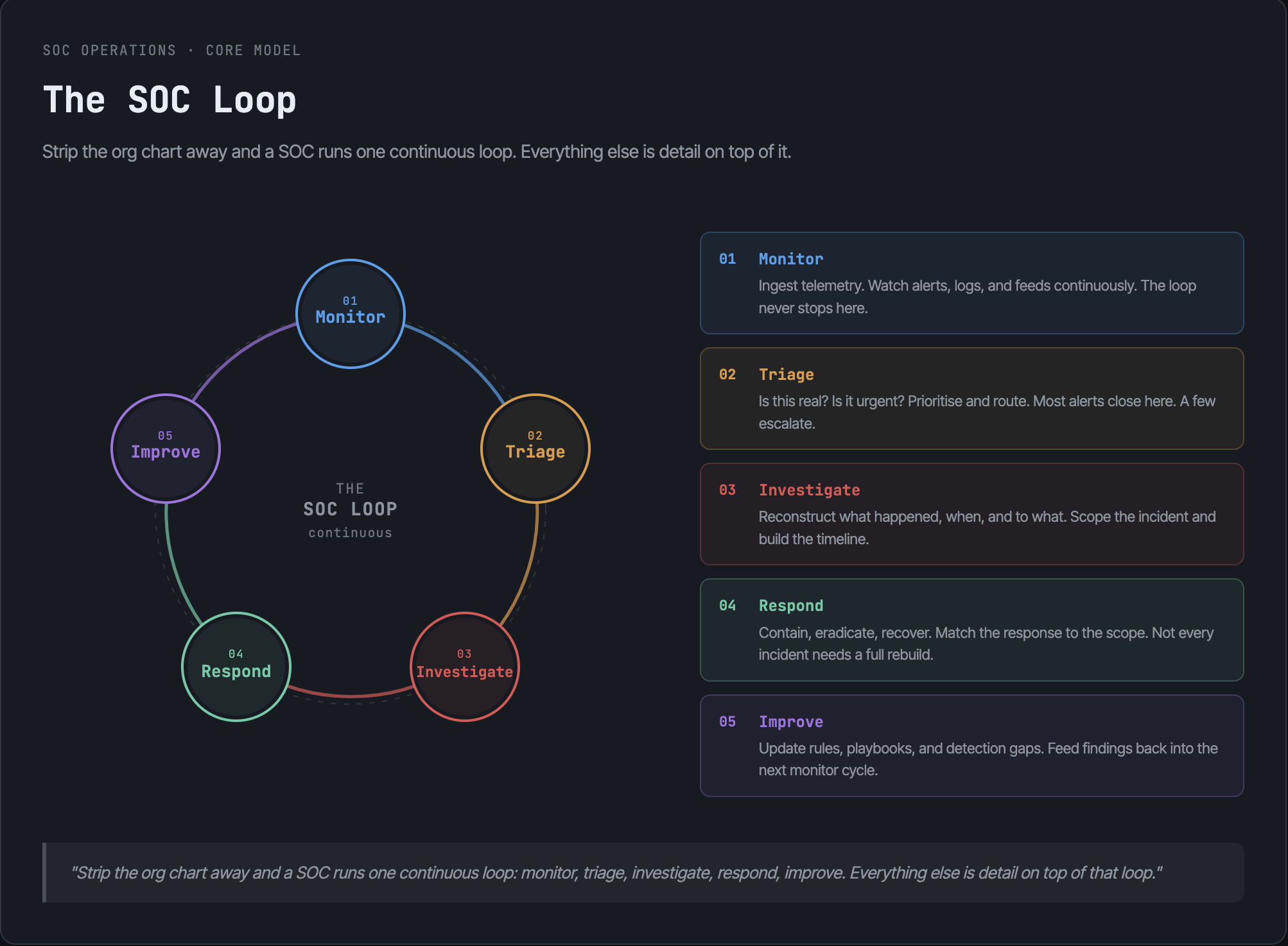 s detail on top of that loop.
Monitor. The team watches the environment around the clock. Telemetry streams in from endpoints, servers, network devices, identity providers, and cloud platforms into a central SIEM and the detection tools layered around it. Detection logic runs against that stream and raises alerts on anything suspicious.
Triage. Most alerts are not incidents. A Tier 1 analyst reviews each one, separates true positives from the flood of false positives and benign anomalies, and decides what deserves a deeper look. This is the highest-volume work in the queue and the first place a poorly tuned pipeline drowns its own people.
Investigate. When an alert survives triage, an analyst pivots into the data to scope it. Which user, which host, which credentials, what did the attacker touch, and how did they get in. This is where log search, endpoint forensics, and threat intelligence enrichment turn a single alert into a full picture of the activity.
Respond. Once an incident is confirmed, the team acts to contain and remediate: isolate the host, disable the account, reset credentials, block the indicator at the perimeter, preserve evidence for the investigation, and notify whoever needs to know. Speed here is the whole game.
Improve. After the incident closes, the team feeds what it learned back into detection: write a rule for the technique that slipped through, tune the alert that fired too late, suppress the noise that buried the real signal. A team that skips this step fights the same intrusion forever.
Around that loop sit the supporting jobs: managing and tuning the security tooling, patch and vulnerability management, enforcing security policy, supporting backups and recovery, and advising the rest of the business on risk. The loop is the product. The rest keeps the loop running.
Who works in a SOC?
A SOC is a team of specialists, and most are organized into tiers by depth of work. The tiering is not about seniority for its own sake. It is about routing work to the right skill level so expensive expertise is not spent closing false positives.
| Role / tier | What they do | Typical work |
|---|---|---|
| Tier 1: Triage analyst | First responder. Monitors the alert queue, triages, escalates real threats | Alert review, initial classification, basic enrichment, escalation |
| Tier 2: Incident responder | Investigates escalated alerts, scopes and contains incidents | Deep investigation, forensics, root-cause analysis, remediation |
| Tier 3: Threat hunter | Proactively hunts threats the alerts miss; builds advanced detections | Hypothesis-driven hunting, detection engineering, malware and forensic analysis |
| SOC engineer | Builds and maintains the tooling the analysts run on | SIEM and tool administration, data onboarding, automation, rule deployment |
| SOC manager / lead | Runs the team, the process, and the relationship with the business | Staffing, metrics, escalation, crisis coordination, reporting to leadership |
Tier 1 (triage analysts) are the front line. They live in the alert queue, decide what is urgent, do basic enrichment, and escalate anything that looks real. High volume, fast decisions.
Tier 2 (incident responders) take the escalations. They dig into the data, perform forensics, determine root cause, scope the blast radius, and drive remediation. This is where an alert becomes a worked incident.
Tier 3 (threat hunters and detection engineers) are the senior practitioners. They do not wait for alerts. They form hypotheses about how an attacker could be in the environment and go looking, then turn what they find into new detections. They also handle the hardest forensic and malware analysis.
SOC engineers keep the stack running: onboarding log sources, administering the SIEM and EDR, building automation, and deploying detection content. The analysts are only as effective as the pipeline the engineers maintain.
SOC managers own the outcomes: staffing the shifts, tracking the metrics, coordinating during a crisis, and translating security work into language the business understands. Larger programs add specialized roles, threat intelligence analysts, compliance and audit staff, and a CISO above the whole function.
Not every team has all five. A small team may have one person wearing three of these hats. The functions still have to happen.
SOC tools and technologies
A SOC is a stack. No single product runs one, and a pile of disconnected tools does not either. The art is integrating them so telemetry and context flow between them.
| Tool | Role in the SOC |
| SIEM | Central log collection, normalization, correlation, and search. The hub. |
| EDR / XDR | Endpoint (EDR) and cross-domain (XDR) detection and response telemetry |
| SOAR | Automates repetitive response with playbooks; cuts manual toil |
| UEBA | Behavioral baselines per user and host; flags anomalies static rules miss |
| Threat intelligence platform | Enriches alerts with known-bad IPs, domains, and hashes |
| Firewall / IDS / IPS | Perimeter and network detection and blocking |
| Vulnerability scanner | Finds and prioritizes exposures before attackers exploit them |
| Asset inventory | Tracks what you have to defend; you cannot monitor what you cannot see |
| Case management / ticketing | Tracks incidents through investigation to closure |
The SIEM sits at the center of most SOCs. It is the one place that ingests data from every other tool, normalizes it into a common shape, and correlates across all of it to surface threats no single source reveals. The firewall catches a connection, the EDR catches a process, identity logs catch the login, and the SIEM is where those become one alert. SOAR sits next to it, taking confirmed alerts and running the routine response steps automatically so analysts spend their time on judgment, not copy-paste.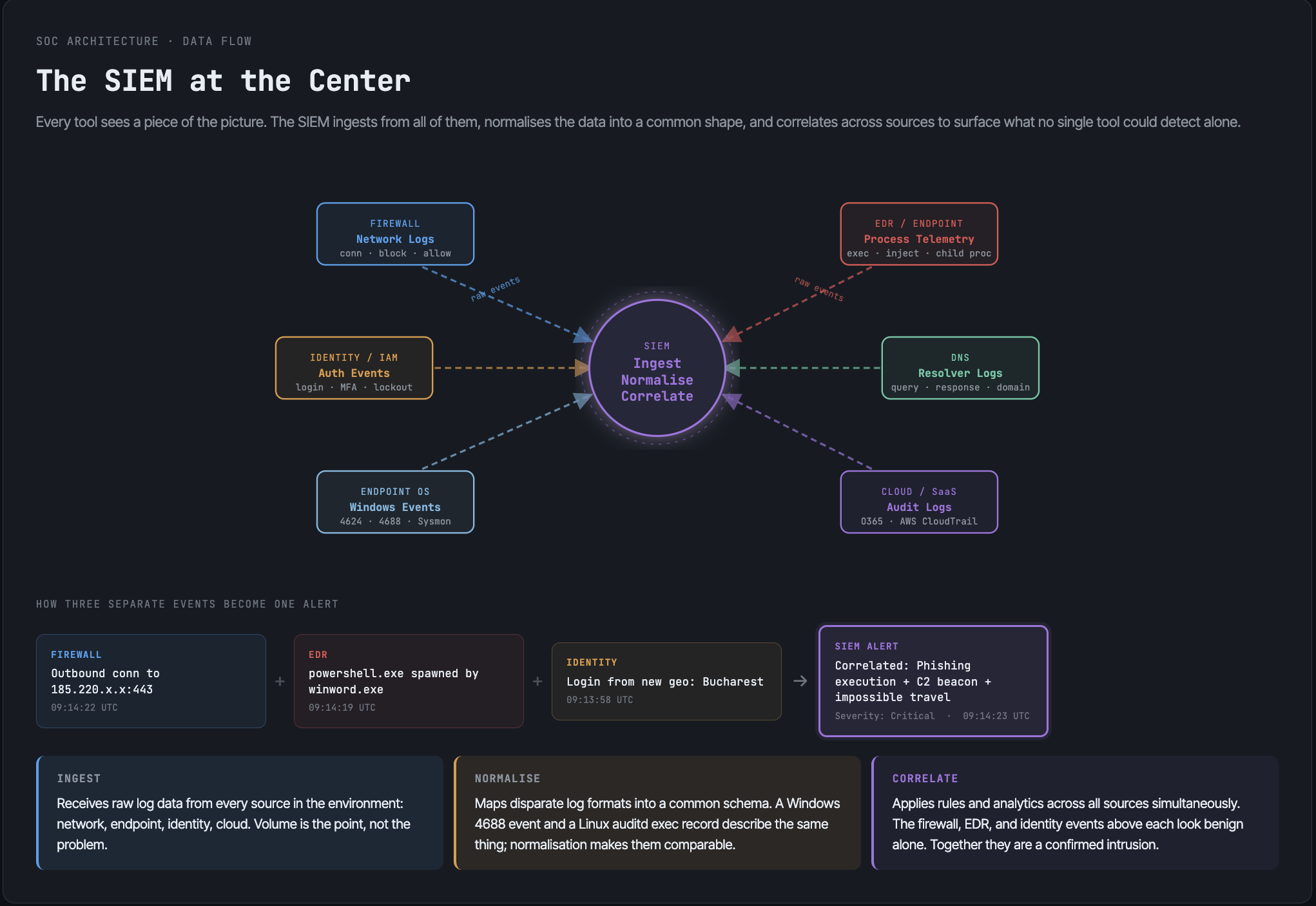
The trend in modern SOCs is consolidation and automation: fewer, better-integrated platforms, with AI and automation handling first-pass triage so human analysts focus on the incidents that need a human.
Types of SOC: models for building one
You can build the same SOC function several ways. The choice comes down to a trade between control, cost, and the staff you can realistically hire and retain.
| Model | Who runs it | Best for | Trade-off |
| In-house | Your full-time staff, on-premises or remote | Large orgs, sensitive data, full control | Highest cost; hardest to staff 24/7 |
| Virtual | Distributed part-time or remote staff, no dedicated facility | Smaller teams, distributed orgs | Less cohesion; relies on strong process |
| Co-managed / hybrid | Your team plus an external provider | Most orgs wanting control without 24/7 headcount | Coordination overhead; shared responsibility |
| Fully outsourced (MSSP / MDR) | A managed security service provider | Orgs without the staff or budget to build one | Less control; provider may not know your environment |
| Global (GSOC) | Coordinated SOCs across regions | Large multinationals | Complex; expensive to run |
In-house SOC. Your own people, your own tooling, full control over detection and data. Maximum visibility and the deepest knowledge of your environment, at the highest cost. Staffing every shift, every day of the year, is the hard part.
Virtual SOC. No dedicated room. A distributed or part-time team operating remotely, often on cloud tooling. Cheaper and more flexible, but it lives or dies on disciplined process, since the team is not sitting together.
Co-managed / hybrid SOC. You keep an internal team for the work that needs context and ownership, and lean on an external provider for 24/7 coverage or specialized skills. The common landing spot for organizations that want control without hiring a night shift. Combines on-prem, cloud, and multi-cloud as needed.
Fully outsourced SOC. A Managed Security Service Provider (MSSP) or Managed Detection and Response (MDR) vendor runs detection and response for you. Fastest path to coverage if you lack the staff, but the provider starts without deep knowledge of your environment, and you give up direct control.
Global SOC (GSOC). For multinationals, a GSOC coordinates regional SOCs, prevents duplicated effort, and provides follow-the-sun coverage where each region hands off to the next instead of running a night shift.
SOC vs. NOC
A SOC and a NOC (Network Operations Center) look similar from the outside, a team watching screens around the clock, and get confused constantly. They share goals: keep services available and recover fast when something breaks. The difference is what they defend against.
| SOC | NOC | |
| Primary concern | Security threats and incidents | Network performance and availability |
| Watches for | Attacks, intrusions, malicious activity | Outages, latency, hardware and service failures |
| Adversary | A human attacker | Failure, load, and entropy |
| Success looks like | Threats detected and contained fast | Uptime and performance maintained |
A NOC cares whether the network is up and fast. A SOC cares whether the network is compromised. A NOC engineer sees a server pegged at 100% CPU and asks what is overloading it. A SOC analyst sees the same spike and asks whether it is a cryptominer. The skill sets overlap, the tooling sometimes overlaps, but the mindset is different: a NOC fights entropy, a SOC fights an adversary who adapts.
How a SOC measures itself
A SOC that cannot measure itself cannot improve, and cannot prove its value when budget season comes. A handful of metrics matter more than the rest.
-
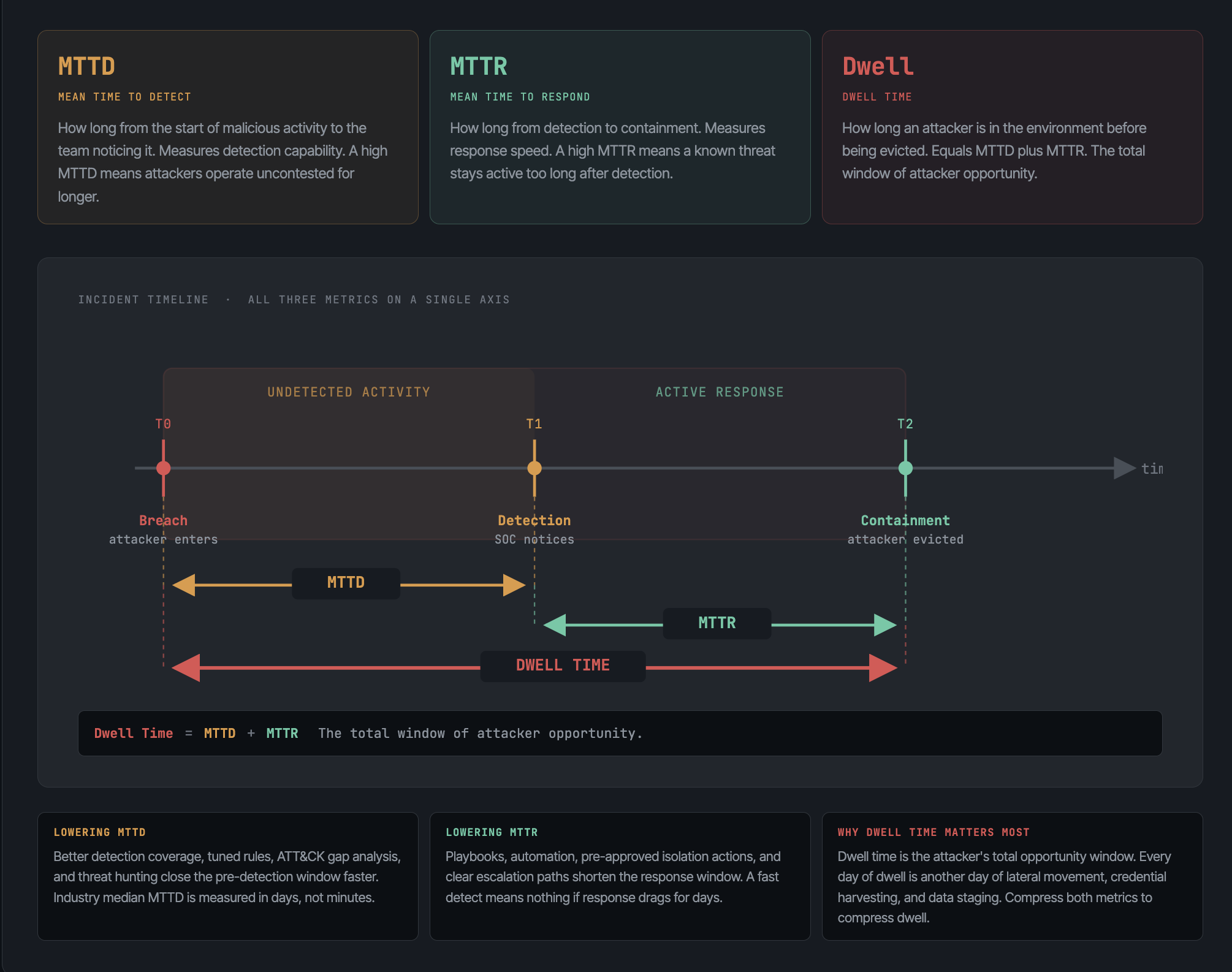
MTTD (Mean Time to Detect). How long from the start of malicious activity to the team noticing it. The clock the attacker is racing. Lower is better.
-
MTTR (Mean Time to Respond). How long from detection to containment. Detecting fast means nothing if response is slow. Lower is better.
-
Dwell time. How long an attacker is in the environment before being evicted. The metric breaches are ultimately judged on.
-
False positive rate. The share of alerts that turn out to be nothing. High rates are the direct cause of alert fatigue and burnout. In many SOCs this exceeds 50%.
-
Alert volume and triage rate. How many alerts arrive and how many actually get worked. When the second number falls below the first, threats are slipping through.
MTTD and MTTR are the headline numbers because they map directly to damage. The faster you detect and respond, the less an attacker can do. Every tuning effort, every automation, every new detection is ultimately judged on whether it moved those two numbers down without driving the false positive rate up.
SOC challenges: the hard parts
Any honest account names the parts that make this hard. These are the reasons these programs underperform, and they are operational, not theoretical.
Alert fatigue. This is the defining problem of the modern SOC. Tools generate far more alerts than any team can investigate, and most are false positives. More than one-third of security analysts ignore alerts when the queue is full, according to an IDC and FireEye survey. When analysts tune out, the one real alert in the flood gets missed. Tuning and risk-based alerting are the fix, and the work never fully ends. We go deeper on this in our breakdown of SOC alert fatigue.
The staffing shortage. There are not enough skilled analysts. The 2024 ISC2 Cybersecurity Workforce Study put the global shortage at more than 4.7 million professionals. SOC roles are among the hardest to fill and keep, which is why so many organizations turn to co-managed and outsourced models.
Burnout. Alert fatigue, night shifts, and constant pressure grind people down. High turnover follows, and every analyst who leaves takes environment knowledge with them. Retention is a security control, not just an HR concern.
Tool sprawl. SOCs accumulate tools, and disconnected tools create blind spots and swivel-chair work where analysts manually correlate across consoles. Integration and consolidation matter more than the count of products.
24/7 coverage is genuinely hard. Real attacks happen at 3 a.m. on holidays, precisely when coverage is thinnest. Staffing every hour of every day with skilled people is expensive and is the single biggest reason fully in-house SOCs are rare outside large enterprises.
A SOC does not run itself. The tooling is the easy part to buy and the hard part to operate well, and the people are the constraint that no purchase removes.
Best practices for building a SOC
If you are standing up a SOC or sharpening one, the order of operations matters more than any single product choice.
-
Start with strategy, not tools. Decide what you are protecting, what you must detect, your coverage requirements, and whether you build, outsource, or run a hybrid. Buying a SIEM before you know your use cases is how budgets die.
-
Get visibility across the whole environment. You cannot defend what you cannot see. Inventory your assets, then onboard the high-value log sources first: identity, endpoint, and network. Blind spots, especially in cloud and third-party systems, are where attackers live.
-
Choose tools for integration, not feature lists. The stack has to work as one pipeline. Prioritize how cleanly tools share data and context over how long their feature sheets are.
-
Invest in people and never stop training. Detection content and triage instinct are built by skilled analysts, not bought. Continuous, hands-on training is what turns a tool into a capability.
-
Tune relentlessly and adopt risk-based alerting. Suppress known-good noise, fix the rules that cry wolf, and consolidate alerts into scored incidents so analysts see signal, not raw events.
-
Apply zero-trust principles. Continuous authentication, least-privilege access, and network segmentation shrink what an attacker can reach and give the team fewer fires to fight.
-
Measure and report. Track MTTD, MTTR, and dwell time, and report them up. What you measure is what improves, and what you report is what keeps the program funded.
The bottleneck in every one of these steps is skill. The fastest way to build it is hands-on work against realistic data. Working real investigations on actual logs and attack data, the kind in CyberDefenders blue team labs, builds the triage and investigation instincts no product manual teaches. Those are the same skills the CCD certification track validates for SOC roles.
Frequently Asked Questions
What is a SOC in simple terms?
A SOC (Security Operations Center) is the team, process, and tools that monitor an organization's systems for cyber threats and respond when one is found, usually around the clock. It is the central hub where security alerts are triaged, investigated, and contained.
What is the difference between a SOC and a NOC?
A SOC (Security Operations Center) defends against security threats: attacks, intrusions, and malicious activity. A NOC (Network Operations Center) maintains network performance and availability: uptime, latency, and outages. A NOC fights failure; a SOC fights an attacker.
What roles work in a SOC?
A SOC typically has Tier 1 triage analysts who monitor alerts, Tier 2 incident responders who investigate and contain, and Tier 3 threat hunters and detection engineers. Supporting roles include SOC engineers who maintain the tooling and a SOC manager who runs the team and reports to leadership.
What tools does a SOC use?
The core of most SOCs is a SIEM for log collection and correlation, supported by EDR or XDR for endpoint and cross-domain detection, SOAR for automated response, UEBA for behavioral analytics, threat intelligence platforms, firewalls, vulnerability scanners, and case management. Integration between them matters more than any single tool.
Should I build an in-house SOC or outsource it?
It depends on your size, budget, and how sensitive your data is. In-house gives the most control and environment knowledge but is expensive and hard to staff 24/7. Outsourcing to an MSSP or MDR provider is faster and cheaper but gives up control. Most organizations land on a co-managed hybrid that keeps an internal team and buys external coverage.
What metrics measure SOC performance?
The key metrics are MTTD (mean time to detect), MTTR (mean time to respond), and dwell time, which measure how fast threats are caught and contained. False positive rate and alert triage rate measure how much noise the team fights. Lower detection and response times with a controlled false positive rate signal a healthy SOC.