What Is Cybersecurity? A Practitioner's Complete Guide
A SOC analyst opens her queue on a Monday. An endpoint agent flagged powershell.exe spawning from a Word document, then reaching out to an IP in a country the company does no business with. Within twenty minutes she has pulled the process tree, confirmed the macro, isolated the host, and pushed a detection rule so the next attempt fires an alert before anyone clicks.
That is cybersecurity. Not the padlock icon. The decision to isolate the host.
Cybersecurity is the practice of protecting systems, networks, data, and the people who use them from digital attack. The vendor definitions stop at "technologies, processes, and policies." This guide goes further: what cybersecurity is actually made of, the frameworks that organize it, the threats you will meet in a real queue, and how you turn reading about it into doing it.
Why Cybersecurity Matters
The money is the fastest argument. IBM's Cost of a Data Breach report put the global average breach at USD 4.44 million in 2025, the first decline in five years, even as the US average climbed to a record USD 10.22 million. IDC projects worldwide security spending will reach USD 377 billion by 2028. Spending climbs because the losses climb.
The second argument is people. The US Bureau of Labor Statistics projects 29% growth in information security analyst roles from 2024 to 2034, far above average. ISC2 puts the global cybersecurity workforce gap at a record 4.8 million unfilled roles. A security skills shortage also adds about USD 1.76 million to the average breach, and more than half of breached organizations now report severe staffing shortages. The shortage is not abstract. It has a price tag, and it is the reason this field hires.
The third argument is reach. A ransomware hit on a hospital delays surgeries. A breach at a utility is a public-safety event. Cybersecurity stopped being an IT subtopic the moment software started running the physical world.
The CIA Triad: What You Are Actually Protecting
Every control you will ever deploy serves one of three goals. The CIA triad is the model, and it is worth more than any tool list because it tells you why a control exists.
-
Confidentiality. Only authorized people see the data. Encryption, access control, and least privilege live here. A leaked customer database is a confidentiality failure.
-
Integrity. Data and systems stay accurate and unaltered. Hashing, digital signatures, and change monitoring live here. A tampered bank balance or a poisoned software update is an integrity failure.
-
Availability. Authorized users get access when they need it. Redundancy, backups, and DDoS protection live here. A ransomware lockout is an availability failure.
When you evaluate any incident or any new control, ask which leg of the triad it touches. Ransomware that both encrypts files and steals them attacks availability and confidentiality, which is why double-extortion hurts twice.
The NIST Framework: How Defenders Organize the Work
The CIA triad tells you the goal. The NIST Cybersecurity Framework tells you the workflow. CSF 2.0 defines six functions, and a mature security program runs all of them continuously.
| Function | What it covers | Example activity |
|---|---|---|
| Govern | Risk strategy, roles, policy | Defining risk appetite and ownership |
| Identify | Assets, data, risks | Asset inventory, attack surface mapping |
| Protect | Safeguards | MFA, patching, encryption, training |
| Detect | Finding events | SIEM alerts, EDR, threat hunting |
| Respond | Acting on incidents | Containment, eradication, forensics |
| Recover | Restoring operations | Backup restore, lessons learned |
Notice where the analyst from the opening sits: Detect and Respond. That is where most blue-team careers begin, because that is where the volume is. Govern was added in CSF 2.0 to make explicit what breaches kept proving, that strategy and accountability decide whether the other five functions get funded.
The Domains of Cybersecurity
Cybersecurity splits into domains because no single team defends everything. These are the areas you will see on job descriptions and in any layered defense.
Network Security
Controlling traffic in and out of systems. Firewalls, intrusion detection and prevention (IDS/IPS), and network segmentation. The goal is to block unauthorized access, catch attacks in progress, and keep authorized users connected.
Endpoint Security
Protecting laptops, servers, phones, and other devices where users and attackers meet. Endpoint detection and response (EDR) gives analysts the process trees and telemetry that made the opening investigation possible. Unified endpoint management pulls device control into one console.
Application Security
Finding and fixing flaws in software before and after release. DevSecOps pushes security testing into the build pipeline instead of bolting it on at the end. Most web breaches trace back to an AppSec gap.
Cloud Security
Securing infrastructure, data, and workloads hosted off-premises. Cloud runs on a shared-responsibility model: the provider secures the platform, you secure what you put on it. Misconfigured storage buckets and over-permissive identities are the recurring failures.
Identity Security
Protecting credentials and the systems that manage them. This is no longer a side domain. According to the IBM X-Force 2026 Threat Intelligence Index, abuse of valid accounts and stolen credentials drives about 32% of intrusions, second only to the exploitation of public-facing applications. Identity remains one of the two dominant ways into corporate networks. Multi-factor authentication and zero-trust architecture are the front-line answers.
Information and Data Security
Protecting data itself, in any form, against unauthorized access or alteration. Data loss prevention (DLP), classification, and encryption sit here. Most cybersecurity work is, in the end, about the data.
Critical Infrastructure and OT Security
Defending the systems a society runs on: power, water, transport, healthcare. NIST and CISA publish guidance because the blast radius of failure is public, not just corporate.
AI Security
The newest domain, and a moving target. It means two things at once: protecting AI systems from attacks like prompt injection and data poisoning, and using AI to strengthen defense. IBM's Institute for Business Value found only 24% of generative AI initiatives are secured, which is the gap attackers are already working.
The Threats You Will Actually See
A queue does not produce exotic attacks every day. It produces the same families over and over. Know these cold.
| Threat | What it does | First defensive move |
|---|---|---|
| Malware | Code written to harm a system; nearly every attack uses some | EDR, application allowlisting |
| Ransomware | Encrypts or steals data, demands payment | Offline backups, segmentation |
| Phishing | Social engineering by email, text, or voice | MFA, user training, email filtering |
| Credential theft | Stolen logins, account takeover | MFA, privileged access management |
| Insider threats | Misuse by authorized users | UEBA, least privilege, monitoring |
| DDoS | Floods a service to crash it | Traffic scrubbing, rate limiting |
| Cryptojacking | Hijacks compute to mine crypto | Endpoint monitoring, egress rules |
A few that earn extra attention:
Phishing is the front door. Bulk scams are obvious, but spear phishing and business email compromise target named individuals for real money. Attackers now generate convincing lures with generative AI in minutes, which is why training that teaches people to pause beats training that teaches them to spot typos.
Ransomware has shifted. Since 2023 the share of victims who pay has fallen sharply as more organizations refuse and governments disrupt the groups, even as raw attack counts have climbed to record highs. Operators adapted to double extortion, stealing data before encrypting so they can leak it even if you restore from backup. Availability and confidentiality, hit together.
Credential theft is the quiet leader. Kerberoasting abuses the Kerberos protocol in Active Directory to crack service-account passwords offline. Infostealer malware harvests saved credentials by the thousand and sells them on the dark web. This is the ~32% credential-abuse number from above, in mechanical terms.
AI attacks are the growth area. Prompt injection feeds malicious input to a model to make it leak data or act against its instructions. Data poisoning corrupts a model's training so it fails in the attacker's favor. The defenses are still being written, which is exactly why the domain is hiring.
How an Attack Unfolds
Threats are not single events. They are sequences, and defenders who understand the sequence can break it at multiple points. Most intrusions move through recognizable stages: reconnaissance, initial access, execution, persistence, privilege escalation, lateral movement, and finally the objective, whether that is data theft, encryption, or sabotage.
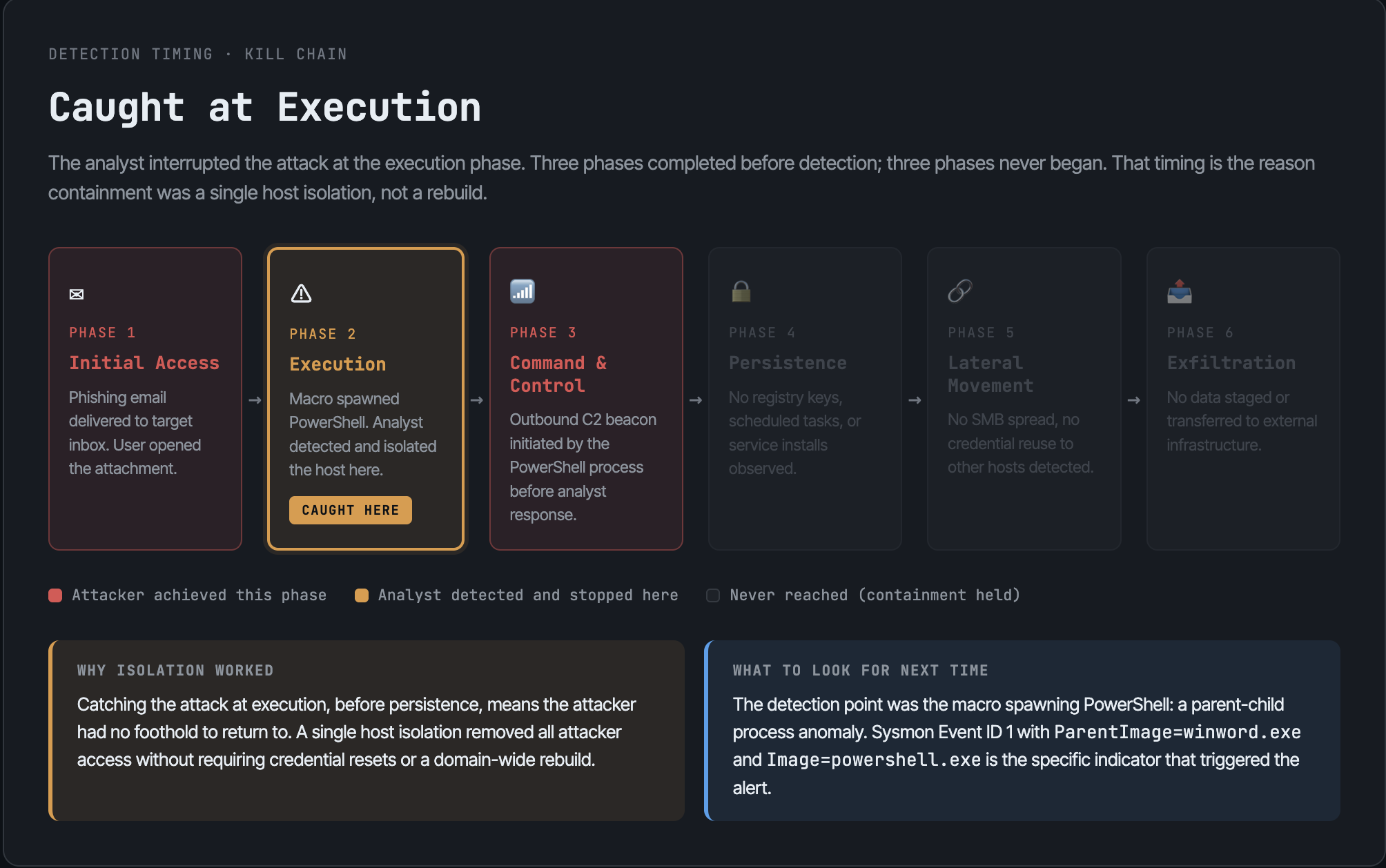
Trace the opening investigation against those stages. The phishing email was initial access. The macro spawning PowerShell was execution. The outbound connection was the attacker reaching command and control. The analyst caught it at execution, before persistence or lateral movement, which is why containment was an isolation instead of a company-wide rebuild. Catch an attack early in the chain and you handle an incident. Catch it late and you handle a disaster.
MITRE ATT&CK is the public knowledge base that maps these stages to the specific techniques attackers use, with real-world examples for each. Blue teams use it to write detections, measure coverage, and speak a common language during an incident. When a threat report says an actor used "T1558.003 Kerberoasting," that is ATT&CK. Learning to read it is one of the highest-leverage skills a new defender can pick up, because it turns a vague "we got attacked" into a precise list of what to detect next time.
The takeaway: defense in depth works because it forces the attacker to succeed at every stage while you only have to catch them at one.
Five Myths That Get Organizations Breached
-
"A strong password is enough." Passwords are bought, phished, and keylogged regardless of length. The control that matters is MFA, ideally phishing-resistant.
-
"The big risks are all known." Thousands of new vulnerabilities are published every year, and human error keeps inventing new ones. The landscape moves; a static defense decays.
-
"Our attack surface is contained." Every new technology, OT, IoT, cloud, AI, adds vectors. Attack surface management exists because the surface never stops growing.
-
"Our industry is too boring to target." Ransomware now hits local governments, nonprofits, schools, and healthcare. Attackers pick soft targets, not glamorous ones.
-
"We are too small to bother with." The Hiscox Cyber Readiness Report 2025 found 59% of small and mid-sized businesses suffered a cyberattack in the past year. Small means under-defended, which means attractive.
Cybersecurity Best Practices
Strategies differ by organization, but the load-bearing practices repeat:
-
Security awareness training. The cheapest control with the widest reach. It turns the people attackers target into people who report.
-
Identity and access management. MFA, least privilege, and zero trust. If credential theft is the most common entry point, IAM is the most leveraged defense.
-
Patch and vulnerability management. A running cycle of scan, prioritize, patch, verify. Most exploited vulnerabilities had a patch available.
-
Data protection. Encryption and DLP make stolen data useless and stop exfiltration in progress.
-
Detection and response. SIEM, SOAR, and EDR feeding a written incident response plan. Detection without a plan is just noise.
-
Backup and disaster recovery. Tested, offline, restorable. The difference between a ransomware incident and a ransomware catastrophe.
-
Attack surface management. Continuous discovery from the attacker's point of view, because you cannot defend what you have not inventoried.
How to Actually Learn Cybersecurity
Reading a definition does not build the skill. The analyst in the opening got fast by working hundreds of investigations, most of them in practice environments before any of it was real.
That is the gap between knowing what cybersecurity is and being able to do it, and it only closes one way: hands-on repetition against realistic scenarios. Pull apart real malware. Investigate a captured intrusion from the logs up. Build the muscle memory of triage, containment, and analysis on a system where a mistake teaches instead of costs.
A realistic progression looks like this. Start with the fundamentals on this page plus core networking and operating-system internals, because you cannot spot abnormal traffic or a malicious process if you do not know what normal looks like. Add a scripting language, usually Python, so you can automate the boring parts of analysis. Then specialize: a cybersecurity career rarely means "doing all of it." It means picking a lane, detection engineering, incident response, malware analysis, threat hunting, and going deep. Each lane has its own tools, and the only way to learn the tools is to use them against real data.
Frequently asked questions
Cybersecurity is protecting computers, networks, data, and users from digital attacks. In practice it means stopping attackers from stealing data, locking systems, or disrupting services, and detecting and responding when they get through.
The core domains are network security, endpoint security, application security, cloud security, identity security, information and data security, critical infrastructure security, and the emerging field of AI security. Each defends a different layer of an organization's environment.
The CIA triad is the foundational model of three goals every security control serves: confidentiality (only authorized access), integrity (data stays accurate and unaltered), and availability (access when needed). Every framework and control maps back to one of the three.
Malware, ransomware, phishing, credential theft, insider threats, DDoS, and cryptojacking. Stolen credentials and the exploitation of public-facing applications are the most common entry points; credential and valid-account abuse alone accounts for roughly a third of intrusions (IBM X-Force 2026).
Yes. The US Bureau of Labor Statistics projects 29% growth in security analyst roles from 2024 to 2034, and ISC2 puts the global cybersecurity workforce gap at a record 4.8 million unfilled roles. Demand far outpaces supply, especially in detection and response.
Build hands-on skills, not just theory. Start with the fundamentals (CIA triad, networking, operating systems), then practice on realistic scenarios. Hands-on platforms like CyberDefenders let you investigate real incidents and malware in a safe environment before doing it on the job.
Information security protects information in any form, including paper and physical media. Cybersecurity focuses on digital systems and data. Data security, the protection of digital information, is the overlap and the focus of most cybersecurity work.