Hands-On Labs vs. Video Courses: Which Actually Builds SOC Skills?
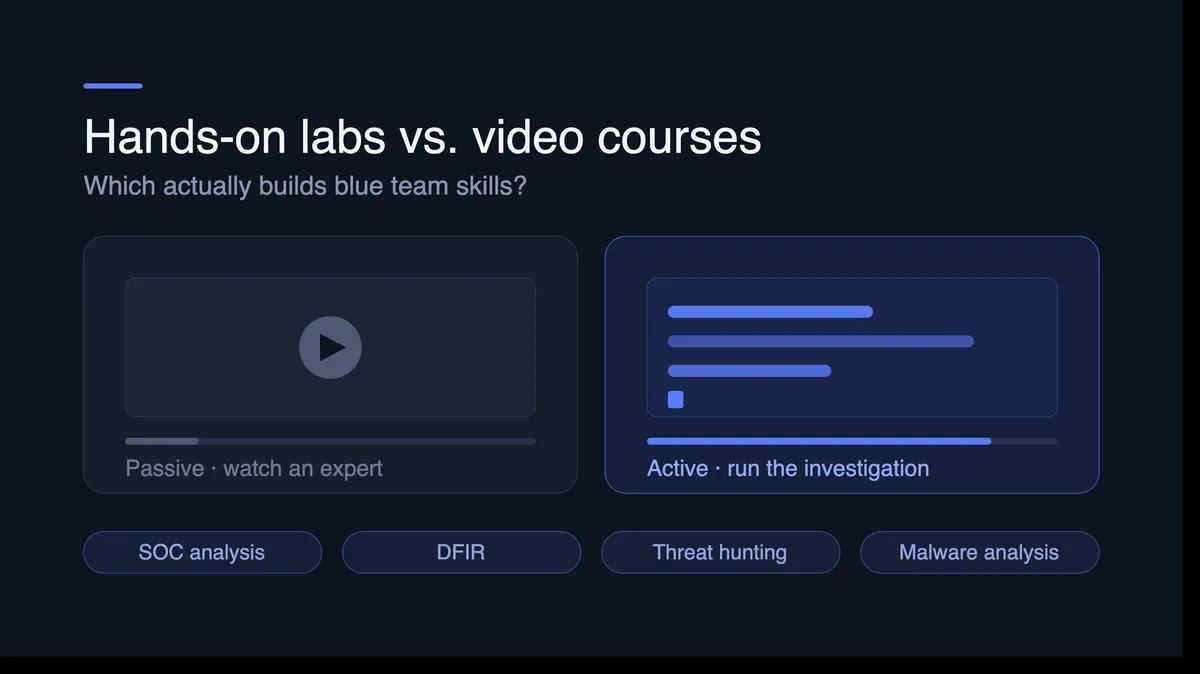
An analyst on your team finishes a 40-hour video course on incident response. They pass every quiz, and the completion certificate lands in your inbox. Two weeks later a real alert fires, a PowerShell execution with an encoded command line, and they stall at the first pivot. The course was not bad. It was doing a different job than the one you bought it for.
That gap is the entire hands-on labs vs. video courses debate, and it matters to anyone comparing hands-on cybersecurity training against a video library for their SOC. The two formats are not competitors doing the same work at different prices. They build different things, and only one of them builds the thing your team is measured on.
The evidence for that split is unusually consistent, from learning science to hiring data. Here is what each format actually does, where video-only programs fail, and how to sequence the two so your budget produces analysts who can investigate, not just answer quiz questions.
Which actually builds SOC skills: labs or video courses?
Hands-on labs build SOC skills. Video courses build the knowledge that supports those skills, and they do it efficiently, but knowledge does not investigate an incident. Skill forms only when an analyst has to run the investigation themselves: choose the query, follow the evidence, and commit to a call. The strongest programs use video to introduce a concept, then move it into a lab within days.
The formats split cleanly when you compare what each one trains:
| Video courses | Hands-on labs | |
|---|---|---|
| What they build | Conceptual knowledge, vocabulary, mental models | Executable skill: queries, pivots, decisions |
| Learner mode | Passive: watch an expert work | Active: do the work, hit the dead ends |
| Feedback signal | Quiz recall | Whether the investigation actually succeeds |
| Retention | Decays fast without use | Reinforced by retrieval and repetition |
| What you can measure | Completion rates, quiz scores | Performance on realistic scenarios |
| Cost per seat-hour | Lower | Higher |
| Best for | Introducing new topics at scale | Building and proving job readiness |
Neither column is dispensable. The failure mode is buying the left column and expecting the right column's outcomes.
What video courses actually do well
Video is the most efficient way to move explanations into heads, and a serious training program should say so without embarrassment. Video courses earn their place in four situations:
- Introducing a topic. A well-built lesson on Kerberos authentication or NTFS internals compresses hours of reading into a structured walkthrough. That is real value before an analyst ever touches a lab.
- Covering ground at scale. When a new regulation, threat actor, or tool arrives, a video brief gets thirty people to shared vocabulary by Friday.
- Self-paced ramping. New hires can absorb foundations without consuming a senior analyst's shift.
- Consistency and cost. Every viewer gets the same material, at a per-seat price that makes broad coverage affordable.
The problem is not video. The problem is stopping there and calling the result readiness.
Where video-only training breaks down
Video-only training breaks down at the exact point the SOC job begins: execution. Four failure modes show up on every team that runs a watch-and-quiz program.
People do not finish passive courses. The cleanest large-scale measurement of self-paced video learning comes from MIT and Harvard researchers who analyzed 12.67 million registrations across 565 of their online courses, published in Science in 2019.
About half of registrants never started, and just 3.13% completed their course in 2017-18, down from roughly 6% four years earlier. Open-enrollment courses are a floor, not a forecast for a mandated corporate program, but the direction is the point: passive video, left to itself, does not get finished.
What is watched gets forgotten. The forgetting curve is one of the oldest replicated findings in psychology. When Murre and Dros re-ran Ebbinghaus' classic memory experiment in 2015, they reproduced the same shape: decay is steepest in the hours and first day after learning, then flattens. That experiment used nonsense syllables rather than technical concepts, so treat it as a directional finding rather than a schedule.
The direction is enough. Material that is never retrieved does not stay available for the next incident.
Quizzes measure recognition, not performance. A multiple-choice question hands the analyst the answer and asks them to spot it. An investigation hands them an empty query bar. Passing the first says very little about surviving the second.
Watching feels like learning. A polished demo of a memory forensics workflow feels like understanding, because the expert made every step look obvious. That feeling does not survive first contact with a raw memory image and no narrator. Analysts come out of video programs confident, and the confidence is the most dangerous part.
What the evidence says about learning by doing
Every serious measurement of active versus passive learning lands the same way, and the hiring market has already priced it in.
Start with the learning science. The largest meta-analysis on the question, 225 studies published in PNAS by Freeman and colleagues, compared traditional lectures with active learning in undergraduate science and engineering courses. Active learning raised average exam performance by about 6%, and students in lecture-based courses were 1.5 times more likely to fail than students who learned by doing. That result covers the same cognitive work a SOC analyst does: applying technical concepts to problems under constraints.
Employers behave as if they have read that study. Cyberbit's Same Job, New Skills report, which analyzed nearly 1,000 cybersecurity job postings collected between January 2024 and March 2025, found that 83% of roles required hands-on experience, including 75% of junior roles.
Of the postings demanding hands-on experience, 93% also required familiarity with a specific tool category such as SIEM or EDR, and among those naming vendors by name, 95% named licensed enterprise platforms. That is a requirement no video library can satisfy, because the skill being tested is operating the tool. Watching courses does not clear the bar the market has set, and the bar inside your SOC is higher than the one at the interview.
The cost of getting this wrong is already showing up in incident data. In ISC2's 2025 Cybersecurity Workforce Study of more than 16,000 professionals, 95% reported at least one skills gap on their team, and 88% said their organization had experienced at least one significant security event attributed to skills shortages. A training program that produces certificates instead of capability is how those gaps stay open while looking closed. We broke down the budget math of that illusion in the hidden cost of an under-skilled security team.
What hands-on cybersecurity training builds that video cannot
Hands-on labs train the specific SOC analyst skills that video can only describe. Four of them decide whether an analyst is useful during an incident:
- Tool fluency under uncertainty. Writing the SIEM query when nobody has told you which field matters, pivoting from a process ID to a parent chain to a network connection. Fluency comes from repetitions, not demonstrations.
- Evidence handling. Decoding the base64 PowerShell payload, building a timeline from an NTFS $MFT, carving a suspicious process out of a memory image. These are motor skills as much as mental ones.
- Judgment. Real telemetry offers forty plausible leads and rewards the analyst who picks the right three. Judgment only develops where wrong turns have consequences, which a video can never provide.
- Resilience in messy data. Labs built on real attack data include the noise, the gaps, and the dead ends. Analysts who have worked through degraded evidence do not stall when production telemetry disappoints them, a failure pattern we cover in why SOC analysts fail their first real incident response.
There is also a layer above individual skill. Incidents are handled by teams, and coordination under time pressure is its own competency. Running shared scenarios in a cyber range trains the handoffs, communication, and role clarity that no amount of individual watching or even individual lab work will produce.
Labs vs. video by discipline: SOC, DFIR, threat hunting, and malware analysis
The verdict is the same across every blue team training discipline, but the ratio and the reason change. It's worth mapping your own program discipline by discipline rather than buying one blended curriculum.
SOC analysis. The most video-tolerant of the four, because a lot of Tier 1 work is pattern recognition against known alert types. Video can carry the alert taxonomy and the tool tour. But triage speed and escalation judgment only come from volume, which is why effective SOC analyst training starts with many short reps and only then moves into SOC Tier 2, where SIEM training gets deep enough to investigate in Splunk or Sentinel rather than just navigate them. The reps have to be frequent, not profound.
DFIR. The least video-tolerant. Forensics is a sequence of small procedural decisions where an early mistake quietly invalidates everything downstream, and a video cannot let you make that mistake.
Acquisition order, write-blocking, artifact precedence, timeline construction: all of it is procedure under pressure. Real digital forensics training also has to separate disk from memory forensics, because the two behave nothing alike under the same incident. Expect the highest lab ratio here, and expect your incident response training to lean on both.
Threat hunting. The discipline video misrepresents most badly, because a recorded hunt always finds something. Real hunting is mostly hypotheses that die. Analysts trained only on successful walkthroughs learn to expect a payoff and abandon the method when the first three hunts come back empty. The skill being built is tolerance for negative results, and only repeated threat hunting labs in real telemetry build it.
Malware analysis. The one place video earns the largest share, because the conceptual load is genuinely heavy: file formats, packers, assembly, API behavior. Front-load more lecture here than elsewhere. But the analysis itself is adversarial, samples are built to defeat the exact workflow the video demonstrated, and no amount of watching prepares anyone for a malware analysis lab where the sample fights back.
How to combine video and labs in one SOC training program
The right question is not labs or video. It is sequence and proportion. A program that converts knowledge into capability looks like this:
- Use video to introduce, never to certify. Lessons carry concepts, vocabulary, and tool overviews. Treat completion as the start line of a skill, not evidence of it.
- Put every concept into a lab within days. Retention drops fastest immediately after learning, so the rep should land while the lesson is still warm. A lesson on lateral movement should be followed by an investigation of one that week. The exact interval matters less than the habit of never letting a concept sit unpracticed.
- Assess with performance, not quizzes. Make analysts prove skills in realistic scenarios. This is how we weight our own certifications: for both the Certified CyberDefender Level 1 (CCDL1) and Level 2. The CCDL2 validates senior skills with a 48-hour hands-on practical exam across threat hunting and disk, memory, and network forensics. Four-fifths of readiness is measured by what a candidate can do, because that is the honest ratio.
- Benchmark the team and repeat on a cadence. Track who can actually run which investigation, compare against a standard like the NICE Workforce Framework, and close gaps with targeted reps. A team training and readiness platform gives managers the dashboards to see that per analyst and report it upward. Skills decay; the program should not end.
Run that sequence and the video library keeps its job, the labs do theirs, and the first real incident stops being the first test of whether any of it worked.
See what your team does with a live investigation
The fastest way to settle the labs-versus-video question for your own team is to watch them work a realistic scenario instead of a video queue.
- Give your analysts a live investigation built on real attack data. Start with the BlueYard CyberRange.
Key takeaways
- Video courses and hands-on labs are not interchangeable: video transfers knowledge, labs build the executable skill a SOC is measured on.
- Passive video programs leak at every stage: low completion, fast forgetting, quiz scores that measure recognition rather than performance, and false confidence.
- The evidence favors doing: a 225-study meta-analysis found lecture-taught students 1.5 times more likely to fail than active learners, 83% of analyzed cybersecurity job postings required hands-on experience, and 88% of organizations tie a significant security consequence in the past year to a skills gap.
- Labs uniquely train tool fluency, evidence handling, judgment, and resilience in messy data, and shared cyber range scenarios add team coordination on top.
- The working sequence: introduce with video, move to a lab within days, assess by performance, benchmark and repeat. Certify what analysts can do, not what they watched.
FAQ
Are video courses enough to become a SOC analyst?
No. Video courses build necessary background knowledge, but hiring data shows the market demands demonstrated skill: 83% of analyzed cybersecurity job postings required hands-on experience, and most also required proficiency with specific enterprise security tools. Video plus lab practice is the combination that works.
Why are hands-on labs more effective than video courses for SOC skills?
Because skill is formed by retrieval and execution, not exposure. Labs force the analyst to choose queries, follow evidence, and make calls with consequences, which is the actual job. Meta-analysis of 225 studies shows active learning outperforms passive instruction on both scores and failure rates.
Do employers value hands-on experience over certifications?
Increasingly, yes. Cyberbit's analysis of nearly 1,000 job postings found 83% required hands-on experience regardless of seniority, including 75% of junior roles, and 93% of those postings also demanded familiarity with a named tool category. Certifications still count, but they carry the most weight when the exam itself is performance-based.
What is a cyber range?
A cyber range is a live, realistic environment where defenders investigate simulated attacks with real tools and real attack data, individually or as a team. It is the training layer where knowledge, tool skills, and team coordination get exercised together under conditions that resemble a genuine incident.
How much of a SOC training program should be hands-on?
Most of it. As a reference point, the Certified CyberDefender study tracks allocate 80% of learner progress to investigations and labs, with lessons and quizzes at 20%. Video introduces concepts; the majority of training time should be spent applying them in realistic scenarios.
Sources
- Freeman et al., Active learning increases student performance in science, engineering, and mathematics (PNAS, 2014) (225-study meta-analysis; ~6% exam improvement; 1.5x failure odds under lecture)
- Reich & Ruipérez-Valiente, The MOOC Pivot (Science, 2019) (565 MIT/Harvard online courses, 12.67M registrations; 3.13% completion in 2017-18; about half never start)
- Murre & Dros, Replication and Analysis of Ebbinghaus' Forgetting Curve (PLOS ONE, 2015) (forgetting curve replicated; steepest decay in the first days)
- Cyberbit 2026 Cybersecurity Readiness Report (~1,000 postings analyzed; 83% of roles and 75% of junior roles require hands-on experience; 20% of certification-only candidates reach interviews)
- ISC2 2025 Cybersecurity Workforce Study (16,000+ respondents; 95% report at least one skills gap; 88% tie a significant security event to skills shortages)
- CyberDefenders Help Center: CCD exam format and readiness weighting (48-hour practical exam; investigations 45% / labs 35% / lessons 20%)