Why Most SOC Analysts Fail Their First Real Incident Response
You hire a promising SOC analyst. They pass the certifications, clear 200 alerts a shift, and keep the queue clean. Then a real incident lands, and they freeze.
If you own SOC readiness as a manager, an L&D lead, or a CISO, that moment is not a surprise you can afford. It is also rarely a talent problem.
The short answer: analysts freeze on their first real incident because triage and incident response are two different jobs, and most training only teaches the first one. Triage answers a closed question about a single alert. Response manages an open, uncertain situation across an entire environment. When a training program never separates the two, the first real incident becomes the place that gap shows up in public, under pressure, with a clock running.
The useful part for a leader is that this failure is predictable, which means it is preventable by design. It is a training-design problem, not a hiring mistake.
What actually changes between alert triage and incident response?
Triage asks a bounded question: is this alert malicious, and does it need to go further? Incident response asks an open one: what is actually happening across this environment, and what should we do about it before it gets worse?
That shift from a closed question to an open one is where most first-timers come undone. Four things change at once, and none of them are covered by a clean alert queue.
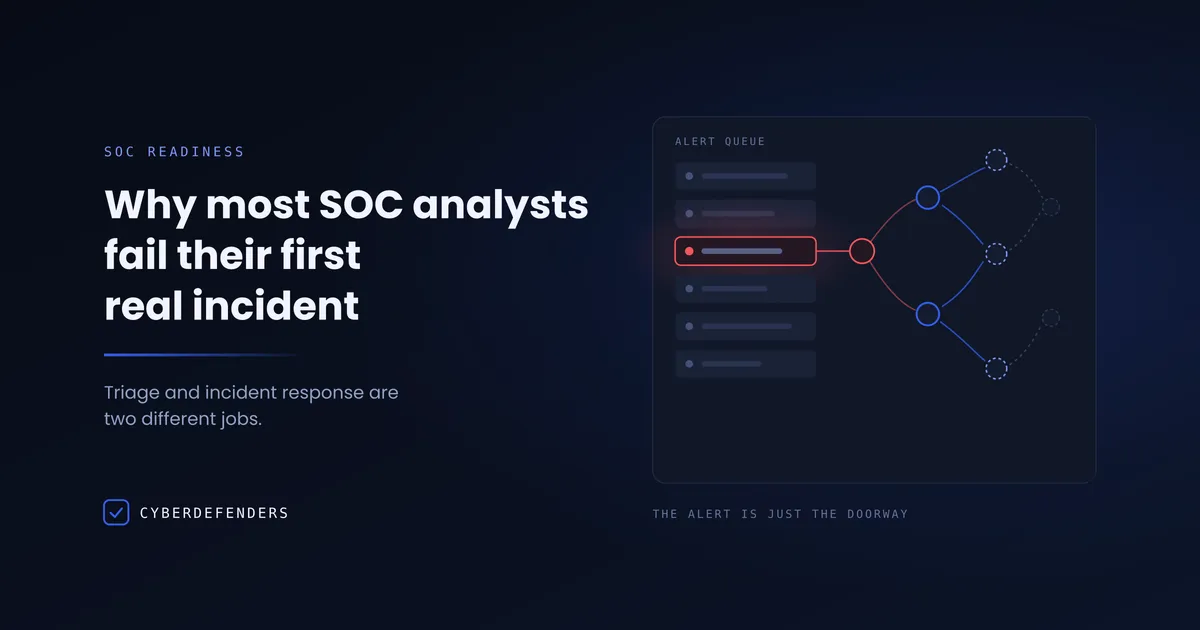
The unit of work expands. In triage, the alert is the job. In an incident, the alert is just the doorway. The real job is the whole incident, which almost always reaches beyond the detection that fired. Analysts who stay anchored to explaining the original alert scope the incident too narrowly and find the rest of the intrusion late.
The time horizon stretches. Triage runs in minutes. Incidents run over hours or days, with evidence arriving out of order and early assumptions breaking halfway through. The work has to be thought of in phases, not checkpoints.
Ownership moves. In triage, success is escalating cleanly to someone else. In response, the analyst sits much closer to the outcome and has to drive toward containment even when the picture is incomplete.
Certainty stops being the goal. The aim is no longer to be sure. It is proportionate action with incomplete information. Waiting for certainty during a live incident is itself a decision, and usually the wrong one.
These are judgment skills. Judgment is exactly what routine alert work never asks your people to build.
Why do most analysts fail their first incident?
Most first-incident failures fall into a handful of repeatable patterns. If you recognize these on your team, the people are not broken. They are undertrained for open-ended work.
- They investigate the alert instead of the incident. The work looks busy and technical, but it stays anchored to the trigger. Related activity gets found late or not at all.
- They chase certainty instead of acting. Time spent proving the full story is time the adversary spends moving. Early on, proportionate action matters more than a complete narrative.
- They defend their first theory instead of testing it. The initial hypothesis becomes something to protect rather than disprove, and contradicting evidence gets explained away.
- The playbook breaks and they stall. Playbooks assume clean logs and predictable escalation points. Real attackers break those assumptions, and a procedure-only analyst has nowhere to go when the script runs out.
- They cannot pivot off the dashboard. Plenty of analysts are fluent in the SIEM but hesitant on a live host. When telemetry goes dark, they treat it as a dead end instead of a reason to inspect the endpoint directly.
- Communication fragments. Findings scatter across chats, tickets, and notes, and nobody holds the single shared picture of the incident. Situational awareness dies in the gaps.
- Nobody prepared them for the cognitive load. Stress, ambiguity, and time pressure degrade recall and decision-making. If every practice run was calm and well-lit, the first noisy, adversarial one hits like a different job.
The 2026 SANS SOC Survey found the same weakness from the leadership side. Twenty-four percent of cyber leaders named lack of enterprise-wide visibility as their single biggest barrier to effective security operations, ranking it above staffing shortfalls and automation gaps. Analysts who have only ever worked from a complete dashboard are being asked to operate in environments where the picture is structurally incomplete.
What is the training system getting wrong?
Zoom out and the individual failures start to look like a program problem that leadership owns.
Hiring now assumes practical readiness on day one. Cyberbit's Same Job, New Skills 2026 report found that 83% of cybersecurity roles explicitly require hands-on experience regardless of seniority, and 75% of junior roles demand it too. The report calls this the Junior Paradox: early-career professionals are expected to demonstrate real, tool-based experience before they have access to environments where that experience can be built. Entry level, in many cases, no longer means entry. The burden of building real readiness has shifted onto your team, not the hiring pipeline.
Yet a lot of preparation still stops at theory. As long as training rewards recall and heavily coached lab exercises, it builds confidence that does not survive contact with a real adversary. Guided scenarios with hints and guaranteed-clean data teach analysts that a tidy path always exists. Real incidents offer no such promise.
The stakes attach directly to business risk. In IBM's 2026 Cost of a Data Breach Report, the global average cost of a breach rose 12% to a record $4.99 million, drawn from breaches at 602 organizations between March 2025 and February 2026. IBM's own explanation for the increase is the lag between discovering a problem and closing it, which is precisely the interval a hesitant first responder stretches. The skills side is just as direct. In ISC2's 2025 Cybersecurity Workforce Study of 16,029 practitioners, 88% said their organization experienced at least one significant cybersecurity consequence in the past year because of a skills shortage, and 69% experienced more than one. ISC2's own conclusion was that resilience now depends less on headcount than on agility, capability, and continual skill development. Under-skilled teams also hand junior analysts real incidents sooner, with less backup, than anyone would design on purpose. The full breakdown of what that gap costs is in our guide on the hidden cost of an under-skilled security team.
The pattern is clear. Organizations expect incident readiness immediately, train people on theory and over-coached labs, then act surprised when the first real incident exposes the difference.
Before you buy more training, find out what you actually have. A 20-minute readiness review maps your team's current investigation and response coverage against Tier 1 and Tier 2 expectations, so you know which gaps are real. Book a readiness review
What does effective incident response training look like?
Effective incident response training puts analysts in realistic conditions repeatedly, before an attacker does it for them. Three things separate it from the checkbox version.
It uses real attack data. Scenarios should be built from real incidents and current attacker tactics, techniques, and procedures, mapped to frameworks like MITRE ATT&CK, so analysts practice against behavior they will actually face. Synthetic scenarios teach pattern-matching. Real intrusion data teaches investigation.
It validates capability, not attendance. A meaningful credential should make an analyst prove they can investigate under time pressure rather than recall the right answer from a slide. Ask any vendor a simple question: what does a candidate have to do to pass, and how long do they have to do it?
It is a cycle, not an event. The teams that hold up under real incidents practice individually, then practice together, review performance, close the gaps, and repeat. Readiness decays. A one-time bootcamp does not survive the next quarter of turnover and new attacker techniques.
This is the premise the CyberDefenders Cyber Range is built on: browser-based, scenario-driven labs built from real attack data across DFIR, threat hunting, and SOC investigation, with no lab setup to slow the team down. On the validation side, Certified CyberDefender Level 1 covers Tier 1 detection, investigation, and response skills, and Certified CyberDefender Level 2 is assessed through a hands-on practical exam built around complex real-world scenarios.
How do you build incident response readiness in your SOC?
If you own the SOC, the budget, or the training program, here is a practical sequence.
- Baseline the team. Establish where each analyst actually stands on detection, investigation, and response, not where their resume says they stand.
- Practice on real scenarios. Move reps out of slide decks and into hands-on labs built on real attack data, including the messy, degraded cases where telemetry is incomplete.
- Run under pressure, as a team. Put analysts in unscripted scenarios that force coordination and communication, because that is where real incidents fail.
- Measure performance and benchmark it. Track investigation quality and response speed, and compare against an external standard so improvement is visible and defensible to leadership. This is where a team training and readiness platform earns its keep, giving managers per-analyst benchmarks they can report upward.
- Validate with a real credential. Use a practical, hands-on assessment to confirm Tier 1 readiness, then a harder one to prove advanced capability under exam-grade pressure.
- Repeat on a cadence. Treat readiness as an ongoing program, not a launch.
Do this and the first real incident stops being the first time your team has ever operated under real conditions.
Key takeaways
- When an analyst fails their first incident, it is usually a training-design gap the team owns, not a talent gap in the hire.
- Triage and incident response are different jobs. The unit of work, time horizon, ownership, and tolerance for uncertainty all change at once.
- The common failure patterns are narrow scoping, chasing certainty, defending a first theory, stalling when playbooks break, freezing under cognitive load, and being unable to pivot off the dashboard.
- Theory-first and over-coached training builds confidence that does not survive a real adversary, and the readiness burden has shifted from the hiring pipeline onto your team.
- The fix is a designed program: realistic, full-lifecycle, un-hinted practice, benchmarked on real cases and measured against an external standard.
Put your team in real conditions before an attacker does
Your analysts will face a real incident. The only question is whether they meet it having already worked dozens of realistic ones, or having only ever passed quizzes.
Get your whole team reps on real attack data. Run your SOC through scenario-driven labs built from real intrusions, benchmark every analyst individually, and report readiness upward with numbers instead of attendance records. talk to us about your SOC
Training yourself rather than a team? Start with the CyberDefenders Cyber Range.
FAQ
Why do strong analysts freeze on their first real incident?
Because the work shifts from answering a bounded question to managing an open, uncertain situation, and most training never rehearses that shift. Freezing is a signal the analyst was trained for triage, not response.
How is incident response different from alert triage?
Triage decides whether a single alert is malicious. Incident response scopes and drives the whole event to a resolution, over a longer time horizon, with more ownership and far less certainty.
How do I know if my SOC team is ready for a real incident?
Benchmark them on realistic, hands-on scenarios rather than certificates or quiz scores. Practical assessment under live conditions is the only reliable signal, because a real incident tests judgment, not recall.
What is the best way to prepare a team for incident response without a real incident?
Run scenario-based labs built from real intrusions, take each one end to end through containment and write-up, rotate analysts through the full lifecycle, and time-box some of it so they practice deciding under pressure.
Do certifications make a team incident-ready?
It depends on the certification. Recall-based exams prove knowledge, not readiness. Certifications built on hands-on, practical assessment map far more closely to what a real incident demands.
How long does it take to build incident response readiness in a SOC?
Plan in quarters, not weeks. A useful baseline plus a first cycle of hands-on reps is achievable inside a quarter, but readiness decays with turnover and new attacker techniques, so the program has to run on a cadence rather than finish.
Sources
- IBM Cost of a Data Breach Report 2026 (global average breach cost $4.99 million, up 12%; 602 organizations, March 2025 to February 2026). Full report: ibm.com/reports/data-breach
- ISC2 2025 Cybersecurity Workforce Study (88% experienced at least one significant cybersecurity consequence due to a skills shortage, 69% more than one; resilience depends on capability over headcount). Study hub: 2025 ISC2 Cybersecurity Workforce Study
- Cyberbit, Same Job, New Skills 2026 report (83% of roles and 75% of junior roles require hands-on experience; the Junior Paradox)
- SANS 2026 SOC Survey, 10th annual (24% of cyber leaders cite lack of enterprise-wide visibility as the biggest barrier to SOC effectiveness). Announcement with the figure: GlobeNewswire, June 11, 2026