The Hidden Cost of an Under-Skilled Security Team
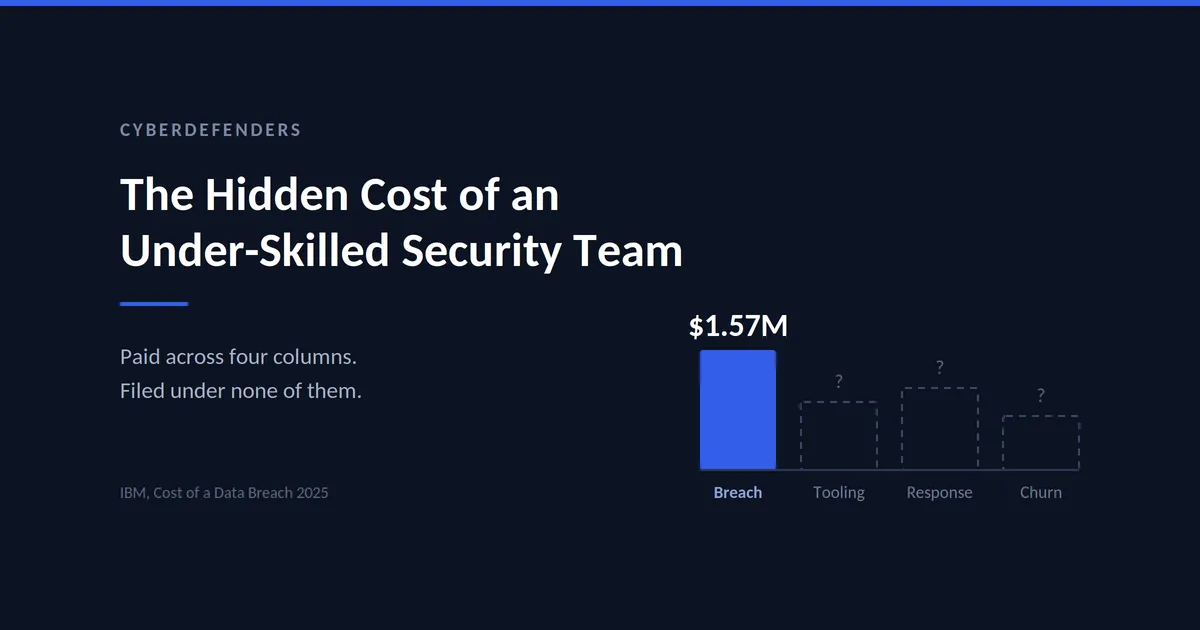
That gap has a measurable price. In its 2025 report, IBM found that organizations with a high-level security skills shortage paid an average of USD 1.57 million more per breach than those with little or none. Its 2026 edition raised the stakes around that number: the global average breach cost hit a record USD 4.99 million, up 12% in a single year, and the time to identify and contain a breach got worse for the first time in five years. And that surcharge is only the part that gets counted. The rest is paid in places most organizations never trace back to skills: a platform running at a fraction of what you licensed, an investigation that drags for weeks, and a resignation letter from the one analyst who understood the environment.
If you are a CISO, a SOC manager, or the person who owns the training line item, this is the number you are being asked about without being given it. Here is where the cybersecurity skills gap cost actually lands, what the newest data says, and why it stays invisible.
What the data says
| Figure | What it measures | Source (edition) |
|---|---|---|
| USD 1.57M | Added breach cost for a high-level security skills shortage | IBM, Cost of a Data Breach 2025 |
| USD 5.22M vs 3.65M | Average breach cost, high shortage vs little or none | IBM, Cost of a Data Breach 2025 |
| USD 4.99M | Global average breach cost, up 12% year over year, a record high | IBM, Cost of a Data Breach 2026 |
| 247 days | Mean time to identify and contain a breach, up after five years of improvement | IBM, Cost of a Data Breach 2026 |
| 56% | IT leaders naming insufficient skills a top cause of breaches, third year running | Fortinet, 2026 Global Cybersecurity Skills Gap Report |
| 86% | Organizations breached at least once in the prior 12 months | Fortinet, 2026 Global Cybersecurity Skills Gap Report |
| 88% | Organizations reporting a significant cybersecurity consequence from a skills deficiency | ISC2, 2025 Cybersecurity Workforce Study |
| 62% | SOC professionals saying their org is not doing enough to retain talent | SANS, 2025 SOC Survey |
What does a cybersecurity skills gap actually cost?
The real cost of a cybersecurity skills gap is the sum of four things that rarely get attributed to skills:
- Higher breach costs. An under-skilled team makes each breach more expensive, not just more likely.
- Wasted security tooling. Platforms you licensed run in their most basic mode.
- Slower incident response. Longer dwell time means wider blast radius.
- Higher staff attrition. Shaky fundamentals burn people out and they leave.
Each is measurable. Each compounds. And because each gets blamed on something else (bad luck, the wrong product, not enough headcount), the underlying capability gap never gets fixed and keeps generating the same costs year after year.
The industry has started naming the problem directly. In its 2025 Cybersecurity Workforce Study, ISC2 declined for the first time in the study's history to publish a global workforce-gap estimate. The reason was that respondents told them critical skills now outweigh headcount as the binding constraint. An organization that has counted the shortage of people for years just stopped counting it, because counting people had stopped describing the problem.
Higher breach costs: the breach you pay more for
The clearest dollar figure comes from IBM. In its Cost of a Data Breach Report 2025, organizations with a high-level security skills shortage averaged USD 5.22 million per breach. Those with little or no shortage averaged USD 3.65 million. The difference is USD 1.57 million.
That USD 1.57 million is not the cost of the breach. It is the surcharge for being under-skilled when it happened. And the base it sits on top of just moved: IBM's 2026 report put the global average breach cost at USD 4.99 million, a record high and a 12% jump in twelve months, driven largely by detection, escalation, and lost business.
Practitioners see the same link from the ground. Fortinet's 2026 Global Cybersecurity Skills Gap Report, based on 2,750 decision-makers across 32 countries, found that 86% of organizations had experienced at least one breach in the prior 12 months, and that for the third year running IT leaders named insufficient cybersecurity skills and training as a top cause, cited by 56%. More than half (52%) said breaches cost them over USD 1 million, up from 38% in 2021.
So the first hidden cost is the least hidden once you look at it directly: an under-skilled team does not just make a breach more likely, it makes each breach more expensive.
Wasted tooling: the platforms you bought but cannot fully run
Security budgets skew heavily toward products, on the assumption that capability comes in the box. It does not. A SIEM, EDR, or cloud-security platform is only as good as the analyst driving it, and an under-skilled team quietly runs sophisticated tooling in its most basic mode: advanced detections untuned, threat-hunting features untouched, automation never configured.
We are not going to put a number on this one, because nobody publishes a credible dollar figure for it. The percentages that circulate for shelfware and unused security tooling come from vendor and analyst surveys with incompatible methods and definitions, and none of them isolate skills as the cause. What we do have is practitioners naming the effect directly. In ISC2's 2025 study, 24% of respondents said a skills shortage left their teams unable to take advantage of emerging cybersecurity technologies, and another 24% pointed to misconfigured systems. Those are not analyst estimates of waste. They are security professionals reporting that the capability to use what they already have is missing.
The SANS 2025 SOC Survey shows the same pattern operating, though it does not attribute the cause to skills: 42% of SOCs send all incoming data to a SIEM with no defined plan for retrieving or analyzing it. That data is licensed, ingested, stored, and paid for. Nobody has decided what to do with it.
Then the loop closes. You spend more on tools to compensate for a team that cannot fully operate the tools you already have, which widens the gap between spend and outcome, which reads on the next budget cycle as a tooling problem. The fix for an under-skilled team is almost never another platform. It is reps in a cyber range on the same tools your SOC already runs.
Slower response: the investigation that takes too long
Speed is where skills convert directly into exposure. IBM found the average breach took 247 days to identify and contain in 2026, an increase that reversed five straight years of gradual improvement. That is more than eight months in which an attacker is inside. IBM also found that breaches running past 200 days averaged USD 5.65 million against USD 4.32 million for those resolved faster, a USD 1.33 million premium for being slow. Time is priced, and the industry just started moving in the wrong direction.
IBM's 2026 report does not publish a lifecycle figure specific to skills-short teams, so treat the connection as a mechanism rather than a measurement. But the mechanism is easy to trace: slow response is a downstream symptom of a capability gap. Analysts hesitate on ambiguous evidence, escalate late, scope narrowly, and stall when a playbook stops matching reality.
The SANS 2025 SOC Survey shows how reactive most operations still are. 85% of respondents said endpoint alerts, not proactive detection, are the primary trigger for their incident response, and the report notes that much of what gets labeled threat hunting is retroactive analysis rather than hypothesis-driven investigation. Both are capability problems as much as tooling problems, and both stretch response times.
One 2026 finding points straight at where that capability should live. IBM found that internal IT and security teams identified and contained breaches roughly 15% faster than external providers did. The team that knows your environment moves faster than the team that has to learn it mid-incident, which is an argument for building capability in-house rather than renting it, provided the in-house team is actually trained to use it.
The cost here is rarely invoiced, but it is real: longer dwell time, wider blast radius, more systems touched, and more of the breach surcharge above. A team that responds well is cheaper than a team that responds slowly, even at the same headcount.
Attrition: the people you keep losing
An under-skilled team is also a team that burns out faster, because when the fundamentals are shaky, every incident is harder than it needs to be. Constant firefighting, alert overload, and the stress of feeling out of your depth push people toward the door. The SANS 2025 SOC Survey found that 62% of SOC professionals believe their organization is not doing enough to retain top talent, and that the most common tenure for SOC staff is just three to five years. That is trained, hard-to-replace capability walking out on a cycle.
Replacing a specialized analyst is not just a recruiter fee. It is the recruiting spend, the ramp time before the new hire is productive, the institutional knowledge that walked out, and the added load on whoever stays.
ISC2's 2025 study underlines how hard that hole is to fill: 29% of organizations said they cannot afford staff with the skills they need, and 33% lack the resources to staff their teams adequately. Under-investment in skills and high attrition are the same problem wearing two faces. People leave teams where they cannot grow and cannot cope, and thin teams hand junior analysts work they were never trained for, which drives the next resignation.
Why the cost stays hidden
If the price is this large, why does it stay off the radar? Because it is distributed and misattributed. The breach surcharge gets folded into "the cost of the breach." The unused tooling gets blamed on the vendor. The slow response gets chalked up to a hard case. The attrition gets filed under a tight labor market. Each cost lands in a different column, owned by a different narrative, and none of them points back at capability.
That fragmentation is what lets an organization spend heavily on security and still carry an under-skilled team for years without ever naming the problem. The costs are not missing. They are scattered.
ISC2's 2025 study puts a number on how often they surface anyway: 88% of organizations reported at least one significant cybersecurity consequence caused by a skills deficiency in the team or the wider organization, and 69% reported more than one. Those consequences were not all breaches. They included misconfigured systems, oversights in security processes, and underqualified people assigned to critical roles, which is exactly the kind of damage that never gets filed under skills.
Close the gap on purpose
The way out is to stop treating skills as an assumption and start treating them as something you measure and build deliberately. This is where the CISO, the SOC manager, and the L&D lead have to agree on one thing: capability is a program, not a line item.
Measure capability, not attendance. Course completions and certificates on a wall do not tell you whether the team can run a live investigation. Benchmark real skills against realistic scenarios so the gap becomes visible before a breach makes it visible.
Close gaps with hands-on, real-incident practice. Skills that hold up under pressure are built by doing, on cases that look like the ones you will actually face, not by watching lectures. This is the difference between a team that has learned about response and one that has done it.
Make upskilling continuous. Threats change quarterly. A one-time onboarding course ages out fast. Ongoing reps keep the team current and keep the costs above from creeping back.
Map it to a framework the board understands. Tying capability development to the NICE Workforce Framework, NIST, and DoD 8140 turns "we trained the team" into a defensible, auditable readiness story, which is what turns training from a cost line into a risk-reduction investment.
Key takeaways
- The cost of a cybersecurity skills gap is real but hidden, because it is paid across breach costs, wasted tooling, slow response, and attrition rather than as a single line item.
- IBM's 2025 report found a high-level security skills shortage added USD 1.57 million to the average breach. Its 2026 report shows the base cost rising to a record USD 4.99 million while containment times lengthened to 247 days, the first deterioration in five years. Fortinet's 2026 report found 56% of organizations name a skills gap as a top breach cause, for the third year running.
- ISC2's 2025 study stopped publishing a workforce-gap number entirely, because skills now outrank headcount as the binding constraint. 88% of organizations traced at least one significant cybersecurity consequence to a skills deficiency.
- Under-skilled teams cannot fully operate the tools you already bought, so more product spend rarely closes the gap.
- The fix is to measure capability, close gaps with hands-on real-incident practice, keep it continuous, and map it to a framework leadership can act on.
Turn a hidden cost into a measured investment
The costs of an under-skilled security team are already on your books. They are just filed under breach response, tool renewals, recruiting, and attrition instead of under the skills gap that caused them. Naming them is the first step to controlling them.
See how CyberDefenders benchmarks and certifies SOC readiness at scale and get a readiness baseline for your team.
Building individual capability first? Give your analysts reps on real attack data in the cyber range, set a Tier 1 standard with CCDL1, and validate senior analysts under pressure with CCDL2.
Readiness is built, not bought. The team you develop now is cheaper than the breach, the churn, and the wasted spend you pay for later.
FAQ
How much does a cybersecurity skills gap cost?
Start with the two costs that are already quantified. IBM's 2025 report measured a USD 1.57 million surcharge on breaches at organizations with a high-level security skills shortage, and your own recruiting and ramp costs give you a per-analyst replacement figure. Then factor in speed: IBM's 2026 report found breaches running past 200 days cost USD 5.65 million against USD 4.32 million for faster containment. Add the tooling you are paying for and not fully operating. The total is almost always larger than the training budget being debated.
How does a cybersecurity skills gap increase breach costs?
Under-skilled teams respond more slowly and scope incidents more narrowly, which increases dwell time and blast radius. IBM's data ties both slower containment and staffing shortages to higher breach costs independently, and its 2026 report found internal teams contain breaches about 15% faster than external providers. ISC2 found 88% of organizations traced a significant cybersecurity consequence to a skills deficiency.
How do you measure a cybersecurity skills gap in a security team?
Benchmark the team against realistic, hands-on scenarios rather than counting course completions or certificates. Practical assessment shows what people can actually do under live conditions, which is what a real incident tests.
Is it cheaper to buy security tools or train the security team?
Neither substitutes for the other, but tools deliver capability only when someone can fully operate them, and under-skilled teams routinely run advanced platforms in basic mode. In ISC2's 2025 study, 24% of respondents said a skills shortage left their teams unable to take advantage of emerging security technologies. Adding products on top of a skills gap tends to widen the gap between spend and outcome.
How do you close a cybersecurity skills gap?
Identify the specific capability gaps that matter most for your environment, then close them with continuous, hands-on practice on real-incident scenarios, measured against a workforce framework so leadership can see the risk reduction.
Sources
- IBM, Cost of a Data Breach Report 2026: USD 4.99M global average, up 12% and a record high; 247-day lifecycle, up after five years of improvement; USD 5.65M for breaches running past 200 days vs USD 4.32M for faster containment; internal teams contain breaches about 15% faster than external providers. Based on 602 organizations across 17 industries and 16 countries, breached between March 2025 and February 2026.
- IBM, Cost of a Data Breach Report 2025: skills shortage adds USD 1.57M; USD 5.22M with a high shortage vs USD 3.65M without. Cited for the skills-shortage measurement specifically.
- Fortinet, 2026 Global Cybersecurity Skills Gap Report: 2,750 respondents across 32 countries; 86% breached; 56% cite skills as a top cause for the third year running; 52% say breaches cost over USD 1M, up from 38% in 2021.
- ISC2, 2025 Cybersecurity Workforce Study: 16,029 respondents; no workforce-gap estimate published, for the first time in the study's history; 95% report at least one skill need; 59% report critical or significant skills needs, up from 44% in 2024; 88% report a significant cybersecurity consequence from a skills deficiency, 69% more than one; 33% lack resources to staff adequately, 29% cannot afford skilled hires.
- SANS, 2025 SOC Survey: 62% say their org is not doing enough to retain talent; typical SOC tenure of three to five years; 85% trigger incident response from endpoint alerts; 42% dump all incoming data into a SIEM with no retrieval plan.