Cyber Range vs. Cyber Lab: What's the Difference?
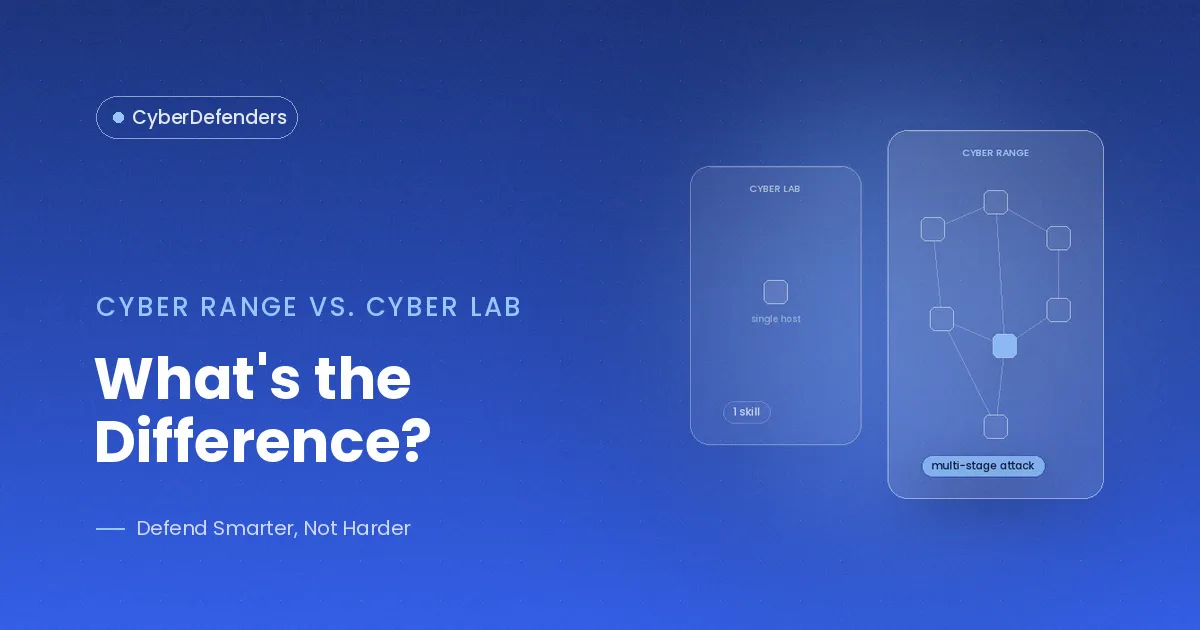
A cyber lab is an isolated environment for practicing a specific tool or technique, with no adversary and no unfolding incident. A cyber range is a full simulated environment where an attack has happened or is happening, and the analyst investigates it against evidence and is scored on the result. The cyber range vs cyber lab distinction is the difference between having the tools and having the incident.
An engineer on the team offers to build a lab. Three virtual machines, a domain controller, Splunk on a fourth, Sysmon everywhere. It takes two weekends and it is good work: new analysts learn where the logs live, how to write a search, what a normal process tree looks like. Six months later the lab is still there and nobody has touched it in weeks. Not because it broke. Because there is nothing in it to investigate. Everyone who needed to learn the tools has learned them, and the lab has no attacker, no evidence, and no question to answer.
That is the whole distinction, and it is why the two are not competitors. A lab teaches you to use the instruments. A range gives you a patient. What follows: a definition of each, the nine dimensions that decide a build-or-buy, when each one is the right choice, and how teams run both in a loop. It does not compare either to capture-the-flag formats; that comparison is in CTF vs. cyber range.
What is a cyber lab? (including the home lab)
A cyber lab is a sandboxed environment where a learner practices a tool, a technique, or a configuration without risk to production. It can be a home lab on a laptop, a set of cloud VMs a team shares, the "virtual lab" bundled with a course, or a vendor's product environment for learning their console.
Three features define it. The learner controls the environment: they build it, break it, and reset it. The scope is narrow by design: one tool, one technique, one thing to learn at a time. And there is no adversary: nothing in the lab is trying to hide, and nothing happened in it that the learner has to reconstruct. The value of a lab is repetition on the instrument. Learn Wireshark filters, learn the Splunk query language, learn how Kerberos authentication appears in event logs, learn what Volatility's plugins return on a clean image. Two of those are worth doing properly before anything else, and we cover them in mastering Windows event log analysis and why memory forensics matters. All of it is necessary, and none of it is investigation.
The term also gets used for physical research facilities and for university teaching spaces. Those are out of scope here; this comparison is about practice environments.
What is a cyber range?
A cyber range is a provisioned environment modeled on a real estate, in which an attack has already been carried out or is underway, and the analyst's job is to work out what happened using production tooling. The learner builds nothing. They arrive to hosts, identity, telemetry, and an incident somebody else staged, and the session ends with their findings measured against what actually occurred. The definition, types, and components are covered in what a cyber range is; this article stays on the comparison.
Cyber range vs cyber lab: the differences at a glance
The two environments differ on nine dimensions, and the first four (environment, realism, infrastructure, attack simulation) are the ones that determine the other five.
| Cyber lab | Cyber range | |
|---|---|---|
| Purpose | Learn a tool or technique | Investigate an incident and be measured |
| Environment | Learner-built, small, static | Provisioned, realistic estate, stateful |
| Adversary | None | Attack already executed or live |
| Evidence | Clean, or whatever the learner generates | Real or high-fidelity artifacts with noise and gaps |
| Scope of an exercise | One skill | A scenario spanning hosts, evidence types, and stages |
| Who uses it | One learner at a time | Solo analysts or a team on one investigation |
| Assessment | Self-checked, or none | Scored against ground truth, tracked over time |
| Scaling | Rebuild per learner | Provisioned on demand for many |
| Cost shape | Low to start, high in maintenance time | Subscription; scenario upkeep is the vendor's problem |
Environment
A lab environment is whatever the learner assembles: a few VMs, a SIEM, an agent or two. It is small because building it is the work, and it is static because nothing changes in it unless the learner changes it. A range environment is provisioned for the analyst and reflects a real estate: multiple hosts, identity infrastructure, network segments, cloud accounts, and the telemetry all of that generates. The analyst does not build it and should not have to. They arrive to a running environment where something has already gone wrong.
Realism
Realism in a lab is limited by what the learner can generate. You can run Mimikatz against your own domain controller and see what the logs look like, and that is useful, but you generated the attack, you know what you did, and the logs contain nothing else. Realism in a range means evidence from real or high-fidelity intrusions, surrounded by the noise of normal operations: a patching tool that touches every host nightly, a monitoring account that authenticates constantly, three leads that look identical and one that matters. An analyst whose only reference is their own lab has never had to decide which of five plausible explanations to test first, and that decision is most of the job.
Infrastructure
A lab's infrastructure is the learner's problem. Hypervisor or cloud account, images, networking, licenses, snapshots, and the hours to keep it working. That is a fine trade for an individual learning the tools and a poor one for a team that needs to train forty analysts. A range's infrastructure is the platform's problem: environments spin up on demand in the browser, identical for every analyst, and disappear when the session ends. For what to ask about provisioning, isolation, and delivery model, see what to look for in an enterprise cyber range platform.
Attack simulation
This is the dimension that separates the two most cleanly. A lab has no attack in it unless the learner performs one, and a learner attacking their own lab knows exactly what they did. A range contains an attack the analyst did not perform and does not know the shape of: pre-captured evidence from a real intrusion, or live attacker emulation running while the analyst works. The investigation is only real when the attacker's actions are unknown to the investigator. That is the property a lab cannot provide to the person who built it.
Individual vs. team use
Labs are single-learner environments almost by definition: one person, one machine, one skill. A team can share a lab, but they share the infrastructure, not an exercise. Ranges support both individual work and team exercises in which several analysts share one investigation, hand off a case, and coordinate an escalation. The coordination skills that fail first in real incidents can only be trained where several people work one incident, and that is a range property.
Scenario complexity
A lab exercise is a single skill practiced in isolation: parse this log type, run this plugin, write this query. A range scenario spans stages and evidence types: the phishing email leads to the endpoint, the endpoint to the credentials, the credentials to the domain controller, the domain controller to the exfiltration channel. The analyst has to pivot, prioritize, and decide when the timeline is complete. Complexity here is not difficulty for its own sake. It is the shape of a real incident, and it is what teaches judgment rather than procedure.
Assessment
Labs generally have no assessment beyond the learner's own sense of whether the thing worked. Some course labs include check questions, which measure whether the step was followed. Ranges score the investigation against the scenario's ground truth: which findings were reached, which were missed, whether the scope was called correctly, how long each step took. Over many scenarios that becomes a per-analyst capability profile, which is what a lead needs and a lab cannot produce. It is a different question from the operational numbers a SOC already tracks, which we covered in SOC metrics: analyzing and upgrading SOC analyst performance.
Scalability
A lab scales by rebuilding. Every new learner needs their own copy, or shares one and waits. A team of five can live with that; a team of fifty cannot, and a distributed team across regions cannot at all. A range scales by provisioning: many analysts working the same scenario concurrently, from anywhere, with no local setup, and a manager who can see all of them. If the question is "how do we train the team" rather than "how do I learn this tool," scalability decides it.
Cost and operational considerations
Labs are cheap to start and expensive to sustain. The tools are mostly free and a laptop or a small cloud bill covers the infrastructure. The real cost is time: building the environment, keeping it working, and, if you want anything to investigate, creating scenarios, which means someone on the team playing attacker, capturing evidence, writing the ground truth, and doing it again when the technique goes stale. That is a full-time job dressed up as a side project.
The most-used community project in this space makes the point. DetectionLab automated exactly this build, was widely adopted, and its README now opens with a notice: "As of 2023-01-01, DetectionLab is no longer being actively maintained." Maintaining a realistic lab is not a weekend problem that ends, and that is true whether the maintainer is a well-known open-source author or the engineer on your team who volunteered.
Ranges move that cost onto someone else. The subscription buys scenario creation, maintenance, and currency as the vendor's problem rather than yours. Range pricing is rarely published and the models vary, so the comparison that matters is not sticker price against zero, it is subscription cost against the salaried hours a home-built equivalent would consume. For evaluating pricing models against your requirements, see how to choose a cyber range.
When to choose a cyber lab
Choose a lab when the goal is to learn an instrument, and the learner is an individual.
- Learning a tool from zero: Wireshark, Splunk or Elastic, Volatility, KAPE, a cloud provider's console and logging. The first hours with any of these are better spent in a lab where nothing is at stake and the learner controls the pace.
- Understanding what normal looks like. A lab is where an analyst learns what a healthy process tree, a routine authentication sequence, or a baseline of DNS traffic looks like, which is the reference they need before an anomaly means anything.
- Testing a specific configuration or detection: does this Sigma rule fire on this event, does this GPO produce this log.
- Personal study and certification prep at the tool level, where the cost has to be near zero.
- Any situation where the learner needs to break and rebuild the environment freely.
We looked at why doing beats watching in hands-on labs vs. video courses; a lab is the cheapest way to make the doing happen for tool skills.
When to choose a cyber range
Choose a range when the goal is to investigate, and especially when the learner is a team.
- Building investigation skill once the tools are familiar. Knowing Wireshark is not the same as finding lateral movement in a capture you did not generate.
- Training a team, or more than a handful of individuals, where provisioning and per-analyst visibility matter more than control of the environment.
- Rehearsing incidents: ransomware, credential theft, cloud compromise, with realistic evidence and a scope the analyst has to call.
- Producing evidence of capability: onboarding checks, promotion readiness, a readiness picture a security leader can report.
- Practicing coordination, which requires several analysts on one incident.
For how a session runs and how analysts progress through scenarios, see how cyber range training works.
Using a cyber lab and a cyber range together
The strongest programs use both in a loop: the lab to learn the instrument, the range to use it on a real problem, and the range debrief to reveal which instrument needs more lab time.
A new analyst spends their first weeks in a lab learning the SIEM and the forensic toolset. They move to range scenarios as soon as they can follow a process tree and write a query. The first scenarios show exactly where the tool skills are thin: slow in memory analysis, uncertain in cloud logs. That sends them back to the lab for targeted practice on the specific gap, not the whole curriculum, and then forward to the next scenario. Taught, applied, corrected, applied again. The lab makes the range productive; the range makes the lab purposeful.
See the difference in one exercise
The distinction stops being abstract about ten minutes into a range exercise, at the point where you know the tool perfectly well and still do not know what the attacker did. That is the gap your lab was never going to close, because you were always the one who staged the activity.
Pick something short in a tool you already know: an easy web server compromise worked in Wireshark makes the point as well as anything longer. Filter the catalog to Community and you have a set that is free to work, all of it in the browser, and the tracks put them in levels if you would rather follow a path than take one test.
FAQ
Is a home lab a cyber range?
No. A home lab is an environment you build and control to learn tools and configurations. It becomes range-like only if someone else stages an attack in it that you then investigate without knowing what they did, which most home labs never have. The two are complementary: the home lab is where tool skills are cheapest to build.
Can a team turn its existing lab into a cyber range?
Partly, and at a cost that is usually underestimated. You would need someone to play attacker, capture realistic evidence, write the ground truth, build scoring, and repeat it as techniques change. For one or two scenarios it is a good learning project; as an ongoing program it is a full-time role. Most teams keep the lab for tool practice and use a range for scenarios.
Is a "virtual lab" in an online course the same as a cyber lab?
Yes, in the sense used here: it is an isolated environment for practicing what the lesson just taught, usually with steps to follow and check questions. It is not a range, because there is no unknown attack to investigate and no assessment beyond whether the steps were completed.
Do analysts need a cyber lab before using a cyber range?
They need the fundamentals a lab teaches: basic networking, how Windows and Linux log activity, comfort with a command line, and a first pass at the core tools. Whether they get that from a lab, a course, or the job matters less than having it. Entry-level range scenarios then teach tool use in context, and the debrief shows which tools still need dedicated practice.