Best Cyber Range Platforms
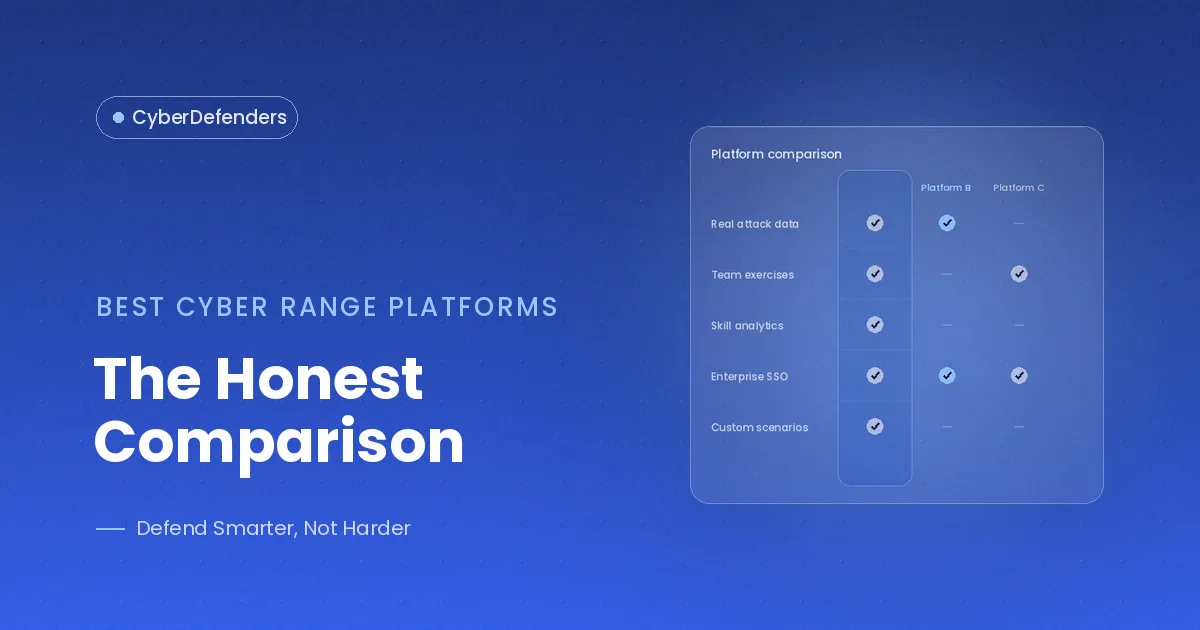
The best cyber range platform depends on who is training and what they need to be able to do afterward. For SOC analysts and DFIR practitioners who need realistic investigations, CyberDefenders is the strongest fit. Complete beginners are better served by TryHackMe. Enterprise SOCs that want live-fire team exercises should look at Cyberbit or Hack The Box's Threat Range. Organizations that need to exercise the whole business, not just the SOC, should look at Immersive; those that need to replicate their own infrastructure, at SimSpace or CybExer.
This comparison covers eight platforms. It does not rank them on a single scale, because they solve different problems, and it does not quote prices, because most of these vendors only sell on quote. It does show the pricing model and deployment approach for each, which is usually enough to know whether a platform belongs on your shortlist.
If you are still working out what separates a cyber range from a lab or a CTF, start with What is a cyber range? and CTF vs. cyber range.
The eight cyber range platforms at a glance
| Platform | Best for | Pricing model | Deployment |
|---|---|---|---|
| CyberDefenders | Hands-on blue-team investigations: SOC, DFIR, threat hunting, malware analysis; CCDL1 and CCDL2 certifications | Free labs; individual plans; enterprise quote generated online | Browser-based, cloud |
| TryHackMe | Beginners and structured progression into SOC roles | Free tier; published individual and business plans | Browser-based, cloud |
| Hack The Box | Broad offensive and defensive training, plus team-based blue-team simulation | Published individual and enterprise plans | Browser and VPN, cloud; dedicated labs for enterprise |
| RangeForce (a Cyberbit company) | Continuous SOC upskilling on commercial security tools, with skills reporting | Enterprise by quote | Browser-based SaaS |
| Cyberbit | Enterprise SOC readiness and live-fire team exercises | Enterprise by quote | Cloud-based range |
| Immersive | Enterprise-wide cyber resilience: labs, range exercises, crisis drills | Enterprise by quote | Cloud SaaS |
| SimSpace | High-fidelity replicas of production environments | Enterprise by quote | Managed cloud, self-hosted, or air-gapped |
| CybExer | Government, defense, and critical infrastructure; digital twins | Enterprise by quote | Cloud, on-premises, or hybrid |
Pricing models and deployment options reflect each vendor's public materials as of September 2026.
How we compared them
Every platform was looked at against the same questions. How realistic is the hands-on work? How much of it is defensive? Can analysts train together? What can a manager measure afterward? Is there enough content for weekly practice rather than a one-off event? And what does it take to deploy and administer?
A platform built for a quarterly live-fire exercise should not be judged as if it were a weekly lab platform, and the reverse is also true. So each section below leads with the job the platform is best at, then names the trade-off. The numbering groups platforms by use case, from individual skills through to enterprise simulation; it is not a ranking. For the full buyer's checklist, see How to evaluate a cyber range vendor.
1. CyberDefenders: best for hands-on blue-team investigations
CyberDefenders is known for the quality of its hands-on labs. Analysts start from evidence such as disk and memory images, packet captures, logs, and malware samples, and have to work out what happened. The lab poses the questions an investigator would need to answer; working out how is the exercise. That is the difference between learning a concept and building the reasoning an analyst uses on shift, and it is why practitioners tend to name CyberDefenders first when asked where to practice blue-team work.
Coverage is defensive end to end: SOC operations, DFIR, threat hunting, threat intelligence, malware analysis, and cloud forensics. Everything runs in the browser, and there are free labs to start with.
Two certifications give the training a finish line: CCDL1 for entry-level SOC analysts and CCDL2, formerly CCD, for intermediate-to-advanced DFIR and threat hunting. Both are assessed hands-on, so a manager knows an analyst can work a case, not just that they finished the labs.
For teams, cybersecurity training for teams and enterprises adds the Team Management Dashboard on top of the same labs, tracking progress, completion, and skill coverage across the team.
Best for: SOC analysts, DFIR practitioners, threat hunters, and teams that want continuous defensive practice with a measurable endpoint.
Trade-off: CyberDefenders is defensive by design. Analysts study attacks from the defender's side, reconstructing what the adversary did from the evidence left behind, rather than learning to run the attack themselves.
2. TryHackMe: best for beginners
TryHackMe is where to start when the people you are training do not yet know what a SOC does. Pre Security assumes no background and covers computers, networks, and the web before touching security; Cyber Security 101 and the SOC Level 1 and 2 paths then move into SIEM, phishing analysis, endpoint and network security, and DFIR fundamentals. SOC Level 1 was rebuilt in late 2025 and Pre Security in early 2026, so the content is current. Everything runs in the browser, the free tier is generous, and the gamification keeps junior learners moving. The business plan adds a management dashboard for assigning paths and tracking progress, skills reporting, and SSO.
Best for: Career changers, interns, and junior analysts with no security background.
Trade-off: Rooms tell learners what to do and check the answer. That is right for fundamentals and wrong for an open-ended case with no walkthrough. Once the basics are in place, analysts outgrow it, and CyberDefenders is the natural next step for anyone heading into a SOCor other blue team role.
3. Hack The Box: best for offensive and defensive training on one platform
Hack The Box has moved a long way from its CTF origins. Academy covers both sides, including defensive modules on Splunk detection, YARA and Sigma, and traffic analysis; Sherlocks are DFIR-style investigations; and Threat Range, launched in September 2025, is a team-based live-fire simulation for SOC and DFIR analysts. The 2025 acquisition of LetsDefend also brought a large SOC-simulator library into the ecosystem.
Best for: Organizations that want offensive and defensive training together, and analysts who benefit from understanding the attacker's side.
Trade-off: Breadth means knowing which product you are buying; Academy, Labs, Sherlocks, Dedicated Labs, Threat Range, and the LetsDefend content are priced and scoped differently.
4. RangeForce: best for SOC upskilling on commercial tools
RangeForce, a Cyberbit company since September 2025, trains analysts on the tools they already use. Modules run against real infrastructure with commercial tooling such as Splunk and Fortinet, team threat exercises test coordination, and reporting maps skills to MITRE ATT&CK and D3FEND, which helps when a manager has to show progression against a framework. Anyone evaluating it should ask how the RangeForce and Cyberbit platforms are being combined.
Best for: SOC managers who need framework-mapped skills reporting and analysts trained on their production stack.
Trade-off: Enterprise-only, no self-serve, and the modules are more guided than open investigations.
5. Cyberbit: best for enterprise SOC readiness
Cyberbit answers a different question: how does the SOC perform together when a serious incident lands? Live-fire exercises run in enterprise-like networks with commercial SIEM, EDR, and firewall tooling, aligned to MITRE ATT&CK, alongside individual labs, a crisis-simulation module, and candidate screening. With RangeForce under the same roof, it can also supply the continuous individual practice the team exercises assume.
Best for: Mature SOCs with a formal readiness program and the budget to run it.
Trade-off: It is a program, not a subscription. Someone has to own scheduling and follow-up, and it is more than a team needs for weekly investigation practice.
6. Immersive: best for organization-wide cyber resilience
Immersive, formerly Immersive Labs, rebranded in 2025 around cyber drills for the whole organization. Immersive One spans technical labs, Cyber Range Exercises (formerly Team Sim), crisis simulations for executives, and workforce exercises for non-technical staff, so a CISO can exercise the board, the SOC, and general staff in one place and report readiness upward.
Best for: Security leaders who need to exercise every layer of the organization, not just the SOC.
Trade-off: If you only need to train analysts, you are paying for scope you will not use. Judge the defensive labs on their own merits rather than on the platform's footprint.
7. SimSpace: best for high-fidelity replicas of production environments
SimSpace is for organizations that need the environment itself to be realistic. Range Workbench designs, versions, and manages production-grade ranges, visually or as YAML, and the wider platform spans IT, cloud, and OT, so a team can test people, processes, and controls together: does the stack produce the expected telemetry, do the playbooks hold, what changes after a fix. It runs as a managed cloud service, self-hosted, or in an air-gapped enclave.
Best for: Large enterprises and government teams validating controls and playbooks as much as skills.
Trade-off: Fidelity costs money and time, and range builds need owners. It is more than most teams need for analyst skill development.
8. CybExer: best for government, defense, and critical infrastructure
CybExer, based in Estonia and NATO-awarded, comes out of the large-scale national exercise world. Its digital-twin environments replicate specific systems across IT, OT, and cloud for bespoke live-fire exercises, and it deploys in the cloud, on-premises, or hybrid, which matters to defense and critical-infrastructure buyers with data-sovereignty requirements.
Best for: Government, defense, critical infrastructure, and any organization whose environment is too unusual for a generic range.
Trade-off: Bespoke means slow. Scoping, procurement, and exercise design take far longer than switching on a SaaS lab platform.
Which cyber range platform should you choose?
Start from the outcome, not the vendor.
| If you need to... | Look at |
|---|---|
| Start from zero | TryHackMe |
| Train SOC Tier 1 analysts | CyberDefenders, TryHackMe |
| Build DFIR and threat-hunting depth | CyberDefenders, Hack The Box (Sherlocks) |
| Certify hands-on blue-team skills | CyberDefenders (CCDL1, CCDL2), Hack The Box (CDSA), TryHackMe (SAL1) |
| Cover offense and defense on one platform | Hack The Box |
| Upskill analysts on your commercial tool stack with skills reporting | RangeForce |
| Run live-fire SOC team exercises | Cyberbit, Hack The Box (Threat Range) |
| Exercise the whole organization, board included | Immersive |
| Replicate your production environment | SimSpace, CybExer |
| Government, defense, or OT environments | CybExer |
Most enterprise programs need two capabilities: continuous individual practice and periodic team exercises. Some vendors now bundle both; many teams still buy them separately. Either way, they are different training problems, and a platform that is excellent at one is rarely excellent at the other. There is more on structuring that in cyber range training and cyber ranges for SOC teams.
Three things to test before you sign
Product tours are designed to look good. Three checks tell you more.
First, put a senior analyst into a scenario and ask whether the evidence would fool them. Telemetry that looks staged is the fastest way to lose analyst buy-in.
Second, ask what a manager sees afterward. Which skills were exercised, where the gaps are, and how that compares to last quarter. Completion percentages on their own tell you almost nothing.
Third, ask how long it takes to onboard ten analysts. If the answer needs a project plan, the program will not run consistently.
The full checklist, including questions specific to live-fire ranges, is in How to evaluate a cyber range vendor.
Where CyberDefenders fits
If the problem you are solving is "our analysts need to get better at investigating incidents," that is what CyberDefenders is built for. Start with the free cybersecurity labs and judge the realism yourself, or see cybersecurity training for teams and enterprises for the Team Management Dashboard, transferable licenses, and a quote you can generate in minutes. If the program needs a defined finish line, CCDL1 and CCDL2 give analysts one to work toward.
FAQ
What is the best cyber range platform?
There is no single best platform. CyberDefenders is the strongest fit for hands-on blue-team investigations, TryHackMe for beginners, Hack The Box for combined offensive and defensive training, RangeForce for continuous SOC upskilling on commercial tools, Cyberbit for enterprise SOC readiness, Immersive for organization-wide resilience exercises, SimSpace for high-fidelity simulation, and CybExer for government and critical infrastructure ranges.
What is the best cyber range platform for beginners?
TryHackMe. Its Pre Security path assumes no background and its SOC paths build toward an analyst role step by step. CyberDefenders is the better starting point for someone who already has IT fundamentals and knows they want a SOC role: CCDL1 takes them from those fundamentals to Tier 1 analyst skills through investigations from day one.
What is the best cyber range platform for a SOC team?
For individual analyst development, CyberDefenders, RangeForce, and Hack The Box. For coordinated team exercises, Cyberbit and Hack The Box's Threat Range. Many SOCs use one platform for weekly individual practice and another for periodic team exercises.
Is CyberDefenders good for cyber range training?
Yes, for defensive skills. CyberDefenders' cloud-based cyber range is built around hands-on, scenario-driven investigations across SOC operations, DFIR, threat hunting, and malware analysis, which makes it well suited to continuous analyst training, and the CCDL1 and CCDL2 certifications give that training a measurable endpoint at Tier 1 and intermediate-to-advanced level. It is not designed for full-network, multi-team live-fire exercises; for those, pair it with an enterprise range.
Should an enterprise use more than one cyber range platform?
Often, yes. Continuous individual training and periodic team exercises are different problems, and the platforms that are best at one are rarely best at the other.