CTF vs. Cyber Range: What Each Format Actually Trains
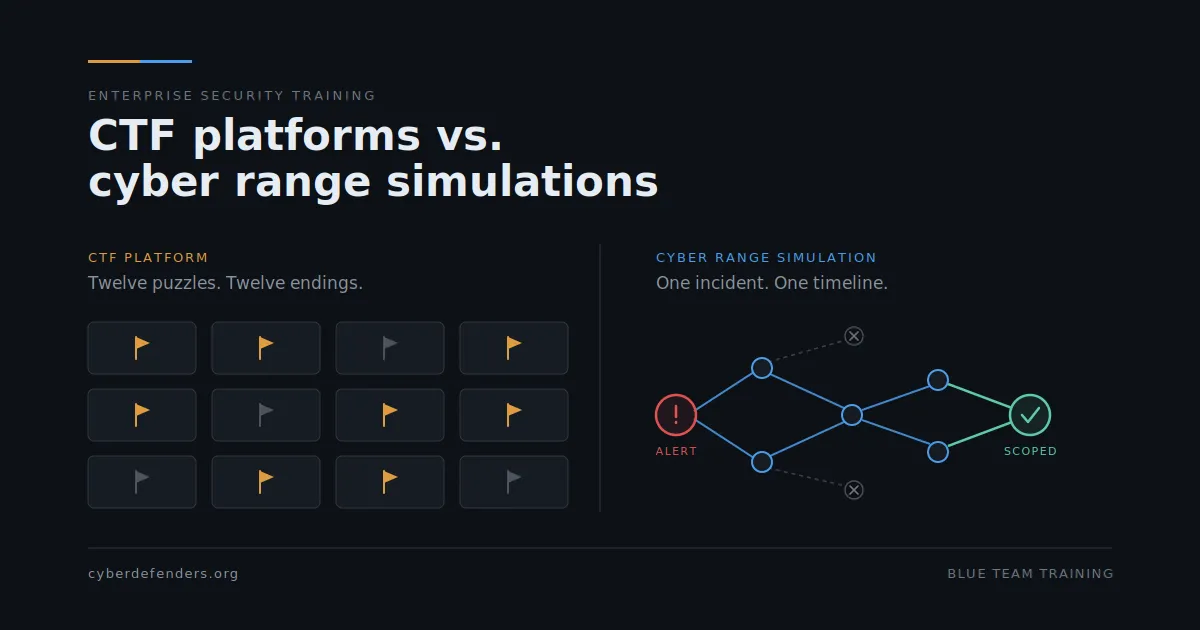
A CTF scores players on self-contained puzzles with a known answer. A cyber range puts analysts inside a full simulated incident with realistic evidence and no guaranteed outcome. The cyber range vs CTF question comes down to what you need to build: CTFs sharpen individual technique, ranges build and prove investigation capability. Most teams need both, in different proportions.
Your team places well in a weekend CTF. Badges land in the Slack channel, two analysts crack a forensics challenge nobody else solved, and morale is the best it has been all year. Three weeks later a phishing alert turns into a lateral movement investigation, and the same people who tore through the puzzles get stuck: nobody owns the timeline, a shift handoff drops half the context, and nobody can say with confidence whether the incident is contained. Both things are true at once. The CTF made individuals sharper, and it did not make the team ready.
That split is what this comparison is about. Here is what each format is, how they differ on the dimensions that matter, when each one is the right call, and how to run both without wasting either.
What is a CTF?
A capture-the-flag (CTF) is a competition format in which players solve self-contained security challenges to recover a hidden string, the flag, and submit it for points. Challenges are grouped by category (forensics, cryptography, web, reverse engineering, binary exploitation) and ranked by difficulty, and a leaderboard tracks who solved what and how fast.
Two variants exist. Jeopardy-style CTFs present a board of independent challenges. Attack-defense CTFs have teams protect their own vulnerable services while attacking others. Most training-oriented CTF platforms use the jeopardy format, because it scales to any number of players and needs no live infrastructure to defend. A CTF can be played solo or as a team, but even team play usually means splitting the challenge list by specialty and working in parallel.
What is a cyber range?
A cyber range is an isolated, realistic environment that reproduces real infrastructure (hosts, network, identity, logs, security tooling) so analysts can investigate simulated attacks with the tools they use in production. The analyst works a scenario from triage to report, and the platform scores their findings against what actually happened. For the full definition, types, and components, see what a cyber range is.
Cyber range vs CTF: the key differences
The two formats separate cleanly when you compare what a single training rep looks like in each.
| CTF | Cyber range | |
|---|---|---|
| Shape of a rep | Solve a puzzle, capture the flag | Work an incident from triage to report |
| Learning objective | Master a specific technique | Build investigation judgment and workflow |
| Evidence | Curated, minimal noise, guaranteed solvable | Realistic telemetry with noise, gaps, dead ends |
| Environment | A file, a service, or a challenge box | A running network with real tooling |
| Who performs | Solo players or teams splitting the puzzle list | Solo analysts or a team sharing one investigation |
| Completion signal | The flag validates your answer | Your own call: scoped or not? |
| What a manager sees | Points and leaderboard rank | Readiness per skill, gaps, progress over time |
| Best for | Engagement, screening, individual depth | Building and proving team readiness |
One caveat before the comparison hardens into a dichotomy: the line is blurrier than vendor categories suggest. Plenty of platforms put CTF-style scoring on top of incident-shaped scenarios. The distinction that matters is not whether points are involved. It is what the exercise is shaped like: a puzzle or an incident.
Learning objectives
A CTF challenge teaches one technique deeply: decode the obfuscated script, carve the file, reverse the logic. A range scenario teaches the investigation itself: which evidence to pull first, how to pivot, when to stop. Both are active learning, and both beat lectures. In a 225-study meta-analysis published in PNAS, students taught by lecture were 1.5 times more likely to fail than those who learned by doing. The question between the two formats is not active versus passive. It is technique versus judgment, and a team needs both.
Realism
CTF evidence is built to be solved. It is curated, minimal, and free of the noise that fills a real SIEM. That is a feature for teaching a technique and a liability for teaching investigation, because an analyst who has only ever worked clean evidence expects clean evidence. Range scenarios include the log source that was never onboarded, the queue of plausible leads where only a few matter, and the timestamps in three time zones. Analysts who have practiced with imperfect evidence keep moving when production data lets them down.
Environment and infrastructure
A CTF challenge is typically a downloadable file, a single vulnerable service, or a challenge box reached through a browser. It needs almost no infrastructure, which is why CTFs are cheap and scale to thousands of players. A range is a running network: endpoints, servers, identity, telemetry, and the defender's tooling, provisioned on demand and isolated from production. It costs more to build and maintain, and that cost is what buys the realism above.
Individual vs. team training
CTF teamwork is parallel solving. Even in team events, collaboration usually means dividing the challenge list and working separately. Range scenarios can host what a challenge queue cannot: a shared investigation, a handoff between shifts, an escalation decision made under pressure. A team of strong CTF players can still coordinate badly, and coordination is usually what fails first in a real incident.
Skill assessment
A CTF measures whether the flag was found and how fast. A range measures what the analyst found, what they missed, whether they scoped the incident correctly, and how long each step took. Only the second kind of measurement answers the questions a CISO asks: who on this team can run a ransomware investigation, where are we weak, is that improving?
The stakes of that question are documented. In ISC2's 2025 Cybersecurity Workforce Study of 16,029 professionals, 95% reported at least one skills need on their team, and 88% had experienced at least one significant cybersecurity consequence because of a skills deficiency in the past year, with 69% experiencing more than one. Skills gaps are not a future risk. They are already producing incidents, and a leaderboard cannot show whether yours are closing.
Scenarios
CTF scenarios follow the interests of challenge authors. This has been measured: researchers who mapped 15,963 CTF challenge solutions against ACM/IEEE curricular guidelines found the content clusters heavily in cryptography and network security while whole areas of the field go largely untouched. Range scenarios are built from real intrusions and can be aimed at a named gap: the cloud incident your team has never worked, the Active Directory attack that keeps appearing in threat reports.
Range scenarios also carry a clock. In IBM's Cost of a Data Breach Report 2026, the average breach cost a record $4.99 million, mean time to identify and contain rose to 247 days, and breaches running past 200 days cost about a third more than those closed sooner. Those figures price a slow response, not any training format. What a range adds is a place where detection and containment speed can be timed, compared, and improved before an incident does the timing for you.
When a CTF makes sense
A CTF is the right tool when the goal is engagement, screening, or depth in a specific technique, and when budget or infrastructure is thin.
- Engagement between structured sessions. In a practitioner account on the SANS Internet Storm Center, a lead analyst at Rapid7 describes analysts who had to be retaught after classroom sessions retaining the material far better once training moved to CTF challenges. One team's experience, not a controlled study, but it matches the broader active-learning evidence.
- Hiring and screening. A candidate's CTF history is evidence of curiosity and persistence, which is a reasonable signal when hiring for potential rather than experience.
- Deep practice on one technique. When an analyst needs to get good at malware deobfuscation or memory carving specifically, a well-built challenge is the fastest rep.
- Community and recruiting events, where the leaderboard is the point.
- Keeping skills moving at no cost. The free platforms analysts already use on their own time fill the gaps between budget cycles.
None of that is an argument against CTFs. It is an argument against asking a puzzle format to carry a readiness program alone.
When a cyber range makes sense
A cyber range is the right tool when the goal is to build or prove investigation capability, especially for a team that will be judged on how it performs during an incident.
- Onboarding into a role, so a new analyst has already worked the incident types they will face before the first real one.
- Rehearsing response. Investigations offer no flag to confirm the answer. Knowing when to stop digging, when to escalate, and when to call an environment clean is a judgment skill, and puzzle formats train against it. We traced where that gap surfaces in why SOC analysts fail their first real incident response.
- Closing a named skills gap, because scenarios can be chosen to target it rather than left to what is trending.
- Proving readiness upward, with per-analyst evidence a CISO or board can read.
- Training coordination, which needs a shared incident, not a shared leaderboard.
There is a retention argument as well. The 2026 SANS SOC Survey of 444 security operations professionals found practitioners rank a lack of skilled staff as their top operational challenge, and coverage of its retention findings places career progression and training ahead of compensation among the reasons analysts stay. A visible, structured training program is itself a retention tool.
Can organizations use both?
Yes, and the strongest programs do. The working pattern is a range for the core and CTF mechanics for fuel: realistic scenarios on a recurring cadence to build and measure capability, with leaderboards, badges, and internal competitions layered on top to keep the reps happening.
The two also merge. When CTF-style scoring sits on top of incident-shaped scenarios, you get the engagement of the puzzle with the training value of the investigation. Our own Blue Team CTF Challenges are built this way: flags and points, but the scenarios are derived from real-world incidents, and solving them means working the evidence the way an analyst would. How to sequence individual scenarios, team exercises, and CTF events into a program a manager can run and report on is covered in how cyber range training works, and for SOC-specific structures in cyber range for SOC teams.
See what your team does with a real incident
The fastest way to settle the cyber range vs CTF question for your own team is to watch them work one realistic incident and read what the dashboard shows. Our cybersecurity training for teams and enterprises gives your analysts the same labs with the Team Management Dashboard, which shows progress and performance in real time, so you see where the strong CTF players are strong and where the team is not. If you want to try it first, our free cybersecurity labs run in the browser.
FAQ
Are CTF platforms good for corporate cybersecurity training?
As a component, yes. CTFs drive engagement and build depth in specific techniques, and practitioner reports describe better recall than lecture-based training. As the core of a corporate program, no: they do not train team coordination, follow a curriculum, or produce readiness metrics a security leader can report.
Do CTF skills transfer to real SOC work?
Partially. Technique skills like decoding obfuscated scripts or parsing artifacts transfer directly. What does not transfer is investigation judgment: real incidents have no flag confirming the answer, no guarantee of solvability, and no scoreboard telling you when to stop. Those skills require incident-shaped practice.
Is a cyber range just a harder CTF?
No. Difficulty is not the difference; shape is. A hard CTF is still a puzzle with a known answer and curated evidence. A range scenario, even an easy one, is an incident with noisy evidence and a scope the analyst has to call themselves. An easy range scenario trains something a hard CTF cannot.
Can a CTF be run inside a cyber range?
Yes. Many platforms score range scenarios with flags and points, which combines the engagement of a CTF with the investigation workflow of a range. The result is still a range exercise as long as the scenario is incident-shaped and the evidence is realistic; the scoring layer does not change what is being trained.
Sources
- 2026 SANS SOC Survey (SANS Institute) (444 security operations professionals and 69 CISOs; lack of skilled staff ranked top operational challenge)
- Help Net Security coverage of the 2026 SANS SOC Survey (retention drivers: meaningful work first, then career progression and training, with compensation fourth)
- ISC2 2025 Cybersecurity Workforce Study (16,029 respondents; 95% report at least one skills need; 88% experienced a significant cybersecurity consequence because of a skills deficiency in the past year, 69% more than one)
- IBM Cost of a Data Breach Report 2026 (global average breach cost $4.99M, a record; mean time to identify and contain rose to 247 days; breaches running past 200 days cost about a third more)
- Freeman et al., Active learning increases student performance in science, engineering, and mathematics (PNAS, 2014) (225-study meta-analysis; students in lecture courses 1.5 times more likely to fail than active learners)
- SANS Internet Storm Center: Gamified Learning: Using Capture the Flag Challenges to Supplement Cybersecurity Training (practitioner account, not a study: Rapid7 lead analyst on recall improvement with CTFs)
- Švábenský et al., Cybersecurity knowledge and skills taught in capture the flag challenges (Computers & Security, 2021) (15,963 CTF challenge solutions since 2012 mapped to ACM/IEEE curricular guidelines; content dominated by cryptography and network security)