Cyber Range for Incident Response Training
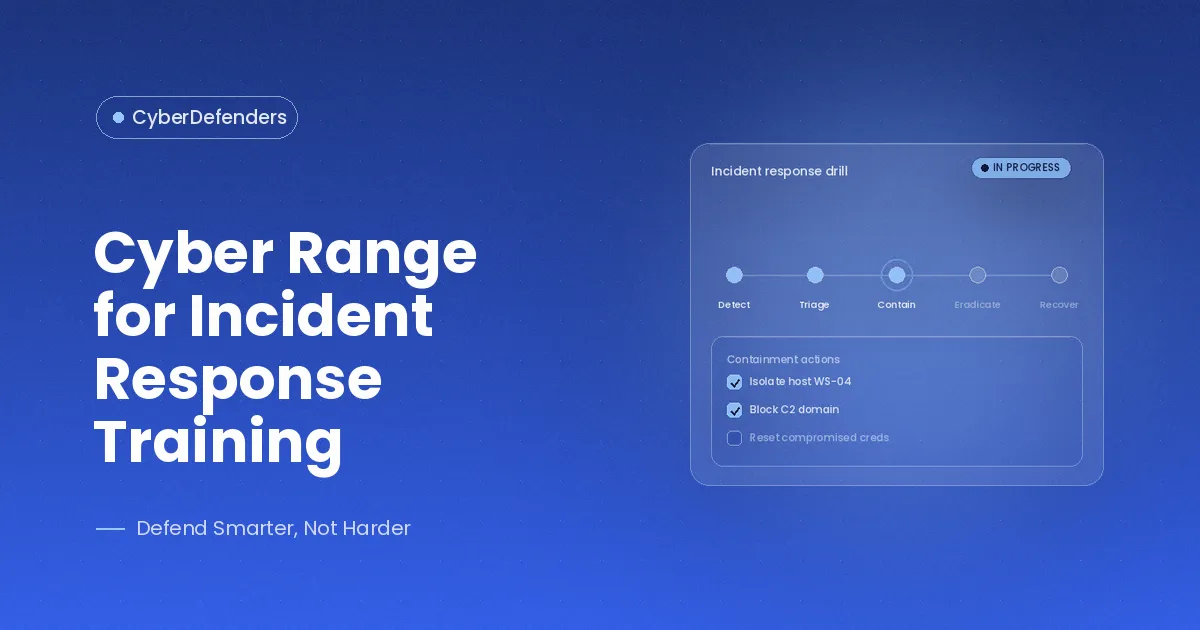
Cyber range incident response training gives responders realistic intrusions to investigate, with real evidence and a known answer, so the team can practice the decisions the incident response lifecycle demands: what happened, how far it spread, what to isolate, what to remove, and when it is safe to recover. The investigation happens in the lab. The response decisions are made from it, written down, and reviewed.
Step four of the playbook says “isolate the affected host.” The responder has the host: it is the CFO’s laptop, the CFO is presenting to the board in twenty minutes, and the evidence so far is one suspicious process and an outbound connection that might be a beacon or might be an update service. Nobody has ever practiced this decision. The responder waits for more evidence. The evidence they wait for is the attacker moving to a second machine.
Incident response plans fail at this point, in the execution rather than in the document. The plan passed the audit and the team has read it. What the team has not done is work a realistic intrusion end to end and make the calls the plan asks for. This guide covers how a SOC or IR team uses a cyber range to do that: what each lifecycle phase looks like in practice, which incident types to rehearse and the labs that fit, how communication and coordination are practiced around the labs, how to measure it, and a simple program you can run. For what a cyber range is in general, see what a cyber range is. SOC triage training and threat hunting have their own guides; this one stays on response.
Why incident response needs hands-on practice
Incident response needs hands-on practice because it is a performance skill used rarely, under pressure, with decisions that cannot be undone. A plan describes what to do. A lab with real evidence is where the team finds out whether they can read the situation well enough to do it.
Four things make the gap between plan and execution wide. Incidents are infrequent, so the skill fades between them. Decisions are irreversible: isolate the wrong host and you lose evidence and a working system; isolate too late and you lose the network. Evidence arrives incomplete and out of order, and every playbook assumes it will be complete and in order. And response involves several functions (SOC, IR, forensics, IT, legal) that rarely work together outside an incident. Most organizations cover this with a tabletop. A tabletop tests the decision path. It cannot test whether the team can find the beacon or scope the intrusion, which is where the twenty minutes above are lost. We traced the first-incident version of this in why SOC analysts fail their first real incident response.
Practicing the incident response lifecycle on a cyber range
A cyber range trains the lifecycle by giving the team a real intrusion to investigate and scoring what they find. Detection, triage, and investigation happen inside the lab. Containment, eradication, and recovery are decisions the team makes from the findings, writes down, and reviews in the debrief. That split matters, so each phase is described honestly below.
Detection and triage
Detection is recognizing that an event is an incident; triage is the first assessment of what it is and how bad it is. Labs start the way real incidents do, with an alert, an artifact, or a suspicious log entry, and ask the responder to establish what they are looking at. The debrief checks whether the responder distinguished the incident from the noise around it and how quickly they reached a defensible first assessment.
Investigation
Investigation is building the timeline: how they got in, what they did, where they went, what they touched. This is the longest phase and the one where responders most often stop early, because the first foothold feels like the whole story. Labs with a second foothold, persistence on a host nobody looked at, or an initial access vector that turns out not to be the phishing email everyone assumed train the discipline to keep scoping. Lab scores show it directly: did the responder find the initial access vector, the persistence, every affected host and account.
Containment, eradication, and recovery
Containment is the decision about what to isolate and when. Eradication is the list of what has to be removed: persistence, malicious accounts, scheduled tasks, altered configurations, stolen credentials. Recovery is the decision that systems are safe to return, in what order, and what to watch for afterward. None of these actions are taken inside a lab. What a cyber range provides is the evidence to make them well.
The practice is simple. When a responder finishes a lab, they write three things before the debrief: the containment call they would make and why, the eradication checklist from their findings, and the recovery decision with the evidence that supports it. The debrief compares each to the lab’s answer key. A responder who isolated one host while the answer key shows persistence on a second has learned the most important lesson in IR, and it cost nothing. Ransomware labs add the recovery question that matters most: can the backups be trusted, given what the operator did before detonation.
Cyber range incident response scenarios worth rehearsing
Five incident types cover most of what an IR team will be judged on. Each is described from the response angle, with the decision it trains and the labs that fit. The full list of blue team exercises with skills and outcomes is in 12 Cyber Range Exercises for Blue Teams.
Ransomware
The decision: how to stop the spread and whether recovery is possible. The operator’s actions before detonation (disabling recovery, deleting shadow copies, staging the payload) decide whether the team can recover. REvil - GOLD SOUTHFIELD works Sysmon logs in Elastic to find that pre-detonation behavior, including the recovery-sabotage commands and the C2 onion domain. Operation Cronos - Lockbit covers the intelligence side of the same threat.
Credential compromise
The decision: which accounts to reset and whether the stolen credentials have already been used. The response is only right if the list of affected accounts is right. PoisonedCredentials finds the rogue host, the accounts that responded, and the systems they touched; PsExec Hunt shows what stolen credentials look like once they are in use for lateral movement.
Malware
The decision: reimage or investigate. A quarantined sample is a reimage; a sample that ran, persisted, or reached C2 is an incident. Reveal reconstructs a multi-stage attack from a Windows memory dump with Volatility 3; Amadey - APT-C-36 pulls processes, C2, payload delivery, and persistence from memory.
Data exfiltration
The decision: what left, and therefore who has to be told. Exfiltration drives notification decisions, and getting the scope wrong in either direction is expensive. Exfiltration is the final stage of GhostConnect - TA583 (HTTPS exfiltration at the end of a full kill chain) and of AzureHunt (exfiltration from Blob Storage).
Insider threat
The decision: policy violation or crime, and what standard of evidence the answer needs. Insider incidents involve an authorized user, so nothing malicious runs and no alert fires; the work is reconstruction from file access, identity, and endpoint records with HR and legal involved from the start. Because the evidence is legitimate activity, this scenario is best rehearsed as a discussion exercise built on your own logging, alongside the technical labs above.
Communication and escalation
Communication is a lifecycle skill, and a cyber range is a good place to practice it because every lab ends with findings that have to be explained. The practice is to require two written artifacts after each lab: the escalation and the update.
The escalation is the note that pulls in the next tier or the IR lead: what, where, since when, how confident, what is being done. The update is the two paragraphs a director reads in a meeting: status, scope so far, business impact, next decision and when. Responders who have never written one under pressure produce ten paragraphs of technical detail or two lines of nothing. Review both in the debrief alongside the lab answers. The first time a responder writes a leadership update should not be during a real incident.
Coordinating as a team
Labs are worked individually, and an IR team still trains together by working the same lab and debriefing as a group, with roles assigned for the discussion. That is where coordination problems appear: two responders who scoped the same host differently, one who stopped at the first foothold, a senior who found the second and can explain how.
The routine: the whole team works one lab in the same week. In the debrief, one person presents the timeline, one presents the containment call and eradication list, one reads out the leadership update, and the incident lead challenges each against the answer key. Disagreements about scope and containment are the point; they are the same disagreements that cost hours in a real incident, surfaced when they are free. How training is managed across many teams is covered in Enterprise Cyber Range: How Security Teams Train Against Real-World Attacks.
Lessons learned
Lessons learned is the phase that improves every other phase, and the one most teams skip after real incidents because everyone is exhausted. A cyber range fixes that by making the debrief part of the exercise rather than a meeting three weeks later.
The debrief that works is blameless, specific, and short. It compares the team’s path to the lab’s answer key phase by phase: where the first assessment was wrong, which host went unscoped, whether the containment call was right, what the eradication list missed, what the recovery decision rested on. Every finding becomes one of three things: a playbook change, a telemetry gap, or a training item for a named person. Log them with owners and check at the next exercise whether they closed.
Measuring incident response performance
IR performance is measured on a cyber range in two layers: what the lab scores and what the debrief judges. The lab scores whether the responder found the initial access vector, the persistence, and every affected host and account, and the Team Management Dashboard shows completion and scores per responder over time. The debrief judges what the lab cannot: the containment call, the eradication list, the recovery decision, and the quality of the escalation and the update.
Keep the debrief judgments simple. For each artifact, mark it right, partly right, or wrong against the answer key, and log the result next to the lab score. Repeat the same labs at the start and end of a quarter and the change is your before and after. Turning that into a business case is covered in Measuring Cyber Range ROI.
A simple, repeatable incident response exercise program
A repeatable IR program needs two cadences: individual labs monthly and a team debrief quarterly. That is enough to keep the plan executable rather than merely documented.
Monthly, each responder works one lab matched to a weakness the last debrief surfaced, rotating across the five incident types so nobody goes a year without a ransomware rep. Each lab ends with the three response decisions and the two written artifacts. Quarterly, the whole team works the same lab and holds the group debrief described above, and the findings go into the playbook backlog. Once a year, run your tabletop on top of a lab the team has just worked, so the leadership decisions are made against a real investigation rather than a slide.
Keep the template to a page per exercise: incident type, lab, participants, decisions and artifacts required, debrief owner, findings log. Filed together, those pages are the program’s memory.
Run your incident response plan against a real intrusion
The fastest way to learn whether your plan executes is to have the team work one realistic intrusion and make the response decisions from it. If you lead an IR or SOC team, book a walkthrough of our cybersecurity training for teams and enterprises and we will show you the labs above, the tracks they sit in, and the Team Management Dashboard. Individual responders can start with the ransomware and credential labs today; browse the blue team labs. Everything runs in the browser with nothing to install.
FAQ
How is cyber range incident response training different from a tabletop exercise?
A tabletop rehearses decisions by discussion; a cyber range gives the team a real intrusion to investigate first, so the decisions are made against evidence. Tabletops are good for testing communication and executive decision-making and cannot show whether the team can find, scope, and read an intrusion. The strongest exercises run both: work the lab, then hold the tabletop on its findings.
How often should an incident response team run cyber range exercises?
One lab per responder each month and one team debrief each quarter. Response skill fades without practice, and a single annual exercise cannot maintain it; the monthly labs are what keep the quarterly debrief from starting at zero.
Can responders practice containment and recovery on a cyber range?
They practice the decisions, not the actions. A lab provides the evidence; the responder writes the containment call, the eradication list, and the recovery decision from it, and the debrief compares each to the answer key. The actions themselves belong in your own environment and change control.
Can the SOC and the IR team train together on a cyber range?
Yes, and they should, because the SOC-to-IR handoff is one of the most common failure points in real incidents. Have both teams work the same lab, then debrief together with the SOC presenting the escalation note and the IR team presenting what they would need from it. SOC-specific training is covered in Cyber Range for SOC Teams.