What Is SIEM? Security Information and Event Management
A single failed login means nothing. A firewall deny means nothing. A new service installed on a host means nothing. Seen together, in order, from one user, inside ten minutes, they mean an attacker is inside your network. The tool that sees them together is a SIEM.
SIEM is the system that pulls log data from every corner of your environment into one place, gives it a common shape, and runs detection logic across all of it at once. It is the backbone of most Security Operations Centers. It is also where a lot of SOC analysts spend their entire shift.
This guide explains what SIEM is, how the pipeline actually works, the use cases it covers, how it differs from SOAR, XDR, EDR, and UEBA, and what to weigh when choosing one. It is written for blue teamers: SOC analysts, threat hunters, and DFIR practitioners who have to operate the thing, not just buy it.
What is SIEM?
SIEM stands for Security Information and Event Management. A SIEM solution collects log and event data from across your infrastructure, normalizes it into a common format, correlates it against detection rules, and stores it for investigation and compliance.
The term merges two older categories. SIM (Security Information Management) handled long-term log storage, reporting, and compliance. SEM (Security Event Management) handled real-time monitoring and alerting. Gartner analysts Mark Nicolett and Amrit Williams coined the combined term SIEM in 2005. The two halves still describe what the platform does: store everything, alert on what matters now.
Put plainly, a SIEM answers three questions a SOC asks constantly:
- What is happening across my environment right now?
- Has this pattern happened before, and when?
- Can I prove what happened during an incident, after the fact?
The market reflects how central this has become. MarketsandMarkets projects the SIEM market growing from $8.39 billion in 2026 to $13.67 billion by 2031, a 10.3% annual clip. The number matters less than the reason behind it: environments got bigger, attacks got faster, and no analyst can watch every log source by hand.
How does a SIEM work?
A SIEM is a pipeline. Data goes in at one end as raw, messy logs from dozens of source types. Detections and searchable history come out the other end. Five stages run in between. Those five stages are the core of any SIEM architecture: whatever the vendor name on the box, the product is some arrangement of them.
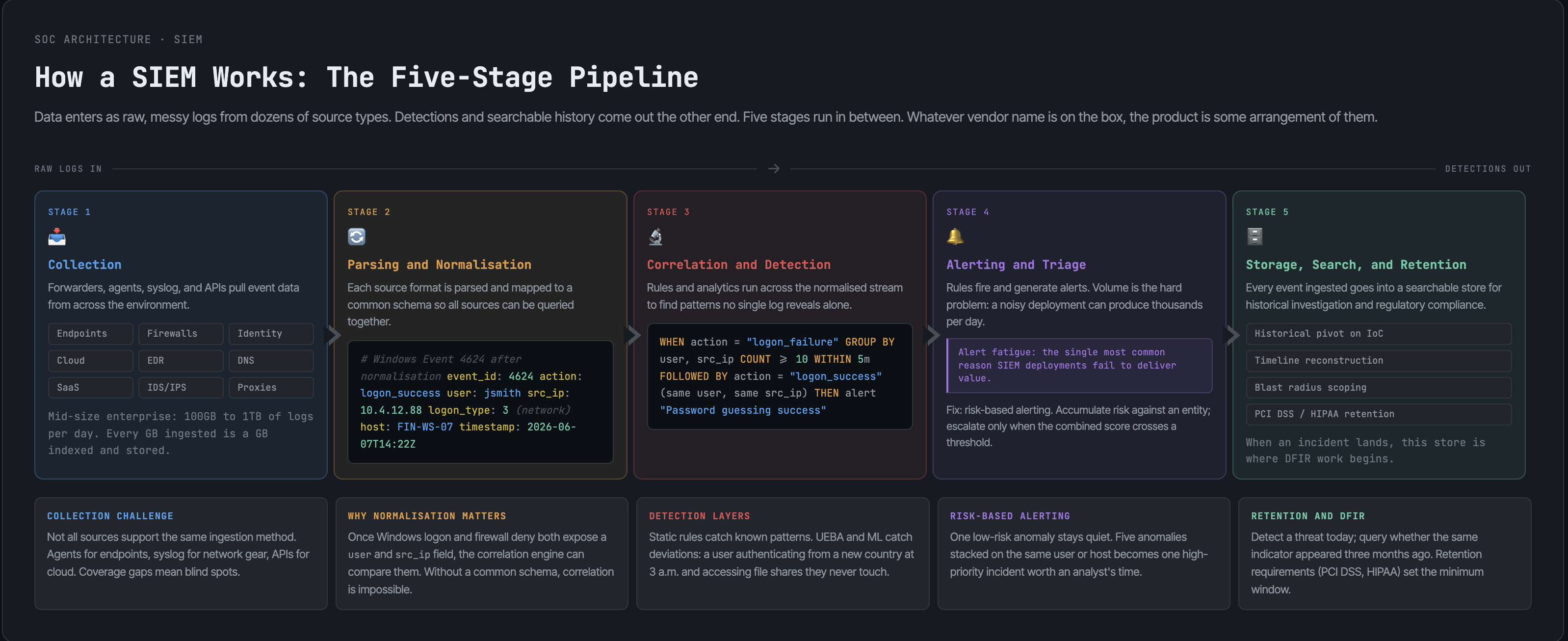
1. Collection
The platform ingests event data from across the environment. Forwarders, agents, syslog, and APIs pull logs from sources like:
- Endpoints and servers (Windows Event Logs, Linux auth and syslog, EDR telemetry)
- Network devices (firewalls, routers, switches, VPN concentrators, proxies)
- Identity systems (Active Directory, Okta, Entra ID authentication events)
- Cloud and SaaS (AWS CloudTrail, Azure Activity, Microsoft 365, GCP audit logs)
- Applications and databases (web server logs, application logs, DB audit trails)
- Security tools (IDS/IPS alerts, antivirus, DNS, web application firewalls)
The volume is the first real engineering problem. A mid-size enterprise can produce hundreds of gigabytes to terabytes of logs per day. Every gigabyte you ingest you also pay to index and store.
2. Parsing and normalization
Raw logs arrive in different formats. A Windows logon event looks nothing like an AWS CloudTrail record, which looks nothing like a Palo Alto firewall log. The platform parses each one and maps its fields to a common schema so they can be queried together.
A Windows successful logon (Event ID 4624) gets normalized into fields any analyst can search across sources:
event_id:        4624
action:          logon_success
user:            jsmith
src_ip:          10.4.12.88
logon_type:      3            (network logon)
host:            FIN-WS-07
timestamp:       2026-06-07T14:22:09Z
Normalization is what makes correlation possible. Once a logon from Windows and a deny from a firewall both expose a user and src_ip field, the platform can line them up.
3. Correlation and detection
This is the core. The engine runs rules and analytics across the normalized stream to find patterns no single log reveals on its own. A correlation rule is a condition over multiple events, often scoped to a time window.
A basic brute-force-then-success rule reads like this:
WHEN action = "logon_failure"
  GROUPED BY user, src_ip
  COUNT >= 10 WITHIN 5 minutes
  FOLLOWED BY action = "logon_success" (same user, same src_ip)
THEN raise alert "Possible password guessing success"
Ten failures alone are noise. Ten failures followed by a success from the same source is an incident. Modern SIEMs layer machine learning and User and Entity Behavior Analytics on top of static rules to catch deviations a hand-written rule would miss, like a user suddenly authenticating from a new country at 3 a.m. and touching file shares they never access.
4. Alerting and triage
When a rule or model fires, the platform generates an alert. The hard truth here is volume. A noisy deployment can produce thousands of alerts a day, and a SOC that drowns in them starts ignoring them. This is alert fatigue, and it is the single most common reason SIEM deployments fail to deliver value.
The fix is risk-based alerting: instead of one alert per rule hit, the platform accumulates risk against an entity (a user or host) and only escalates when the combined score crosses a threshold. One low-risk anomaly stays quiet. Five stacked on the same user becomes one high-priority incident worth an analyst's time.
5. Storage, search, and retention
Every event ingested goes into a searchable store. This serves two jobs. It powers historical investigation, so when you detect a threat today you can ask whether the same indicator appeared three months ago. And it satisfies retention requirements, since regulations like PCI DSS and HIPAA mandate keeping logs for defined periods. When an incident lands, that store is where DFIR work begins: pivot on an IP, rebuild a timeline, scope the blast radius.
Core SIEM capabilities
Strip away vendor branding and most platforms offer the same set of capabilities. These are the ones that matter in daily operations.
| Capability | What it does in practice |
|---|---|
| Log management | Centralized collection, parsing, and retention of all event sources |
| Correlation | Rules and logic that connect events across sources into detections |
| Real-time monitoring | Live dashboards and alerting on activity as it happens |
| UEBA | Behavioral baselines per user and host; alerts on deviation |
| Threat intelligence | Enrichment with known-bad IPs, domains, and hashes |
| Risk-based alerting | Consolidates noise into fewer, scored, high-priority incidents |
| Investigation and forensics | Search, pivoting, and timeline reconstruction over historical data |
| Reporting | Compliance and audit reports against retained data |
UEBA deserves a note. User and Entity Behavior Analytics started as its own product category and is now folded into most SIEMs. It builds a statistical baseline of what normal looks like for each account and device, then flags the deviations: impossible travel, privilege escalation, off-hours access to sensitive data. It is most of how the platform catches insider threats and compromised credentials that static rules miss.
SIEM use cases
A SIEM earns its cost across a handful of jobs.
Threat detection
The headline use case. Correlation rules and analytics surface brute force, lateral movement, command-and-control beaconing, privilege escalation, and data exfiltration. Mapping detections to the MITRE ATT&CK framework gives the SOC coverage they can measure against real adversary techniques.
Incident response
When something fires, it is the first console an analyst opens. They pivot from the alert to every related event, reconstruct the timeline, and scope which hosts and accounts are involved.
Threat hunting
Hunters use its search to test hypotheses across historical data. A question like "show me every host that made an outbound connection to this newly flagged domain in the last 30 days" becomes one query in the platform's search language: SPL in Splunk, KQL in Microsoft Sentinel, ES|QL in Elastic. No alert required, just the hypothesis and the data. This is where the platform stops being a passive alerter and becomes an investigation tool.
Compliance and audit
Centralized, retained, searchable logs are exactly what PCI DSS, HIPAA, SOX, and ISO 27001 auditors ask for. The platform produces the reports.
Insider threat detection
UEBA flags the trusted account behaving untrustworthily: the admin downloading the customer database, the engineer accessing repos outside their team a week before they resign.
SIEM vs. SOAR vs. XDR vs. EDR vs. UEBA
These tools overlap and get confused constantly. Here is the clean split.
| Tool | Primary job | Scope | Acts or just detects? |
|---|---|---|---|
| SIEM | Collect, correlate, store all log data | Entire environment | Detects and investigates |
| SOAR | Automate response with playbooks | Workflow layer above tools | Acts (automated response) |
| XDR | Detect and respond across native telemetry | Endpoint, network, cloud, identity | Detects and responds |
| EDR | Detect and respond on endpoints | Endpoints only | Detects and responds |
| UEBA | Baseline behavior, flag anomalies | Users and entities | Detects |
SIEM vs. SOAR
SIEM detects. SOAR (Security Orchestration, Automation, and Response) acts on the detection. When the platform raises a confirmed phishing alert, the SOAR playbook can automatically pull the email from every inbox, disable the clicked link, and open a ticket. Most mature SOCs run both, with SIEM feeding SOAR.
SIEM vs. XDR
XDR (Extended Detection and Response) ingests a curated set of high-fidelity telemetry, usually from one vendor's stack, and is tuned for fast endpoint-to-cloud detection and response out of the box. SIEM ingests anything from any source and keeps it for the long term, which makes it stronger for broad investigations, compliance, and custom detections, at the cost of more setup. XDR is generally simpler to stand up. SIEM is more flexible and more work.
SIEM vs. EDR
EDR (Endpoint Detection and Response) watches endpoints only and can kill processes and isolate hosts. A SIEM consumes EDR telemetry as one of many sources and correlates it with everything else.
UEBA
UEBA is a detection technique, not a competing platform. It now lives inside most SIEM and XDR products.
Two more comparisons come up constantly, and both are category errors. A SIEM is not a SOC: the SOC (Security Operations Center) is the team and the function, while the platform is one of the tools that team operates. And it is not just log management: log management collects and stores logs, and the correlation and detection layer added on top is what makes it a SIEM. Every SIEM does log management. Not every log manager is one.
The short version: these are layers, not rivals. A common SOC stack runs EDR on endpoints, feeds it plus everything else into a SIEM, uses UEBA inside it for behavioral detection, and hands confirmed incidents to a SOAR for automated response.
Benefits, and the hard parts
The benefits are real:
- Unified visibility across on-prem, cloud, and hybrid from one console.
- Faster detection and response through correlation across sources.
- Fewer missed threats, because patterns spanning multiple systems become visible.
- Compliance coverage from centralized retention and reporting.
The hard parts are just as real, and any honest guide names them:
- Cost scales with data. You pay to ingest, index, and store. Log volume only grows, and so does the bill.
- Alert fatigue is the default state. Out of the box, it is noisy. Without tuning and risk-based alerting, analysts burn out and real alerts get buried.
- Tuning never ends. Environments change, so detection rules need constant review. A SIEM is not a set-and-forget appliance.
- It needs skilled people. The platform is only as good as the analysts writing detections and triaging alerts. The global shortage of skilled SOC staff is a genuine constraint on getting value from one.
It does not detect threats on its own. It gives trained analysts the data and the logic to. That distinction is why staffing and skills matter as much as the platform.
SIEM deployment models
How you run one shapes its cost and operational burden.
- On-premises. You own the hardware, the scaling, and the maintenance. Maximum control, maximum overhead. Common where data cannot leave the building.
- Cloud-native / SaaS. The vendor runs the infrastructure. It scales with data volume on demand, costs less upfront, and supports remote operation. The trade-off is recurring subscription cost and trusting your logs to a third party.
- Hybrid. Sensitive data stays on-prem while the bulk lives in the cloud. Most large organizations land here.
The clear trend is toward cloud and hybrid, driven by the same cloud adoption that made the environments hard to monitor in the first place.
Getting started with a SIEM
If you are standing one up or learning to operate it, the order of operations matters more than the product.
- Define use cases first, not data sources. Decide what you need to detect, then onboard the logs that feed those detections. Ingesting everything "to be safe" is how budgets and signal both die.
- Onboard high-value sources early. Authentication logs, endpoint telemetry, and firewall data catch the most common attacks.
- Map detections to MITRE ATT&CK. It turns "we have some rules" into measurable coverage against real techniques.
- Tune relentlessly. Suppress known-good noise, adjust thresholds, and adopt risk-based alerting so analysts see incidents, not raw events.
- Invest in the analysts. The platform is the easy part. The skill to write good detections and triage fast is what produces results.
How to choose a SIEM
Skip the vendor marketing. Evaluate against your environment:
- Data handling. Can it ingest your sources and your daily volume without the cost curve going vertical?
- Detection content. Does it ship useful out-of-the-box detections, and how hard is it to write your own?
- Search and investigation. How fast is search over months of data? This is where analysts live.
- Integrations. Does it connect cleanly to your EDR, threat intel, and SOAR?
- Pricing model. Per-gigabyte ingest, per-event, or flat. Model it against your real log volume, not a demo.
- Operational burden. Be honest about the staff you have to run it.
Analyst reports like the Gartner Magic Quadrant for SIEM and Gartner Peer Insights are a starting point for the landscape. The major platforms in 2026 include Splunk Enterprise Security (now a Cisco product), Microsoft Sentinel, IBM QRadar (on-premises only; IBM sold its QRadar SaaS line to Palo Alto Networks), Elastic Security, and CrowdStrike Falcon Next-Gen SIEM, alongside open-source options like Wazuh and the ELK stack. The right one is the one your team can actually operate against your data and your threats.
Frequently asked questions
SIEM (Security Information and Event Management) is a security platform that collects log data from across your systems, gives it a common format, and analyzes it to detect threats. It acts as the central monitoring and investigation hub for a Security Operations Center.
SIEM stands for Security Information and Event Management. It merges two earlier categories: SIM (Security Information Management), for log storage, reporting, and compliance, and SEM (Security Event Management), for real-time monitoring and alerting. Gartner analysts coined the combined term in 2005.
Both. It is a software platform, but it only delivers value as part of a process: defining detection use cases, onboarding the right log sources, tuning correlation rules, and triaging the alerts it produces. The platform is bought once. The process never stops.
A SIEM detects and investigates threats by correlating log data. A SOAR automates the response to those threats using playbooks. The SIEM finds the problem; the SOAR acts on it. Many SOCs run both together, with the SIEM feeding alerts into the SOAR.
A SOC (Security Operations Center) is the team and function that defends an organization. The platform is one of the tools that team runs. A SOC is people, process, and technology together; the SIEM is what analysts use to detect and investigate. You can have a SOC without one, but rarely a good one.
Log management collects, stores, and searches log data. A SIEM does all of that and adds normalization, correlation, detection rules, and alerting on top. Every platform of this kind includes log management as its foundation. A plain log manager has no detection logic, and that layer is the difference.
Yes. SIEM remains the foundation of most security operations because it is the one place that ingests and retains data from every source. It now works alongside XDR, SOAR, and AI-driven analytics rather than being replaced by them.
A SIEM collects logs and events from endpoints, servers, network devices, identity systems, cloud and SaaS platforms, applications, and other security tools. It normalizes these different formats into a common schema so they can be searched and correlated together.
The most common cause is alert fatigue from poor tuning, where analysts are buried in noise and miss real alerts. Others include ingesting too much low-value data, weak detection content, and a lack of skilled staff to operate the platform. A SIEM produces value only when it is tuned and run by trained analysts.
You need to read and understand logs from many sources, write and tune correlation rules, triage alerts under time pressure, and pivot through data to investigate incidents. These are core SOC analyst skills, best built through hands-on practice on realistic data.