How to Build a Cybersecurity Training Program for Your Whole Team (Not Just Individuals)
Most security training budgets are spent one person at a time: a course for the new hire, a certification for whoever asks, a conference pass for the analyst who is due one. Each of those can be money well spent, and the team can still fail its next major incident. Incidents are not handled by individuals. They are handled by handoffs, escalations, and five people making decisions under pressure at 2 a.m. That is the gap a cybersecurity team training program exists to close.
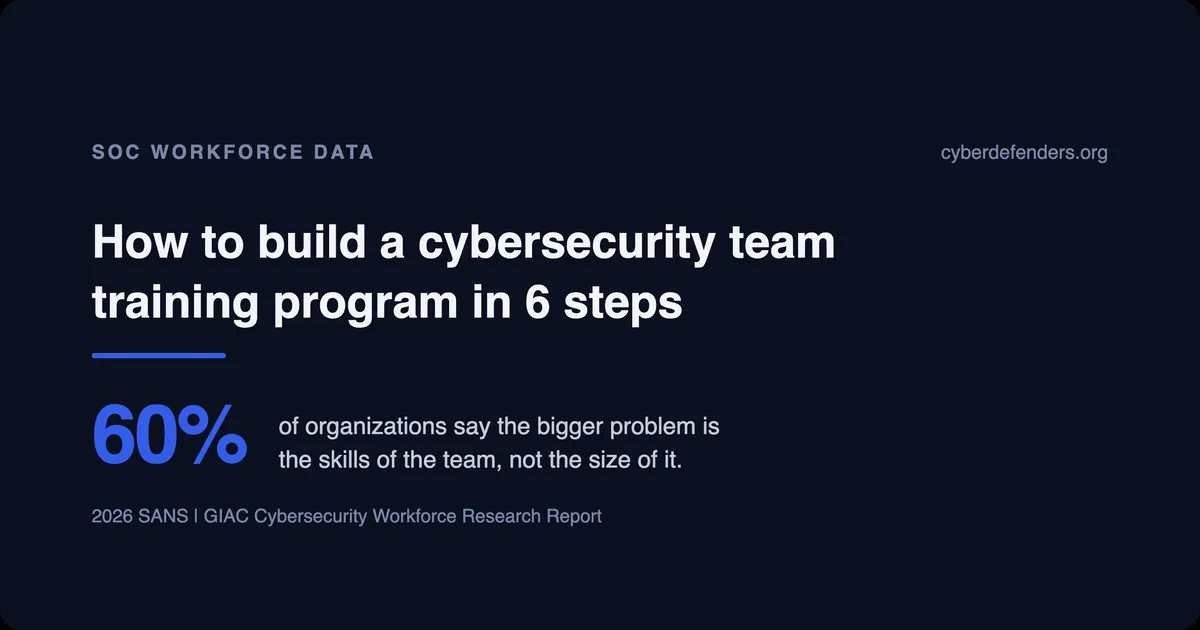
The industry's own data now points the same way. In the 2026 SANS | GIAC Cybersecurity Workforce Research Report, skills gaps decisively overtook headcount as the top workforce problem for the first time in the report's three-year history. Asked to pick their bigger issue, 60% of organizations chose "not having the right staff" over "not enough staff" (40%), a 20-point spread that widened from just four points a year earlier. The constraint is no longer the analysts you cannot hire. It is the capability of the team you already have.
That capability is a system, and it can be built like one: baselined, developed deliberately, and measured. Here is how, in six steps sized so a SOC manager can start this quarter.
Why individual training doesn't add up to team readiness
Individual training builds isolated skills. A team program builds three things individual courses never touch: a map of who can do what across every role, practice on the workflows that connect people during an incident, and measurement that shows whether readiness actually improved. Miss those and you get a team of certificate holders that still stalls when a real intrusion crosses tiers.
The failure pattern is predictable. Triage quality depends on which analyst happens to pick up the alert. The escalation to Tier 2 loses half its context in the handoff. The one person who can read a memory image is on leave. None of that appears in anyone's course completion record, which is why teams full of trained individuals still fail live incidents. We covered the individual version of this in why SOC analysts fail their first real incident response: the missing ingredient is rarely knowledge, it is reps on realistic investigations. At team level, add one more missing ingredient: reps on the handoffs between people.
The scale of the problem is measured, not anecdotal. In ISC2's 2025 Cybersecurity Workforce Study, 95% of the 16,029 professionals surveyed reported at least one skills need in their organization, and 88% had already seen a significant security consequence because of one. The SANS workforce report quantifies those consequences: 47% of organizations saw slower incident response, and 27% experienced breaches tied directly to workforce capability gaps.
What a cybersecurity team training program includes
A complete cybersecurity team training program has six elements: a hands-on skills baseline for every role, team-level objectives tied to operational metrics, a structure that combines individual practice with shared exercises, protected time on the schedule, team-level measurement that leadership can read, and a continuous cycle connected to career paths. The six steps below build them in that order.
Step 1: Baseline the whole team, not just the volunteers
You cannot close a gap you have not located. Start with a skills matrix: roles down one side (triage, detection engineering, forensics, threat hunting, incident lead), team members across the top. The NICE Workforce Framework's work roles are a ready-made starting set if you do not want to invent your own, and they keep the matrix legible to auditors and HR later. Framework alignment also simplifies what comes after: CCDL1 is built against the NIST Cyber Defense Analyst role, so a certification result drops straight into the matrix row it belongs to instead of needing translation.
Then fill the matrix with evidence, not self-ratings. A hands-on assessment (a realistic investigation with real artifacts: disk images, event logs, network captures) shows what each person can actually do under conditions that resemble an incident. Quizzes measure recall; incidents test performance.
Two rules make the baseline honest. Assess everyone, because the analysts who never volunteer for training are usually where the gaps hide. And flag every singleton, meaning any skill only one person on the team can perform. Each singleton is an operational risk with a vacation schedule.
Find out what you actually have. Before you buy more training, map it. A 20-minute readiness review puts your team's current investigation and response coverage against Tier 1 and Tier 2 expectations, so you know which gaps are real. Book a readiness review
Step 2: Set team objectives your operation can feel
"Improve skills" is a wish. A team objective is operational and checkable. Good examples:
- Any on-shift analyst can triage the top ten alert categories without escalating for help.
- Escalations to Tier 2 arrive with a complete context package (scope, timeline, artifacts collected) on the first pass.
- Mean time to detect and respond trends down for the incident classes that hurt you most.
- No critical skill has fewer than three capable people by year end.
Pick three or four, no more. Together with the baseline, this one page is your security team training plan, and it is the version of the program leadership will actually read.
Step 3: Structure it in three layers: reps, drills, milestones
The structure that works combines individual practice with team exercises, because each fixes what the other cannot.
Individual reps. Role-based paths where analysts investigate hands-on scenarios built from real incidents, the way CyberRange labs are, so skill comes from doing investigations rather than watching them. This closes the per-person gaps the baseline found.
Team drills. The layer most SOC team training skips entirely. Put the shift through the same incident together: one analyst triages, hands off to another for investigation, a third runs containment, someone briefs the mock stakeholder. The drill's target is the handoffs, because that is where real incidents go sideways.
Milestones. Certifications work best as checkpoints inside the program, not as the program. A practical certification like CCDL1 makes a clean Tier 1 readiness bar: pass it and the baseline row goes green. For analysts already past triage, CCDL2 sets the equivalent bar for threat hunting and DFIR.
Cross-train against your singleton list deliberately: every quarter, pick one singleton skill and put two more people through its path. Dedicated cybersecurity team training platforms package these layers together (role paths, shared labs, team reporting), which matters mostly at step 5 when you need the numbers.
Step 4: Put training hours on the schedule, or they will not happen
Time is the binding constraint, and it is only narrowly ahead of money. In the SANS workforce report, 60% of organizations named lack of time due to workload as their single greatest training barrier, with 54% citing budget limits. Those six points are the whole argument for scheduling: a funded program still stalls if nobody can step away from the queue. "Train when it is quiet" is how a program dies, because a SOC is never officially quiet.
Treat training like patching: a recurring, protected window with planned coverage. A few practical moves:
- Block fixed hours per analyst per week and rotate who covers the queue during them.
- Prefer short, browser-based lab sessions that fit between shift peaks over week-long offsites that require backfilling a seat.
- Tie drill scheduling to the shift calendar, so the people who work together train together.
An hour of training lost to the alert queue is invisible on any dashboard. The skills gap it preserves costs like an unpatched server: quietly, then all at once.
Step 5: Measure the team, then report it in risk language
Re-run the hands-on baseline on a cadence and track it against the step 2 objectives. Team dashboards that show progress and performance in real time make this cheap to operate; the point is that "readiness" becomes a number that moves, per skill and per person, instead of a feeling.
Then report the delta upward, in the language budget owners use. The 2026 SANS SOC Survey, which polled 444 security operations practitioners alongside 69 CISOs and senior executives, found that 75% of those leaders say management understands technology only works when skilled people run it, yet the same leaders name human capital their top constraint when funding priorities. The survey also found a perception gap that has held for years: 59% of leaders believe management pays close attention to SOC hiring and retention needs, against 32% of practitioners, a 27-point spread the report notes has persisted in every year the question has been asked. Before-and-after capability numbers are what close that gap, especially set against the stakes. IBM's 2026 Cost of a Data Breach Report, published in July 2026, puts the global average breach at a record USD 4.99 million, up 12% year over year and reversing the 9% decline recorded in the 2025 edition.
Step 6: Make it continuous, and connect it to careers
A program that runs once ages out in quarters, because the threats it trained against do. Continuous security training is a cadence, not a subscription: re-baseline quarterly, rotate drill scenarios toward the techniques currently hitting your sector, and retire program content the way you retire detections.
Continuity is also where the program pays for itself twice. The SANS workforce report found only 24% of organizations provide well-defined and clearly communicated career paths, while unclear progression ranks as the third-largest retention obstacle at 31% and tripled as a hiring obstacle year over year, from 9% to 32%. A training program with visible milestones (baseline, path, drill lead, certification, next tier) is a career path, published to the whole team. Given what replacing a trained analyst costs, that retention effect is not a side benefit; we broke down those numbers in the hidden cost of an under-skilled security team.
A 90-day rollout plan
| Days | Focus | Done when |
|---|---|---|
| 1 to 30 | Baseline | Skills matrix built on framework roles; every team member through a hands-on assessment; top three team gaps and all singletons identified |
| 31 to 60 | Structure | Three or four team objectives written; role paths assigned against gaps; protected training hours on the shift schedule; first team drill run on a recent incident type |
| 61 to 90 | Proof | Targeted gaps re-assessed against the baseline; first before-and-after readout delivered to leadership; quarterly cadence locked for the next cycle |
Ninety days does not finish the program. It finishes the argument about whether the program works, because by day 90 you have a measured delta instead of a proposal.
If you would rather not assemble the pieces yourself, Corporate Training packages them: role-based paths on real-incident labs, shared team exercises, and a Team Lead Dashboard that tracks progress and performance in real time. The six steps work either way; the platform just removes the assembly.
Key takeaways
- Individual courses build isolated skills; a cybersecurity team training program adds the coverage map, the handoff practice, and the measurement that individual training cannot provide.
- The 2026 SANS | GIAC workforce report found skills gaps have decisively overtaken headcount as the top workforce problem (60% vs 40%), with 27% of organizations tying breaches directly to capability gaps.
- Baseline every team member with hands-on assessment, then set three or four operational objectives, not "improve skills."
- Structure the program in three layers: individual reps on realistic labs, team drills that exercise handoffs, and certifications as milestones.
- Time is the top barrier (60%), narrowly ahead of budget (54%), so training hours must be scheduled and protected like patch windows.
- Measure quarterly and report before-and-after capability to leadership; the same program doubles as a career path, which defends retention.
FAQ
What is a cybersecurity team training program?
A structured, continuous plan that develops a security team's capability as a unit rather than person by person. It combines a hands-on skills baseline for every role, team-level objectives, individual practice plus shared incident exercises, protected training time, and measurement that shows leadership whether readiness improved.
Why is individual cybersecurity training not enough for a team?
Because incidents are handled by workflows that cross people: triage, escalation, investigation, containment, communication. Individual training cannot exercise handoffs, cannot reveal coverage gaps like single points of failure, and produces no team-level evidence of readiness. All three require a program.
How do I assess my security team's skill gaps?
Build a skills matrix of roles against team members, then fill it with evidence from hands-on assessments: realistic investigations using real artifacts such as disk images and event logs. Include every member, not just volunteers, and flag any skill only one person can perform.
How much time should a security team spend on training?
There is no universal number; what matters is that the time is recurring, protected, and covered, like a patch window. Short, regular hands-on sessions that fit the shift schedule sustain a program better than occasional long courses. In the 2026 SANS | GIAC workforce data, workload-driven lack of time is the single greatest training barrier at 60%, just ahead of budget at 54%.
How do I justify a team training budget to leadership?
With a measured delta and the cost of the alternative. Run the 90-day rollout, show before-and-after capability against the baseline, and set it beside IBM's 2026 figure of USD 4.99 million for the average breach and SANS 2026 data tying 27% of breaches directly to workforce capability gaps.
Sources
- 2026 SANS | GIAC Cybersecurity Workforce Research Report, "The Evolving Cyber Workforce: AI, Compliance, and the Battle for Talent," released at RSAC 2026. Survey of 947 practitioners, leaders and HR professionals across six regions (North America 56%, Europe 16%, Latin America 14%, Asia-Pacific 7%, Africa 5%, Middle East 2%). Cited: 60% "not having the right staff" vs 40% "not enough staff," widened from a four-point gap; first time in the report's three-year history that skills gaps overtook headcount; 27% breaches tied to capability gaps; 47% slower incident response; 60% workload-driven lack of time as top training barrier vs 54% budget; 24% provide well-defined career paths; unclear progression third-largest retention obstacle at 31% and hiring obstacle up from 9% to 32%. Individual figures are itemized in the SANS findings announcement.
- 2026 SANS SOC Survey. 444 security operations practitioners plus a parallel survey of 69 CISOs and senior security executives. Cited: 75% of leaders say management understands technology only works when skilled people run it, while naming human capital the top funding constraint; 59% of leaders vs 32% of practitioners on management attention to SOC hiring and retention, a 27-point gap persisting every year the question has been asked.
- ISC2 2025 Cybersecurity Workforce Study. 16,029 respondents globally. Cited: 95% report at least one skills need in their organization; 88% experienced at least one significant cybersecurity consequence because of a skills shortage, itemized in the ISC2 study announcement. Note: ISC2 declined to publish a global workforce gap estimate this year, on the grounds that respondents prioritized skills over headcount.
- IBM Cost of a Data Breach Report 2026, conducted by Ponemon Institute, published July 29, 2026. Based on 602 organizations breached between March 2025 and February 2026. Cited: global average USD 4.99 million, a record, up 12% year over year, driven by detection, escalation and lost business costs. The 2025 edition had recorded a 9% decline to USD 4.44 million.