Introduction
The “PhishStrike” scenario immerses you in a cybersecurity investigation where an educational institution is targeted with a phishing email. The attacker impersonates a trusted contact to bait faculty members into downloading a malicious file, purportedly an invoice for a $625,000 purchase. Leveraging tools such as Email Header Analyzer, URL Haus, and other threat intelligence platforms, this lab walks you through the analysis of email headers and URL-based malware to uncover Indicators of Compromise (IOCs). This exercise aims to deepen your understanding of phishing tactics, the use of SPF/DKIM for email validation, and effective threat mitigation strategies.
Analysis
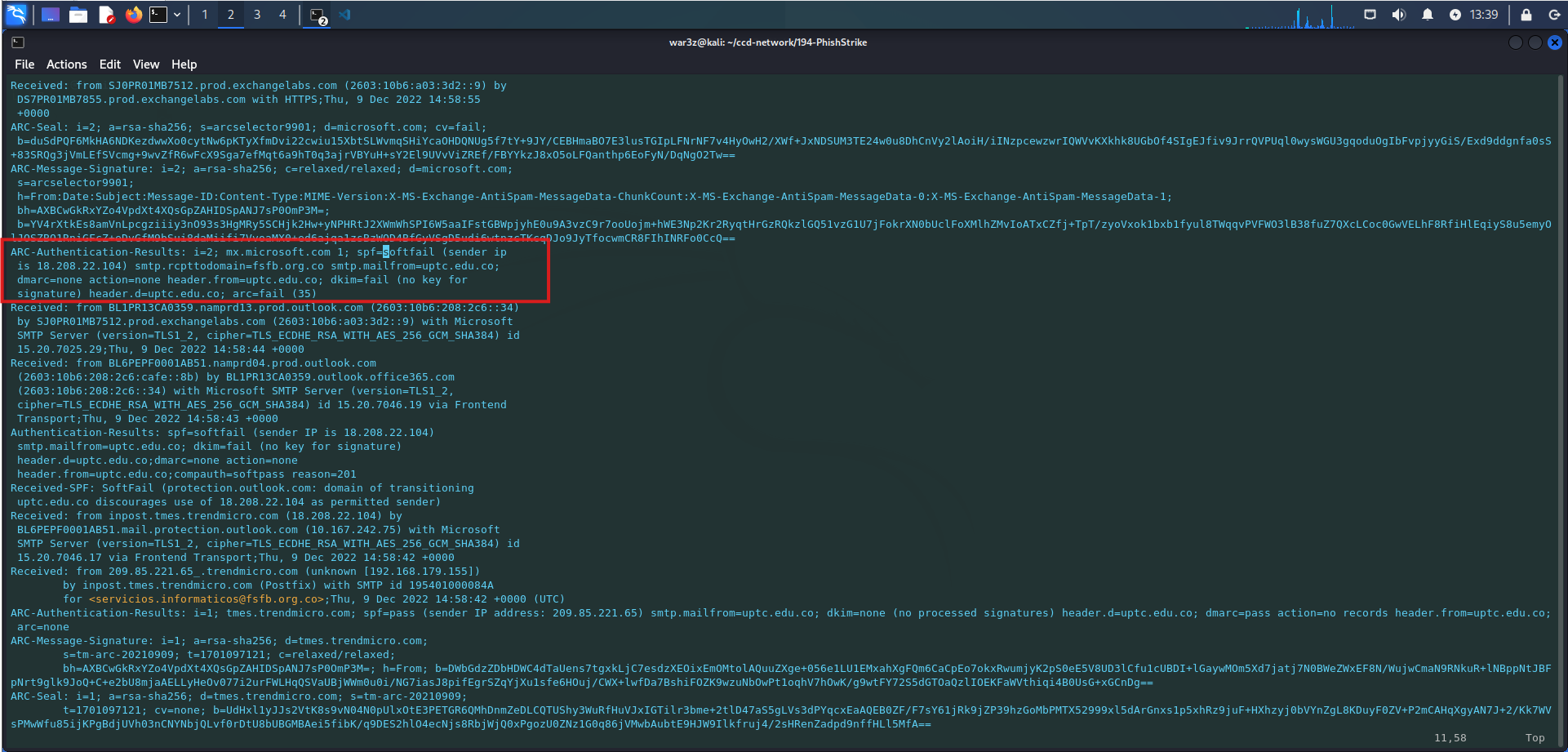
Q1 Identifying the sender's IP address with specific SPF and DKIM values helps trace the source of the phishing email. What is the sender's IP address that has an SPF value of softfail and a DKIM value of fail?
Sender Policy Framework (SPF) and DomainKeys Identified Mail (DKIM) are email authentication protocols that enhance email security. SPF verifies that a mail server is authorized to send emails on behalf of a domain, while DKIM ensures the integrity of the email content by using cryptographic signatures. In this case, analyzing the headers reveals that the sender's IP address is 18.208.22.104, which has an SPF value of “softfail” and a DKIM value of “fail.” A “softfail” in SPF indicates that the sending server is not explicitly authorized but may still send emails on behalf of the domain. The DKIM failure suggests the email signature is missing or invalid, confirming the likelihood of spoofing.
Q2 Understanding the return path of an email is essential for tracing its origin. What is the return path specified in this email?
The Return-Path header in an email serves as the address to which bounces or error messages are sent. It plays a vital role in tracing the origin of an email and identifying potentially forged messages. In this phishing email, the re…
Unlock Your Full Learning Experience with BlueYard Labs
Sign up to track your progress, unlock exclusive labs, and showcaseyour achievements—begin your journey now! Join for Free