How to Become a Digital Forensics Analyst: A 2026 Career Roadmap
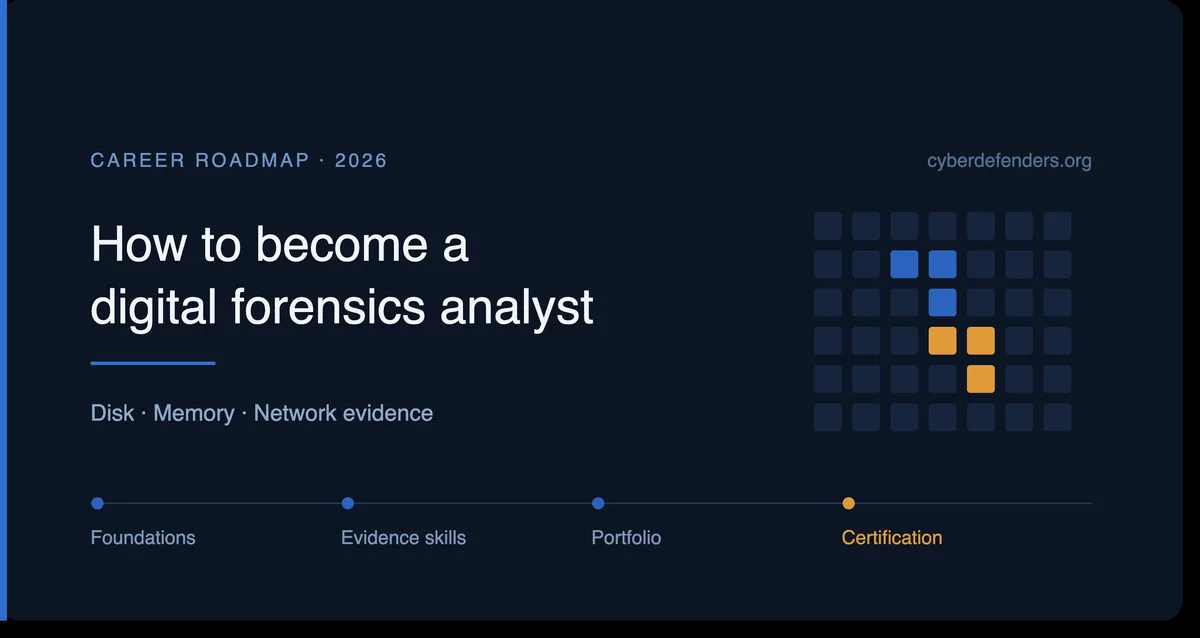
You do not need a computer science degree, a law enforcement badge, or a decade in IT to become a digital forensics analyst. You need four things: solid operating system and networking fundamentals, hands-on skill with the three core evidence types (disk, memory, and network), a portfolio that proves you can run an investigation end to end, and a credential that validates all of it under pressure. This roadmap covers how to build each one, with the 2026 salary data, certification costs, and hiring realities you should plan around.
What does a digital forensics analyst do?
A digital forensics analyst recovers, preserves, and analyzes digital evidence to reconstruct what happened on a system: who did what, when, how, and what it touched. The raw material is disk images, memory dumps, event logs, network captures, mobile extractions, and cloud audit trails. The output is a documented, defensible finding that can survive a courtroom, a regulator, or an executive briefing.
The job splits into two career worlds, and choosing between them early will shape your path:
- Public sector and law enforcement. Criminal cases, fraud, and internal investigations. Heavier emphasis on evidence handling, chain of custody, and courtroom testimony. Often requires a degree or a sworn background, and pay is typically lower than the private sector.
- Enterprise DFIR (digital forensics and incident response). Intrusions, ransomware, business email compromise, and insider threats inside companies, consultancies, and incident response retainers. Faster paced, driven by live incidents rather than case backlogs. In Magnet Forensics' 2026 State of Enterprise DFIR report, cyber incidents continue to dominate enterprise investigation workloads.
Day to day, both worlds share the same core work: imaging and verifying evidence, building timelines from filesystem and registry artifacts, carving deleted data, analyzing memory for hidden processes, tracing attacker movement through logs and packet captures, and writing reports someone else can act on.
Digital forensics analyst salary and job outlook in 2026
Published averages for this title disagree wildly, and the reason matters more than any single number: "digital forensics analyst" covers everything from a police lab technician to a senior DFIR consultant, so any average blends two very different pay markets.
ZipRecruiter puts the US average at $74,125 as of July 2026, with most salaries falling between $40,000 (25th percentile) and $91,500 (75th percentile), and the 90th percentile at $130,000. The Bureau of Labor Statistics does not track the title separately. Its closest category, information security analysts, had a median wage of $124,910 in May 2024, with the bottom 10 percent under $69,660 and the top 10 percent above $186,420.
Read those two together rather than picking one. The ZipRecruiter spread reflects the full title range including public-sector lab roles; the BLS figure skews toward enterprise security work. Your own number depends less on the average than on which lane you enter.
The demand picture is far less ambiguous. BLS projects 29% employment growth for information security analysts from 2024 to 2034, much faster than the average occupation, with about 16,000 openings per year. Private-sector DFIR and consulting roles consistently pay above law enforcement and government positions, which is worth knowing before you pick a lane.
What skills do you need to become a digital forensics analyst?
The core skill is turning raw artifacts into a defensible story of what happened. Everything below serves that.
Foundations (non-negotiable):
- Windows internals. The registry, event logs, NTFS, prefetch, shellbags, and scheduled tasks. Most enterprise evidence is a Windows endpoint.
- Linux fundamentals and the command line. Enough to navigate filesystems, parse logs, and work with forensic tooling.
- Networking. TCP/IP, DNS, HTTP, and how to read a packet capture.
The three core evidence disciplines:
- Disk and endpoint forensics. Imaging, timeline reconstruction, deleted-data recovery, registry and artifact analysis.
- Memory forensics. Analyzing RAM captures with tools like Volatility 3 to find hidden processes, injected code, and credentials that never touch disk.
- Network forensics. Reconstructing attacks from packet captures and flow data with Wireshark and Zeek.
Tooling. Start free: Autopsy and The Sleuth Kit, Eric Zimmerman's tools, KAPE, Volatility 3, and Wireshark cover most of the fundamentals. Commercial suites like EnCase, FTK, X-Ways, and Magnet AXIOM show up in job listings, but the concepts transfer; nobody who can build a timeline by hand is blocked by an unfamiliar GUI.
Investigative discipline. Chain of custody, contemporaneous notes, and report writing. A finding you cannot document and defend does not exist. This is the skill hiring managers say is rarest, and it is also the one most self-taught candidates skip.
Scripting. Python is a force multiplier for parsing artifacts at scale, but it is not a gate. Learn it in parallel, not as a prerequisite.
Do you need a degree to become a digital forensics analyst?
For most private-sector roles, no; demonstrable hands-on ability now outweighs the diploma. Some law enforcement and government positions still hard-require a degree, so check the postings in your target lane.
The catch is that employers replaced the degree filter with an experience filter. In Cyberbit's 2026 Cybersecurity Readiness Report, 83% of cybersecurity roles required hands-on experience regardless of seniority, and 75% of junior roles demanded it too. The report calls it the Junior Paradox: you need experience to get the job that gives you experience. The roadmap below is built to break that loop by making your experience provable before anyone hires you.
How to become a digital forensics analyst in 6 steps
The path from zero to a first forensics role typically takes 12 to 24 months of consistent work. Here is the sequence.
1. Build the foundations (months 1-3)
Learn Windows internals, Linux basics, and networking before touching a forensic tool. A forensic artifact only means something if you know what normal looks like: what the registry does, how processes start, what a healthy authentication log shows. Free OS and networking courses are everywhere; the differentiator is whether you actually work on a live system while you study.
2. Learn the three evidence disciplines hands-on (months 3-9)
Work through disk, memory, and network forensics in that classroom order, but in real investigations, not slide decks. This is exactly how we structure our skill-based tracks on the CyberDefenders Cyber Range: the Network Forensics track (19 labs, easy) builds packet-analysis fundamentals, the Memory Forensics track (14 labs, medium) covers volatile-memory analysis with real malware artifacts, and the Disk Forensics track (19 labs, hard) takes you through disk images, deleted-data recovery, and registry examination. Everything runs in the browser with zero setup, and there is a free tier to start on.
3. Investigate real cases and build a portfolio (months 6-12, ongoing)
Hiring managers do not read course-completion certificates; they read evidence that you can investigate. Build it in public:
- Work labs built on real incidents and current attacker tradecraft. Our range includes cases like Operation Cronos (the LockBit takedown), RediShell (a Kinsing cryptomining intrusion), and CursorJack (endpoint and cloud forensics), so your portfolio references investigations that mirror real casework.
- Compete in Blue Team CTF challenges. Rankings and badges are verifiable proof of skill.
- Publish write-ups of retired challenges and your methodology (respecting platform disclosure rules). A GitHub repo of investigation timelines and a handful of clear write-ups beats a résumé keyword list every time.
4. Get a certification that proves practice, not recall (months 9-18)
Certifications matter most at the résumé-screen stage, and practical ones matter more than multiple-choice ones. The honest comparison:
- GIAC GCFE and GCFA are the most recognized forensics certs in enterprise job listings. They are strong credentials with a real cost: $999 per exam attempt and a $499 renewal every four years, before any training costs.
- CHFI and CFCE carry weight in law enforcement and legal-facing lanes.
- Certified CyberDefender (CCD) Level 1 is the entry-level credential, developed with Mandiant and PwC SOC managers, covering six domains that include DFIR and cloud forensics. The exam is 6 hours in a live, browser-based lab: 48 scenario-based questions you answer by investigating the environment, with no experience prerequisites and two attempts included.
- CCD Level 2, the threat hunting and DFIR certification (formerly CCD), is the destination credential for this career path once you have about a year of experience: its modules span evidence collection, disk and memory forensics, threat hunting, and malware analysis, validated by a 48-hour hands-on practical exam where you investigate real scenarios rather than answer questions about them.
Pick one practical certification and finish it. A completed practical cert plus a public portfolio is a stronger signal than three exam vouchers in progress.
5. Get in the door, even if the title is not "forensics" yet (months 12-24)
Few people land a pure forensics title first. The proven entry points:
- SOC analyst roles are the widest door. Tier 1 work builds log-analysis instincts, and Tier 3 work in most organizations includes forensic investigation. Our SOC Analyst Tier 1 through Tier 3 tracks map that exact progression, and the skills transfer directly (most analysts hit real forensics the first time an alert becomes an incident).
- eDiscovery and litigation support roles teach evidence handling and lead into forensics labs.
- IT support and sysadmin backgrounds convert well because they come with the "what does normal look like" knowledge built in.
Search postings for "digital forensics analyst," "forensic examiner," "DFIR analyst," "incident response analyst," and "security analyst," because the same job hides under all five titles.
6. Specialize and stay current (ongoing)
The field is moving fast enough that the 2026 version of this job differs from the 2023 version. Three shifts worth building toward:
- Cloud forensics. Evidence increasingly lives in M365, Azure, and AWS audit logs rather than on a disk you can image. It is now core curriculum, not an elective; we include cloud forensics in CCD Level 1 for exactly that reason.
- AI-assisted investigation. In Magnet Forensics' 2026 survey of 368 DFIR professionals, 68% now use AI in investigations, up from 20% in 2024. AI will not replace analysts, but analysts who can validate and document AI-assisted findings defensibly will outpace those who cannot.
- Mobile evidence. The same report flags mobile evidence as harder to access than ever, which keeps specialists in demand.
Digital forensics interview questions to prepare for
Most digital forensics interviews test three things: artifact knowledge, investigative reasoning under a scenario, and whether your process would hold up to scrutiny. Increasingly there is a fourth: a hands-on assessment, often a small disk image or packet capture with a time limit. Prepare for all four, not just the trivia.
Artifact and tooling questions:
- Walk me through what happens on an NTFS volume when a file is deleted. Can it be recovered, and when can it not?
- What Windows artifacts would you use to prove a program was executed? (Strong answers cover prefetch, ShimCache, Amcache, and UserAssist, and when each one exists.)
- What is the order of volatility, and how does it shape your collection process?
- How do you verify the integrity of a forensic image, and why does it matter?
- What can memory analysis show you that disk analysis cannot?
Scenario questions:
- A departing employee is suspected of taking data. Where do you look first? (USB device history, shellbags, browser activity, cloud-sync and email logs.)
- An endpoint just triggered a ransomware alert. Walk me through your first hour.
- A user clicked a phishing link three days ago. How do you establish what happened since?
Process and defensibility questions:
- Explain chain of custody and why it matters even when the case never reaches court.
- How do you document an investigation so another analyst could reproduce your findings?
- Tell me about an investigation where your first theory turned out to be wrong.
Two preparation notes. First, the scenario and "tell me about a time" questions do not require job experience: walking through a lab or CTF investigation you actually completed, including the wrong turn you took, is a fully legitimate answer and interviewers treat it as real evidence. Second, practice the hands-on portion the way it will be given, under time pressure and without hints, because that is the condition the assessment reproduces.
Start investigating this week
The gap between "interested in forensics" and "employable in forensics" is a few hundred hours of real investigation reps, and you can start those today for free:
- Create a free account and run your first investigation. Start with the Network Forensics track on the CyberDefenders Cyber Range.
- Planning the certification route? Review the CCD Level 1 syllabus if you are starting out, and the CCD Level 2 threat hunting and DFIR syllabus as the credential this roadmap builds toward.
Key takeaways
- Digital forensics analysts reconstruct incidents from disk, memory, network, mobile, and cloud evidence, and produce findings that hold up under legal or executive scrutiny.
- Demand is strong: BLS projects 29% growth (2024-2034) for the closest tracked category, with entry pay around $50,000-$75,000 and six figures for experienced private-sector analysts.
- A degree is optional in most private-sector lanes, but provable hands-on experience is not: 83% of roles require it, including 75% of junior roles.
- The roadmap is foundations, then disk/memory/network skills built in real labs, then a public portfolio, then one practical certification, then an adjacent role like SOC analyst as the entry point.
- Cloud evidence, AI-assisted investigation, and mobile access hurdles are reshaping the job in 2026; build toward them early.
FAQ
How long does it take to become a digital forensics analyst?
Plan on 12 to 24 months of consistent hands-on work if you are starting from general IT knowledge, and faster if you are already a SOC analyst or sysadmin. The timeline is driven by investigation reps, not course hours.
Can I become a digital forensics analyst without a degree?
Yes, in most private-sector and consulting roles, provided you can show hands-on evidence: lab and CTF history, public write-ups, and a practical certification. Some law enforcement and government roles still require a degree.
Is digital forensics a good career in 2026?
Yes by the numbers: 29% projected growth for the closest BLS category through 2034, about 16,000 openings a year, and expanding scope as cloud and mobile evidence grow. It rewards people who like puzzles, documentation, and finishing an argument with proof.
Do digital forensics analysts need to know programming?
Not to start. Python for parsing artifacts and automating triage makes you faster and more employable, but investigation methodology and artifact knowledge come first.
What is the difference between digital forensics and DFIR?
Digital forensics is the evidence discipline: acquiring and analyzing data to establish what happened. DFIR pairs it with incident response, the live process of containing and remediating an attack. Enterprise roles increasingly expect both, which is why practicing them together beats learning them separately.
Sources
- BLS Occupational Outlook Handbook: Information Security Analysts (median wage $124,910 in May 2024; 29% projected growth 2024-2034; ~16,000 openings/year)
- ZipRecruiter: Digital Forensics Analyst Salary ($74,125 average, $40,000-$91,500 25th-75th percentile, July 2026)
- Glassdoor: Digital Forensics Analyst Salary (~$124,000 average total pay, 2026)
- Magnet Forensics 2026 State of Enterprise DFIR Report (68% of 368 surveyed DFIR professionals use AI in investigations, up from 20% in 2024; cyber incidents dominate workloads; mobile evidence harder to access)
- Cyberbit 2026 Cybersecurity Readiness Report (83% of roles and 75% of junior roles require hands-on experience; the Junior Paradox)
- GIAC Certification Pricing ($999 per certification attempt; $499 renewal)