SOC Analyst Tools: The Complete Guide for Security Teams
SOC Analyst Tools: The Complete Guide for Security Teams
SOC tools are the technology stack that lets security analysts monitor threats across an entire organization, investigate suspicious activity, and respond before attackers achieve their objectives.
From Security Information and Event Management (SIEM) platforms that aggregate millions of log events, to Endpoint Detection and Response (EDR) solutions watching every process on every device, the right toolkit transforms a reactive team into a proactive defense force.
Every second counts in a Security Operations Center. The difference between a contained breach and a catastrophic incident often comes down to one thing: the SOC analyst tools in your team's hands.
This guide covers the essential categories of SOC analyst tools, what each one does, the leading solutions in each category, and how they connect into a unified security operations architecture.
Whether you're building a SOC from scratch or evaluating tools to fill gaps in your current stack, this is the resource you need.
What Are SOC Analyst Tools?
SOC analyst tools are software platforms that Security Operations Center teams use to monitor networks and endpoints, detect threats, investigate security incidents, and coordinate response actions.
They range from log aggregation platforms (SIEM) to automated response systems (SOAR) and form the technological backbone of every modern security operations center.
A well-integrated toolset lowers two key numbers:
- MTTD (Mean Time to Detect): how long it takes to spot a threat.
- MTTR (Mean Time to Respond): how long it takes to deal with it.
According to IBM's Cost of a Data Breach Report 2024, organizations with fully deployed security AI and automation identified breaches 108 days faster than those without.
SIEM Security Information and Event Management: The SOC's Central Nervous System
A SIEM platform is typically the first tool deployed in any SOC. It aggregates log data from every source across the IT environment, firewalls, endpoints, cloud infrastructure, applications, identity systems, and applies correlation rules and analytics to surface actionable security alerts.
Key SIEM Capabilities
1. Centralized log collection and normalization from hundreds of data sources.
2. Real-time correlation across events to detect multi-stage attack patterns.
3. Automated alerting with severity scoring and analyst assignment.
4. Compliance reporting for PCI DSS, HIPAA, SOC 2, ISO 27001, and others.
5. Threat hunting dashboards and historical log search.
Next-Generation SIEM
Modern SIEM platforms have evolved significantly. Next-gen SIEMs incorporate machine learning for behavioral anomaly detection, cloud-native architecture for scale, and native integration with threat intelligence feeds, significantly reducing false positive rates that plague traditional rule-based SIEMs.
For how an AI-powered SOC builds on these capabilities, see our guide: AI-powered SOC.
Leading SIEM Platforms
- Splunk Enterprise Security market leader, with a powerful SPL query language.
- Microsoft Sentinel has cloud-native, tight Azure integration and consumption-based pricing.
- IBM QRadar strong correlation engine, on-prem and cloud deployments.
- LogRhythm SIEM comprehensive TDIR lifecycle in a single platform.
- Elastic SIEM (free/open-source tier available)
CyberDefenders Tip: Hands-on SIEM experience is the #1 skill requested in SOC analyst job postings. Practice on our SIEM training labs before your next interview.
EDR Endpoint Detection and Response: Visibility Into Every Device
While a SIEM watches the environment broadly, EDR solutions go deep, monitoring every process, file change, network connection, and registry modification on individual endpoints in real time.
EDR tools are critical because most attacks ultimately touch an endpoint. Ransomware executes on a workstation. Credential theft happens on a server. Without EDR visibility, these activities are invisible until it's too late.
Key EDR Capabilities
1. Continuous behavioral monitoring of endpoints (laptops, servers, workstations)
2. Detection of fileless attacks, living-off-the-land (LOtL) techniques, and zero-day exploits.
3. Automated containment isolates an infected endpoint from the network with one click.
4. Forensic timeline reconstruction for post-incident investigation.
5. MITRE ATT&CK technique mapping for every detected behavior.
Leading EDR Platforms
- CrowdStrike Falcon, cloud-native, fastest detection speed in independent tests.
- SentinelOne Singularity autonomous AI-powered response.
- Microsoft Defender for Endpoint has deep Windows integration, included in M365 E5.
- Palo Alto Cortex XDR combines EDR with network and cloud telemetry.
- Carbon Black (VMware) has strong threat hunting capabilities.
XDR Extended Detection and Response: Breaking Down Silos
XDR platforms extend detection and response capabilities beyond endpoints to include network, cloud, email, and identity telemetry all correlated in a single platform. Where EDR gives you endpoint depth, XDR gives you cross-domain breadth.
XDR is the evolution of EDR for organizations dealing with complex, multi-vector attacks.
An attacker who enters via a phishing email, moves
laterally through the network, and exfiltrates data from a cloud storage bucket would trigger alerts across three different tools in a traditional stack. XDR correlates these into a single, high-fidelity incident.
Leading XDR Platforms
- Palo Alto Cortex XDR
- Microsoft Defender XDR (formerly Microsoft 365 Defender)
- CrowdStrike Falcon XDR
- Trend Micro Vision One
SOAR Security Orchestration, Automation, and Response: The Force Multiplier
A SOC analyst at a mid-sized enterprise might receive 500–1,000 alerts per day. Without automation, triaging and responding to each one is impossible.
SOAR platforms solve this by automating repetitive analyst tasks and orchestrating response actions across the entire security tool stack.
Key SOAR Capabilities
Playbook automation codified response workflows triggered by specific alert types, Integrated with 200+ security tools via pre-built connectors, and automated threat intelligence enrichment (IP reputation, domain age, malware hash lookup). Also, help in case management and analyst collaboration
MTTR reduction: Gartner research shows that mature SOAR deployments reduce response time by up to 90%
Leading SOAR Platforms
- Palo Alto Cortex XSOAR most comprehensive playbook library
- Splunk SOAR (formerly Phantom)
- IBM Security QRadar SOAR
- Swimlane strong case management
- Microsoft Sentinel (SOAR built-in via Logic Apps)
Threat Intelligence Platforms (TIP): Knowing Your Enemy
Threat Intelligence Platforms collect, normalize, and operationalize threat data from dozens of feeds. Those sources include commercial threat intel, open-source OSINT, ISACs, dark web monitoring, and government feeds such as CISA advisories.
For an analyst, this changes the value of a single indicator. An IP address goes from "unknown" to "known botnet C2 linked to LockBit ransomware" in milliseconds.
Key TIP Capabilities
1. IOC (Indicator of Compromise) management and distribution to detection tools.
2. TTP (Tactics, Techniques, Procedures) tracking via MITRE ATT&CK framework mapping.
3. Threat actor profiling and campaign tracking.
4. Automated IOC blocking via SIEM/firewall/EDR integrations.
Leading TIP Platforms
- Recorded Future's premier commercial platform with AI-driven analysis.
- Anomali ThreatStream.
- CrowdStrike Falcon Intelligence.
- MISP (Malware Information Sharing Platform) leading open-source option.
- OpenCTI is free, community-driven, MITRE ATT&CK native.
NDR Network Detection and Response: Catching What Endpoints Miss
NDR tools analyze east-west and north-south network traffic. Their job is to catch threats that slip past endpoint controls.
Some attacker behavior leaves no endpoint trace at all. Encrypted command-and-control channels, internal reconnaissance, and staged lateral movement are good examples. The network behavior, though, is always there to see.
Leading NDR Platforms
- Darktrace (AI-powered behavioral analysis)
- ExtraHop Reveal(x)
- Vectra AI.
- Cisco Stealthwatch.
UEBA User and Entity Behavior Analytics: Detecting the Insider Threat
UEBA platforms build a behavioral baseline for every user and device. When behavior drifts from that baseline, they alert.
This is the main tool for three hard problems: insider threats, stolen credentials, and slow APT campaigns that rule-based detection never catches.
Example: a privileged user downloads 10GB of data at 2am on a Saturday, from an unusual location. A legacy SIEM fires zero rule-based alerts. UEBA flags it immediately as high severity.
Leading UEBA Platforms
- Splunk UBA.
- Microsoft Defender for Identity.
- Varonis.
- Securonix UEBA.
Vulnerability Management Tools: Finding Weaknesses Before Attackers Do
Vulnerability management tools continuously scan and assess the organization's attack surface, identifying unpatched software, misconfigurations, exposed credentials, and other exploitable weaknesses before threat actors can use them.
Leading Vulnerability Management Platforms
- Tenable Nessus / Tenable.io industry standard for vulnerability scanning.
- Qualys VMDR.
- Rapid7 InsightVM.
- OpenVAS leading free/open-source scanner.
Packet Analyzers & Network Forensics
When an incident occurs, packet capture and analysis tools let analysts reconstruct exactly what happened at the network level, what data was transferred, which systems communicated, and what protocols were used.
- Wireshark is a free, industry-standard packet analyzer.
- Zeek (formerly Bro) open-source network analysis framework.
- NetworkMiner is a passive network sniffer and forensic analyzer.
- The tcpdump command-line packet capture is essential for SOC analysts.
CSPM Cloud Security Posture Management
As organizations migrate to AWS, Azure, and GCP, misconfigurations become the #1 cloud security risk (Gartner). CSPM tools continuously monitor cloud environments for configuration drift, policy violations, compliance failures, and over-privileged access.
- Palo Alto Prisma Cloud
- Wiz fastest-growing CSPM platform
- Orca Security
- AWS Security Hub (free with AWS)
Penetration Testing & Red Team Tools
SOC teams increasingly conduct purple team exercises using offensive tools to validate that their detections actually work. Key tools include:
- Metasploit Framework open-source exploitation framework.
- Cobalt Strike commercial adversary simulation platform.
- Atomic Red Team open-source library of MITRE ATT&CK-aligned test cases.
- Nmap essential network scanner for reconnaissance simulation.
CyberDefenders Tip: Practice detecting red team techniques in our Blue Team Labs the same tools your red team uses are mapped to MITRE ATT&CK detections, you can build in your SIEM.
SOC Case Management & Ticketing
Effective SOC operations require structured incident tracking. Dedicated case management tools or ITSM platforms adapted for security ensure no incident falls through the cracks and provide audit trails for compliance.
- ServiceNow SecOps.
- Jira (with security project templates)
- TheHive free, open-source SOC case management.
- RTIR (Request Tracker for Incident Response)
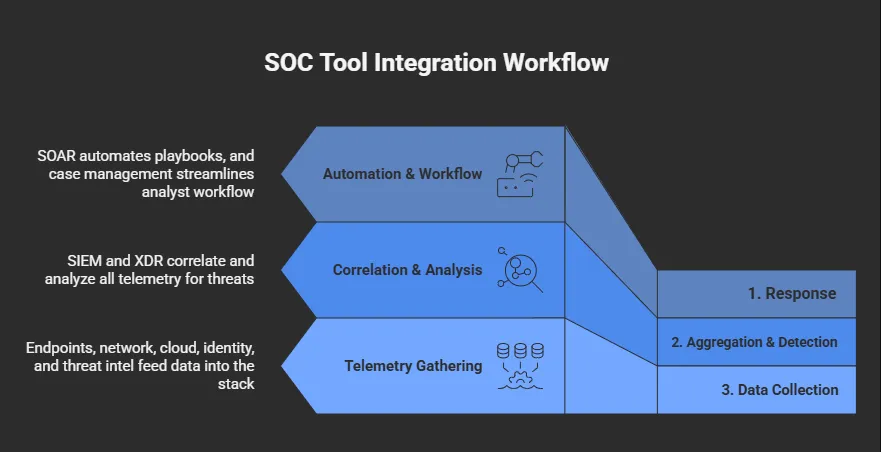
How SOC Tools Integrate: The Full Security Operations Stack
The integration layer matters as much as the tools themselves. Prioritize platforms with open APIs and native SIEM integrations. Most leading vendors support the OCSF (Open Cybersecurity Schema Framework) standard for data interoperability.
Free SOC Tools vs. Paid Platforms
Not every organization has the budget for enterprise platforms. Below are the best free alternatives for each category:
1. SIEM: Elastic SIEM (free tier), Wazuh (open-source)
2. EDR: Wazuh, Microsoft Defender (included with Windows)
3. Threat Intelligence: MISP, OpenCTI, AlienVault OTX
4. Vulnerability Scanning: OpenVAS, Nuclei
5. Network Analysis: Wireshark, Zeek, tcpdump
6. Case Management: TheHive
7. Packet Analysis: Wireshark, NetworkMiner
CyberDefenders Tip: Our free Blue Team Labs give you hands-on practice with enterprise-grade SOC tools, including Splunk, Elastic, and CrowdStrike in realistic lab environments, no licenses required.
Frequently Asked Questions About SOC tools:
Q: What tools does a SOC analyst use?
A: SOC analysts typically use a combination of SIEM (e.g., Splunk, Microsoft Sentinel), EDR (e.g., CrowdStrike, SentinelOne), SOAR platforms for automation, Threat Intelligence Platforms (TIPs), network monitoring tools, and vulnerability scanners. The specific stack varies by organization size and maturity level.
Q: What is the most important SOC tool?
A: The SIEM is widely considered the foundational SOC tool because it aggregates all security telemetry into one place. However, without EDR providing endpoint visibility and SOAR providing automation, the SIEM alone cannot deliver modern SOC effectiveness.
Q: What is the difference between SIEM and SOAR?
A: A SIEM detects threats by correlating log data and generating alerts. A SOAR responds to those alerts by automating investigation and remediation workflows. They are complementary; most mature SOCs use both, often integrated with the SIEM, sending alerts directly to SOAR playbooks.
Q: What is the difference between EDR and XDR?
A: EDR (Endpoint Detection and Response) monitors only endpoint devices. XDR (Extended Detection and Response) extends this to include network, cloud, email, and identity telemetry, correlating threats across all these domains in a single platform.
Q: What free SOC tools are available?
A: Leading free SOC tools include Wazuh (SIEM/EDR), MISP (Threat Intelligence), OpenVAS (Vulnerability Scanning), Wireshark (Packet Analysis), TheHive (Case Management), Zeek (Network Analysis), and Elastic SIEM. Most support enterprise-level use cases with community support.
Q: How do SOC tools integrate with MITRE ATT&CK?
A: Most modern SOC tools, particularly EDR, SIEM, and SOAR platforms, map their detections to the MITRE ATT&CK framework. This allows SOC analysts to understand exactly which tactic and technique an alert corresponds to, prioritize response based on attack stage, and identify gaps in detection coverage using the ATT&CK Navigator.
Q: What SOC tools should a beginner learn first?
A: Start with Splunk (SIEM fundamentals), Wireshark (network analysis), and an EDR platform like Microsoft Defender or CrowdStrike Falcon Go. These three tools appear in the majority of SOC analyst job requirements and form the core of any professional's skill set.
Q: How many tools does a typical SOC use?
A: Industry research (ESG, 2024) found that the average enterprise SOC uses between 25-45 different security tools. However, most practitioners agree that tool sprawl reduces effectiveness, and a well-integrated stack of 8–12 high-quality tools outperforms a fragmented collection of 40+ siloed products.
Start Building Your SOC Skills Today
Understanding SOC tools on paper is one thing. Being able to actually operate them under pressure during a live investigation, with an attacker actively moving through your environment, is what separates effective analysts from exceptional ones.
CyberDefenders offers hands-on, realistic blue team labs built around the exact SOC tools used in enterprise environments. Practice SIEM analysis, EDR investigations, threat hunting, and incident response in scenarios modeled on real-world attacks.
➜ Explore CyberDefenders Blue Team Labs Free to Start: Cyber Range.
➜ View the SOC Analyst Learning Path: SOC Analyst Track.