MITRE ATT&CK Training: How to Turn Framework Knowledge Into Investigation Skills
The MITRE ATT&CK framework has become the shared language of cyber defense. Detection engineers map rules to it, threat intel teams profile adversaries with it, and CISOs report gaps to the board in its terms.
But understanding the framework and applying it during a real investigation are two very different capabilities. An analyst can recognize technique names like Phishing, Process Injection, or OS Credential Dumping and still freeze when those behaviors surface in endpoint logs, network traffic, or a memory dump.
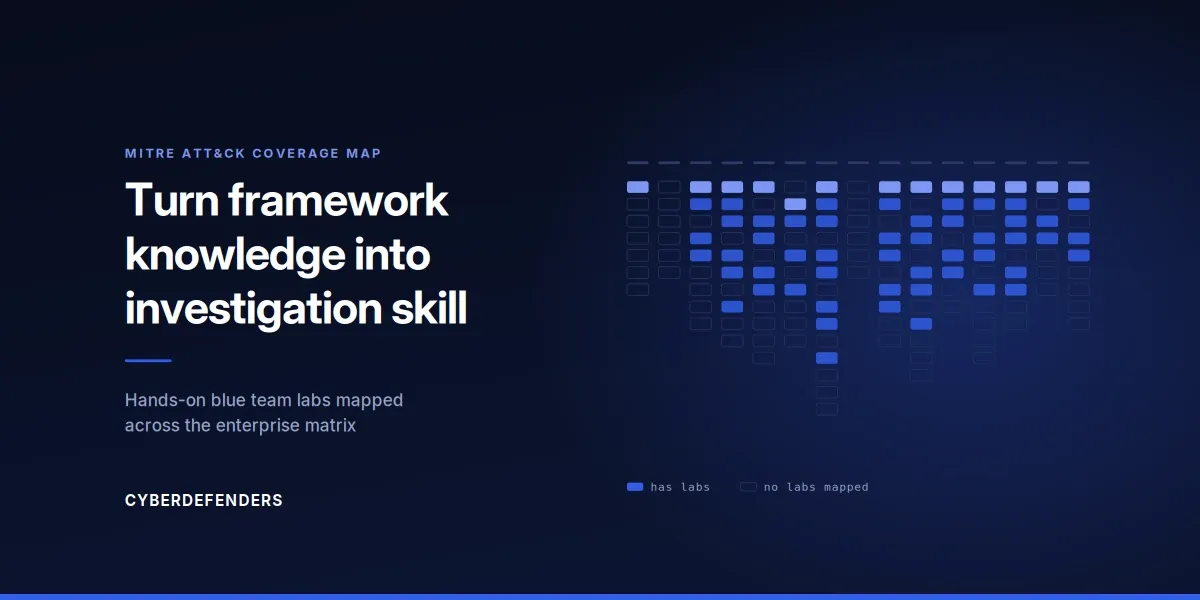
That gap between framework knowledge and investigation skill is exactly what the CyberDefenders MITRE ATT&CK coverage map helps address. The map spans all 15 enterprise tactics and shows which techniques have hands-on labs mapped to them, giving defenders a structured way to find and practice specific adversary behaviors.
For individual defenders, that turns ATT&CK from a reference matrix into a structured training path. For security leaders, it provides an internationally recognized framework for structuring and planning workforce development.
What Is the MITRE ATT&CK Framework?
MITRE ATT&CK (Adversarial Tactics, Techniques, and Common Knowledge) is a publicly available knowledge base of adversary tactics and techniques derived from real-world observations. Rather than cataloging malware samples or CVEs, it catalogs how attackers operate, which is why organizations use it as a foundation for threat modeling, behavioral detection engineering, cyber threat intelligence, incident response, and other threat-informed defense activities.
The four layers of adversary behavior
- Tactics represent an adversary's objective: the reason behind an action.
- Techniques describe how the adversary may achieve that objective.
- Sub-techniques provide more specific variations of a technique.
- Procedures describe how particular threat actors or malware have implemented those behaviors in the wild.
The Enterprise matrix spans 15 tactics that follow the arc of an intrusion, from Reconnaissance and Initial Access, through Persistence, Credential Access, and Lateral Movement, to Exfiltration and Impact. Some tactics run deep: Defense Evasion alone contains more than 40 techniques.
One objective, many evidence trails
For example, an attacker pursuing the Credential Access tactic might dump credentials from LSASS (OS Credential Dumping, T1003), raid browser and application password stores, request service tickets for offline cracking (Kerberoasting, T1558.003), or harvest unsecured credentials left in scripts and configuration files. Same objective, very different evidence trails, and an analyst needs to recognize each one.
If you want the full operational playbook (mapping detections, building Navigator layers, structuring hunts), we've written a complete practitioner guide: MITRE ATT&CK: The Full Guide for SOC & DFIR. This article focuses on the training side: how to turn the framework into hands-on skill.
The Gap Between ATT&CK Knowledge and Investigation Skill
Here's the uncomfortable truth about most ATT&CK adoption: it stops at the spreadsheet. Teams map their SIEM rules to technique IDs, color-code a Navigator layer, and call it coverage.
What actually lands on an analyst's desk
Real investigations are never presented as clean, clearly labeled ATT&CK examples. What actually arrives looks like:
- A suspicious process tree.
- A PowerShell command hidden inside a script.
- A packet capture containing command-and-control traffic.
- Cloud audit logs showing an unexpected privilege change.
- A phishing message that led to activity across several systems.
The questions that matter in the moment
And those questions are stubbornly practical:
- What does OS Credential Dumping (T1003) actually look like in memory, and in your logs?
- Can your analysts distinguish legitimate administrative use of PsExec from lateral movement during an active incident?
- When ransomware operators delete shadow copies to inhibit system recovery (T1490), would your team catch it before data encryption for impact (T1486)?
You can't answer those from documentation. The analyst has to determine what happened, reconstruct the sequence of events, identify the relevant evidence, and communicate the impact. Reading a technique description doesn't build that muscle. Investigating the technique does.
That's the design principle behind our ATT&CK training approach: the labs are designed around realistic, defender-focused investigations, and mapped investigations carry the framework behaviors they exercise.
How the CyberDefenders ATT&CK Coverage Map Works
The coverage map presents the full enterprise matrix (all 15 tactics, with hundreds of techniques and sub-techniques) and marks each technique as either has labs or no labs mapped.
Find labs mapped to specific techniques
The map connects ATT&CK tactics, techniques, and sub-techniques to hands-on CyberDefenders labs, making it easier to find investigations that let you practice specific adversary behaviors.
No environment to build
Every lab runs in the browser: no VMs to build, no environment setup, no training infrastructure to maintain. The distance between "I should practice this" and actually practicing it is one click.
Explore the ATT&CK coverage map: see which techniques have hands-on labs and choose an investigation to practice with a free account.
What ATT&CK-Mapped Labs Look Like in Practice
Two examples from the lab catalog show how a single investigation exercises multiple framework behaviors.
PsExec Hunt: tracing lateral movement through network evidence
PsExec Hunt (Network Forensics) starts the way real incidents do, with an IDS alert flagging suspicious lateral movement. You analyze SMB traffic in a PCAP with Wireshark to trace the attacker's entry point, the machines they pivoted to, and the administrative shares they abused (Remote Services: SMB/Windows Admin Shares, T1021.002). One lab, four tactics practiced: Execution, Defense Evasion, Discovery, and Lateral Movement.
DumpMe: finding a hidden process in memory
DumpMe (Endpoint Forensics) hands you a memory dump from a machine infected with Meterpreter malware. Using Volatility, you identify the malicious process, trace how it hid itself in memory (Process Injection, T1055), analyze its network connections, and extract indicators of compromise, practicing Execution, Defense Evasion, and Command and Control behaviors along the way.
The goal in every lab isn't just reaching the correct answer. It's understanding why the evidence matters, what alternative explanations you ruled out, which ATT&CK behaviors appeared, and how you'd communicate the findings.
How to Use the Coverage Map for Structured Training
1. Pick a priority tactic
Start with an area that matches your role. SOC analysts often begin with Initial Access, Execution, Credential Access, or Command and Control. Threat hunters gravitate toward Persistence, Defense Evasion, Discovery, and Lateral Movement: the registry run keys, scheduled tasks, and token manipulation attackers rely on to dig in and stay quiet. Cloud-focused defenders look for identity, audit log, and control-plane scenarios.
2. Find the mapped techniques
Browse the techniques under that tactic and identify the ones with labs. This converts a vague goal like "improve threat-hunting skills" into a specific, behavior-level learning objective: "I can recognize Kerberos ticket abuse in authentication evidence" rather than "I know what Credential Access is."
3. Complete the investigations
Work through the evidence, not just the questions.
4. Review the techniques you've practiced
After completing the investigations, review the ATT&CK techniques covered by the labs you've worked through and identify areas you want to practice next.
5. Choose what to practice next
You don't need to cover every technique. Prioritize the behaviors relevant to your role, your organization's technology stack, and your threat model. For a guided sequence instead of self-directed selection, learning tracks chain related labs into role-based paths.
Learning Coverage Is Not Security Coverage
One distinction worth being direct about: completing a lab shows an analyst has practiced investigating particular adversary behaviors. It does not prove your organization can detect, prevent, or respond to those behaviors in production.
Organizational coverage requires detection validation, control testing, telemetry assessments, purple team exercises, and adversary emulation. The coverage map is the human-skills layer of a threat-informed defense program: a critical layer, but only one layer. Teams that combine trained analysts with validated detections are the ones that perform when it counts. Treat the map as a learning aid, not a replacement for validated competency assessment or technical control testing.
Start Building Practical MITRE ATT&CK Skills
The MITRE ATT&CK framework is extensive, and memorizing every technique ID is neither realistic nor useful. What matters is pattern recognition under pressure, and that comes from seeing techniques in evidence, repeatedly, in realistic scenarios.
Practitioners: Explore the ATT&CK coverage map and start your first mapped investigation with a free account.
Security leaders: Book a conversation about enterprise training to see how role-based development works for your team.
Frequently Asked Questions
What is the MITRE ATT&CK framework?
The MITRE ATT&CK framework is a publicly available knowledge base that organizes observed adversary behavior into tactics, techniques, and sub-techniques. Security teams use it for threat intelligence, detection engineering, threat hunting, incident response, security assessments, and adversary emulation.
What is MITRE ATT&CK training?
MITRE ATT&CK training teaches defenders how adversary tactics and techniques appear in real security evidence. Effective training goes beyond reading framework documentation. It requires analysts to investigate realistic endpoint, network, memory, disk, email, identity, or cloud artifacts and determine what happened.
How do I practice MITRE ATT&CK techniques hands-on?
Use investigation labs mapped to the framework. The CyberDefenders ATT&CK coverage map shows which techniques across all 14 enterprise tactics have hands-on blue team labs. Each lab is a realistic, browser-based investigation of packet captures, memory dumps, disk images, or cloud logs, giving you hands-on practice with the ATT&CK behaviors involved.
How does CyberDefenders use the MITRE ATT&CK framework?
CyberDefenders maps its blue team labs to ATT&CK tactics, techniques, and sub-techniques on an interactive coverage map. This makes it easier to find hands-on investigations associated with specific adversary behaviors across the framework.
Is CyberDefenders an official MITRE product?
No. CyberDefenders is an independent cybersecurity training platform that uses the MITRE ATT&CK framework to organize and map hands-on lab content. MITRE ATT&CK® and ATT&CK® are registered trademarks of The MITRE Corporation.
Does completing a mapped lab prove that a technique is covered in my organization?
No. Lab completion represents learning and practice coverage. Organizational coverage must be evaluated through telemetry reviews, detection testing, control validation, incident exercises, and other technical assessments.
Can enterprises use CyberDefenders for security team training?
Yes. Organizations use ATT&CK-aligned CyberDefenders labs for structured learning, analyst onboarding, role-based development, skills-gap identification, and threat-informed training initiatives. Enterprise plans include team management and progress visibility.
Is the MITRE ATT&CK framework only for advanced professionals?
No. Beginners can use the framework to understand common attacker behaviors, while experienced professionals apply it to threat hunting, detection engineering, purple teaming, and incident-response planning.