Cyber Incident Reporting Deadlines: What Your SOC Must Do (2026)
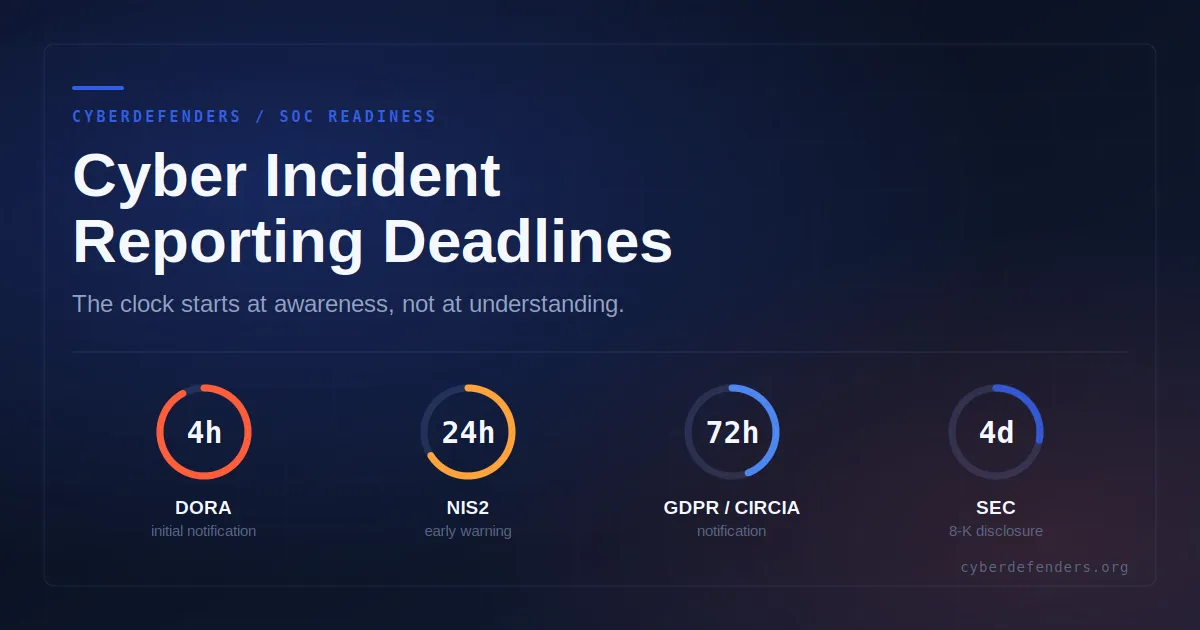
Cyber incident reporting deadlines are shorter than most security teams assume, and they start earlier. Four business days. That is how long a US public company has to disclose a material cyber incident once it determines the incident is material. Under NIS2, an EU essential entity gets 24 hours from awareness to file an early warning. A bank under DORA can owe its regulator an initial notification four hours after classifying an incident as major. And when CISA finalizes its CIRCIA rule, expected this fall, critical infrastructure operators will get 72 hours for covered incidents and 24 hours for ransom payments.
Every one of these regimes shares a design choice that decides everything for the team on the floor: the clock starts when you become aware of an incident, not when you understand it. Awareness arrives on day one. Understanding is something your SOC has to produce under pressure, while the incident is still moving.
That is why reporting deadlines are not really a legal problem. Legal signs the filing, but every fact in it (what happened, which systems, what data, what impact) has to come out of your security operation in the first hours. A team that cannot investigate fast cannot report on time, no matter how good the lawyers are.
What are the current cyber incident reporting deadlines?
As of 2026, the major cyber incident reporting requirements are: four business days under the SEC cybersecurity disclosure rule (from the materiality determination), 24 then 72 hours under NIS2, as little as four hours under DORA, 72 hours under GDPR, and 72 hours under CIRCIA once the final rule takes effect. All of them run from awareness or determination, never from the end of your investigation.
Primary frameworks
| Framework | Who it covers | First deadline | What follows |
|---|---|---|---|
| SEC cybersecurity disclosure rule (Form 8-K, Item 1.05) | US public companies | Four business days from determining an incident is material; the determination itself must be made without unreasonable delay | Amended filings as material facts emerge |
| NIS2 (Article 23), as transposed into national law | EU essential and important entities | Early warning within 24 hours of awareness of a significant incident | Incident notification at 72 hours; final report within one month of the incident notification |
| DORA (Article 19), with time limits set by RTS (EU) 2025/301 | EU financial entities | Initial notification within four hours of classifying an incident as major, and no later than 24 hours after awareness | Intermediate report within 72 hours of the initial notification; final report within one month of the intermediate report |
| GDPR (Article 33) | Any organization processing EU personal data | Notify the supervisory authority within 72 hours of becoming aware of a personal data breach | Reasons required for any delay; information can follow in phases |
| CIRCIA (final rule expected September 2026) | US critical infrastructure across the 16 sectors | 72 hours from reasonable belief that a covered cyber incident occurred | Ransom payments reported within 24 hours of payment; supplemental reports as new information emerges |
Sector and regional deadlines
| Framework | Who it covers | First deadline | Notes |
|---|---|---|---|
| NYDFS Part 500 (500.17) | NY-regulated financial institutions | 72 hours from determining a cybersecurity event occurred | Extortion payments notified within 24 hours |
| HIPAA Breach Notification Rule | US covered entities and business associates | Notify affected individuals without unreasonable delay and no later than 60 calendar days from discovery | HHS notified within 60 days for breaches affecting 500 or more individuals, annually for smaller breaches |
| UK GDPR (Article 33) | Organizations processing UK personal data | 72 hours from awareness, to the ICO | UK NIS Regulations 2018 apply a separate 72-hour duty to operators of essential services |
| Australia, Security of Critical Infrastructure Act 2018 | Responsible entities for critical infrastructure assets | 12 hours for incidents with a significant impact; 72 hours for a relevant impact, to ASD's ACSC | Notifiable Data Breaches scheme runs separately under the Privacy Act 1988 |
| Singapore Cybersecurity Act 2018 | Owners of critical information infrastructure | 2 hours from becoming aware of a prescribed incident | Supplementary details follow within 14 days |
Last verified: July 2026. The list is not exhaustive, and every US state runs its own breach notification law. A multinational incident does not start one clock. It starts several, at different speeds, with different definitions of severity.
Why reporting deadlines are an investigation problem, not a paperwork problem
Every reporting regime asks for the same core facts: what happened, when, how, which systems and data are affected, whether it is contained, and what the impact looks like. Those are investigation outputs. A SOC incident reporting deadline is an investigation deadline with a legal signature on it.
The first year of the SEC rule shows what that means in practice. In an analysis by Debevoise & Plimpton, published on the NYU Program on Corporate Compliance and Enforcement blog, the 26 companies that filed a material-incident 8-K took a mean of 7.88 business days and a median of 4.5 business days between detecting an incident and disclosing it. Nearly half filed within four business days of detection, which is faster than the rule requires, since the four-day clock runs from the materiality determination rather than from detection. Only seven of those 26 identified a material impact in their initial filing, and 13 went on to file amendments as the picture changed.
Read that carefully, because it cuts two ways. Some companies were pushed by the clock. Others chose to disclose early, and Debevoise's own advice to clients is to resist that impulse and not rush a filing before the facts support it. Either way the constraint is the same: whatever goes into that first filing has to come from the security team, on a timeline measured in days, and the quality of those facts is set entirely by how fast the SOC can scope an intrusion.
The frameworks are honest about this. NIS2 and DORA stage their reports precisely because they expect you to know more at 72 hours than at 24. What none of them accepts is silence while you investigate. Withholding notification until the picture is complete is itself a violation.
Detection speed sits underneath all of it. IBM's 2025 Cost of a Data Breach report put the average time to identify a breach at 181 days. Every one of those days is a day the reporting clock has not started, but a regulator reconstructing your timeline will ask when you reasonably should have been aware, and a SOC that let the first alert sit in a queue for a week will have to defend that in writing. The same capability gap that inflates breach costs, which we broke down in the hidden cost of an under-skilled security team, now carries regulatory deadlines on top.
What does your team actually have to be able to do?
Six capabilities decide whether the deadline is met, and none of them is writing the report itself.
- Recognize an incident fast enough to control the clock. Most SOCs still start incident response reactively, from an alert someone eventually escalates. The gap between "alert fired" and "incident declared" is invisible on dashboards and fatal on reporting timelines, and telling a routine alert from the doorway into an intrusion is exactly where analysts fail their first real incident response.
- Classify against reporting thresholds, not just severity labels. Covered and substantial (CIRCIA), significant (NIS2), major (DORA), and material (SEC) all mean specific things. Someone on shift has to recognize when a live incident is trending toward a threshold within hours, which takes criteria agreed with legal in advance plus analysts who can apply them to an incomplete picture.
- Scope the incident in hours. Which systems, which accounts, what data, how the attacker got in, and whether activity is ongoing. Read the required contents of a NIS2 72-hour notification and you are reading an investigation checklist. Teams that scope narrowly file wrong and amend later, in public.
- Contain without destroying evidence. The one-month final reports, and any regulator follow-up, depend on artifacts collected while the team was firefighting. Reimaging your way to containment can leave you unable to answer the questions the final report requires.
- Translate technical findings into business impact. The materiality call belongs to executives and counsel, but they make it on facts the SOC supplies: users affected, records exposed, downtime, recovery cost. An analyst who can only describe an incident in process trees cannot feed that decision.
- Keep a timeline you can defend. Who detected what, when, what was decided, and what was done. Regulators judge the narrative as much as the incident, and sloppy contemporaneous notes turn into amended filings and uncomfortable enforcement conversations.
How do you build a SOC that can meet the clock?
Reporting readiness is built the same way response readiness is built: with measured, repeated practice under realistic conditions, then validation. The difference is what you practice.
- Baseline the team against realistic scenarios. Before drilling anything, find out who can actually scope an intrusion in hours and who stalls. Resumes and course completions will not tell you; hands-on assessment will.
- Drill the first 72 hours, hands-on. Tabletop exercises test the escalation chart. They do not build the analyst capability the filing depends on. Give the team reps on scenarios built from real attack data, with the mess left in, on the CyberDefenders Cyber Range.
- Make the write-up part of every rep. If the report is a deliverable of the investigation, practice producing it: findings, scope, impact, and timeline documented under a clock. Most training stops short of this. The CCDL2 curriculum covers it directly, with a post-incident module on writing an effective IR report, alongside the disk, memory, network and threat-hunting work that produces the findings a report has to carry. Set the Tier 1 foundation first with CCDL1.
- Measure speed and quality, and benchmark them. Track time to escalation, time to scope, and investigation quality so readiness is reportable upward. This is what an enterprise readiness program gives managers: dashboards that show who is ready before a regulator tests it.
- Repeat on a cadence. CIRCIA lands soon, teams churn, and attacker tradecraft moves. A one-time exercise proves last quarter's readiness, not this one's.
The deadlines are fixed. Your readiness is the variable.
Regulators have already decided how fast your organization has to be. The only thing left to decide is whether your team finds out its real speed in practice or in production.
- Give your team reps on real attack data. Start with the CyberDefenders Cyber Range.
- Set a Tier 1 readiness standard. Point developing analysts at CCDL1, aligned with the NIST Cyber Defense Analyst role.
- Prove investigation capability under a clock. Validate experienced analysts with CCDL2 and its 48-hour practical exam.
- Find out where the gaps are before a regulator does. If you own compliance rather than the SOC, a capability baseline tells you which reporting deadlines your organization can realistically meet today. Talk to us about a team readiness assessment.
Key takeaways
- Cyber incident reporting deadlines run from awareness or determination, not from the end of the investigation: four business days (SEC), 24 then 72 hours (NIS2), as little as four hours (DORA), and 72 hours (GDPR, and CIRCIA once the final rule takes effect).
- The content of every report (scope, systems, data, impact) is investigation output, so the deadline lands on the SOC, not on legal.
- First-year SEC data shows the crunch: a 4.5-business-day median and 7.88-business-day mean from detection to filing, only seven of 26 filers identifying a material impact in the initial filing, and half amending later.
- Six capabilities decide the outcome: fast recognition, threshold classification, rapid scoping, evidence-safe containment, impact translation, and defensible documentation.
- Build them like any readiness program: baseline hands-on, drill the first 72 hours on real attack data, practice the write-up, benchmark, and repeat on a cadence.
FAQ
When does the cyber incident reporting clock actually start?
At awareness or classification, not at the end of the investigation. GDPR and NIS2 run from when the organization becomes aware, DORA from classification of the incident as major (and no later than 24 hours after awareness), CIRCIA from reasonable belief that a covered cyber incident occurred, and the SEC's four business days from the materiality determination, which itself must be made without unreasonable delay.
Can we wait until the investigation is finished before reporting?
No. Every framework expects you to report on partial information and update later. NIS2 and DORA stage their reports at 24 or 72 hours and one month for exactly this reason, and the SEC provides for amended filings. Delaying the initial notification until you are certain is itself noncompliance.
What happens if we miss a reporting deadline?
Fines and enforcement. Article 33 violations under GDPR carry fines up to EUR 10 million or 2% of global annual turnover, whichever is higher. NIS2 exposes essential entities to up to EUR 10 million or 2% of worldwide turnover and important entities to EUR 7 million or 1.4%. The SEC can bring enforcement over disclosure failures, and CIRCIA gives CISA subpoena power with referral to the Department of Justice. A visibly late or repeatedly amended filing compounds all of it with reputational damage.
Which cyber incident reporting requirements are hardest to meet?
The short early ones: NIS2's 24-hour early warning and DORA's four-hour initial notification. Both force classification almost immediately after detection, which means the on-shift team, not a later review board, has to recognize severity and escalate correctly in real time.
How is reporting readiness different from incident response readiness?
It adds three demands on top of response: classifying against regulatory thresholds, translating technical findings into impact terms executives can act on, and documenting a defensible timeline while responding. A team can contain an incident competently and still fail the filing because it cannot state scope and impact in time.
When does CIRCIA take effect?
CIRCIA was signed into law in March 2022, but the reporting obligations begin only when CISA's implementing rule takes effect, not on the date the rule is published. CISA published the proposed rule in April 2024, missed the statutory October 2025 deadline for a final rule, and the 2026 Unified Agenda now projects a final rule in September 2026.
Sources
- SEC, final cybersecurity disclosure rules (July 2023)
- Debevoise & Plimpton, "Lessons Learned: One Year of Form 8-K Material Cybersecurity Incident Reporting", NYU PCCE blog (March 2025)
- CISA, Cyber Incident Reporting for Critical Infrastructure Act (CIRCIA)
- Federal News Network, CIRCIA final rule expected September 2026 (July 2026)
- NIS2, Directive (EU) 2022/2555, Article 23
- DORA, Regulation (EU) 2022/2554, Article 19
- Commission Delegated Regulation (EU) 2025/301, Article 5, which sets DORA's reporting time limits
- GDPR, Regulation (EU) 2016/679, Article 33
- HHS, HIPAA Breach Notification Rule and 45 CFR 164.404
- IBM, Cost of a Data Breach Report 2025